- Plants
- ›Vascular Plants
- ›flowering plants
- ›Dicots
- ›saxifrages, stonecrops, and allies
- ›stonecrop family
- ›Sempervivoideae
- ›Sedeae
- ›Dudleya
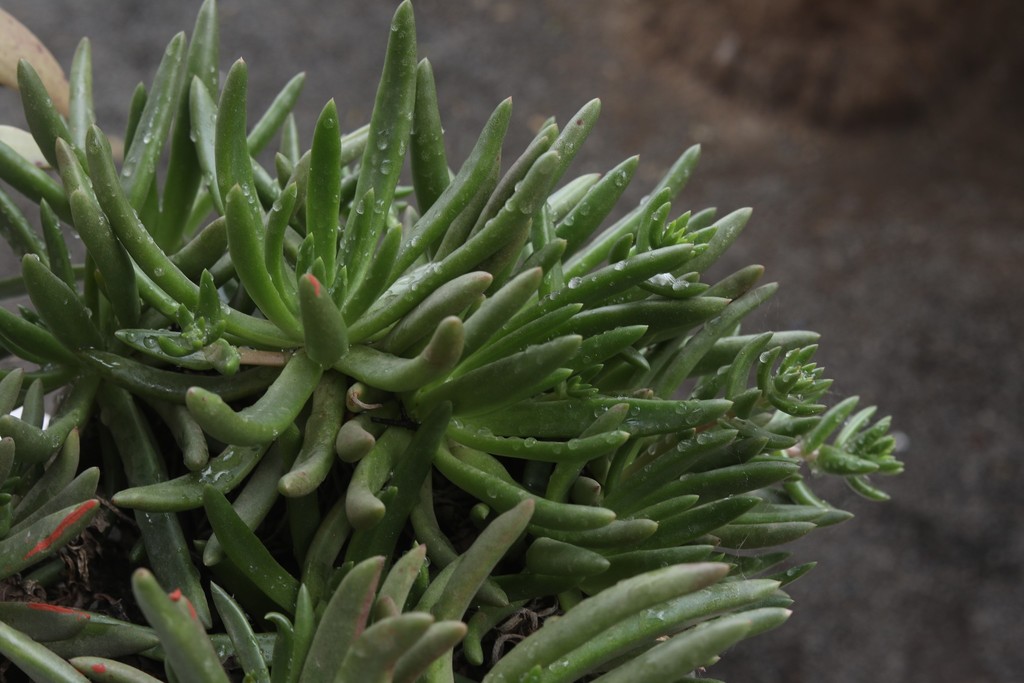
Todos Santos liveforever
Dudleya anomala
Dudleya anomala is a rare species of succulent plant in the family Crassulaceae commonly known as the Todos Santos liveforever. With a dense, cushion-forming habit, this leaf succulent is characterized by elongated stems, slightly sticky leaves, and bell-shaped flowers with white, spreading petals. This species is native to Baja California, Mexico, and is found primarily on islands and one coastal locality.
From the article Dudleya anomala on Wikipedia (CC BY-SA), quoted section by section
Description
Dudleya anomala is a rosette-forming leaf succulent that grows in a caespitose habit, with the stems branching to form dense cushions of rosettes 3–4 dm (12–16 in) in diameter. The stems are elongated and procumbent, and may reach up to 3 dm (12 in) long, and are usually 5–10 mm (0.20–0.39 in) thick. Topping the stems are the rosettes, which contain 20 to 30 close-set leaves, that may become somewhat separated when the stem is rapidly elongating. The leaves are shaped strap-oblanceolate to strap-shaped, with acute tips. The lower surface of the leaf is convex, while the upper surface is only slightly convex. The leaf margins are obtuse or rounded, but not toward the base. The leaves measure 2–5 cm (0.79–1.97 in) long by 4–6 mm (0.16–0.24 in) wide, with the leaf bases 4–7 mm (0.16–0.28 in) broad. The leaves are slightly viscid. The peduncle is 5–15 cm (2.0–5.9 in) by 1–3 mm (0.039–0.118 in) thick, and is covered in ascending bracts. The bracts are shaped narrowly deltoid-ovate to deltoid-lanceolate, with sharply acute tips. The lower bracts measure 1–2 cm (0.39–0.79 in) long by 3–5 mm (0.12–0.20 in) wide. The inflorescence is compact, with an overall rounded shape, and measures about 3–4 cm (1.2–1.6 in) in diameter. …
Wikipedia: “Morphology”
Range & habitat
Dudleya anomala is only found in the state of Baja California, Mexico and has an insular distribution on the Islas Coronados, Isla Todos Santos, and one location on the mainland, the extreme point of the Punta Banda. The range of D. anomala overlaps with those of Dudleya lanceolata, Dudleya candida, and Dudleya attenuata. Specimens of D. anomala observed by Reid Moran occurred on steep, north-facing cliffs on the Coronado Islands. On the Isla Todos Santos, the plant is found densely covering rocks and cliffs on northern and eastern exposures. On the Punta Banda, this species is found on steep, north-facing beach cliffs overlooking the Todos Santos Bay. Populations of Dudleya anomala are consistently associated with Niebla ceruchoides.
Wikipedia: “Distribution and habitat”
In human culture
Anstruther Davidson first described the species as Stylophyllum anomalum in 1928, based on a specimen collected by Robert Kessler from North Coronado Island and deposited in the herbarium of the Los Angeles County Museum by Davidson. Harald Fröderström described Stylophyllum insulare based on a specimen collected by Marcus E. Jones from the Coronado Islands in 1926. This name later became a homonym, so it was changed to Stylophyllum coronatum. Philip A. Munz also observed this species on the Coronado Islands, referring to it as Echeveria virens. Reid Moran wrote a more complete description of the species in 1943, and recognized it as a Dudleya, creating the current combination.
Wikipedia: “Taxonomic history”
Where it lives
Recorded sightings
—
geo-referenced records in GBIF, from museums, herbaria and field observers.
Drag the globe to turn it. Dots are where records exist, not a range map; darker means more records.
In the stacks
Searching the stacks…
Every page naming Dudleya anomala in the Biodiversity Heritage Library →
This page is assembled live from iNaturalist, GBIF, Wikipedia, the Source Library and the Internet Archive. It is not yet part of the hand-edited codex. iNaturalist taxon 282644.