- Plants
- ›Vascular Plants
- ›flowering plants
- ›Dicots
- ›pinks, cactuses, and allies
- ›cacti
- ›globular cacti, moonlight cacti, torch cacti, and allies
- ›Pachycereae
- ›Echinocereus
- ›Echinocereus
- ›Reichenbachia
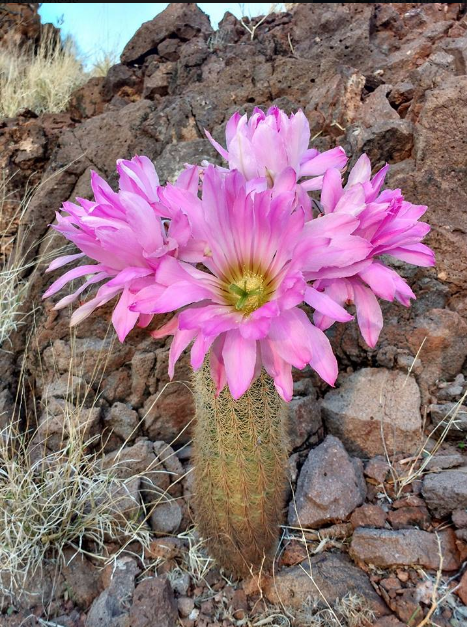
Echinocereus scopulorum
Echinocereus scopulorum is a species of cactus native to Mexico.
From the article Echinocereus scopulorum on Wikipedia (CC BY-SA), quoted section by section
Description
Echinocereus scopulorum grows as a solitary cactus with cylindrical shoots ranging from 10 to 40 cm (3.9 to 15.7 in) long and up to 10 cm (3.9 in) in diameter, concealed by spines. It has 13 to 15 ribs, with three to ten central spines shorter than the approximately 20 peripheral spines, which are whitish with darker tips and 0.4 to 1.4 cm (0.16 to 0.55 in) long. The fragrant, funnel-shaped flowers are light pink to magenta with a white throat, appearing near the tips of the shoots. They are 7 to 8.5 cm (2.8 to 3.3 in) centimeters long and up to 10 cm (3.9 in) in diameter. The spherical to egg-shaped fruits are dark green with white pulp, dry when ripe, but do not crack open.
Range & habitat
Echinocereus scopulorum is found along the coastal xeric scrublands of the Mexican state of Sonora, on Isla Tiburón, and in the states of Sinaloa and Nayarit. It lives in the Sonoran desert, on rocky soils at elevations of 5 to 800 m (16 to 2,625 ft).
Wikipedia: “Distribution”
Where it lives
Recorded sightings
—
geo-referenced records in GBIF, from museums, herbaria and field observers.
Drag the globe to turn it. Dots are where records exist, not a range map; darker means more records.
In the stacks
Searching the stacks…
Every page naming Echinocereus scopulorum in the Biodiversity Heritage Library →
This page is assembled live from iNaturalist, GBIF, Wikipedia, the Source Library and the Internet Archive. It is not yet part of the hand-edited codex. iNaturalist taxon 281845.