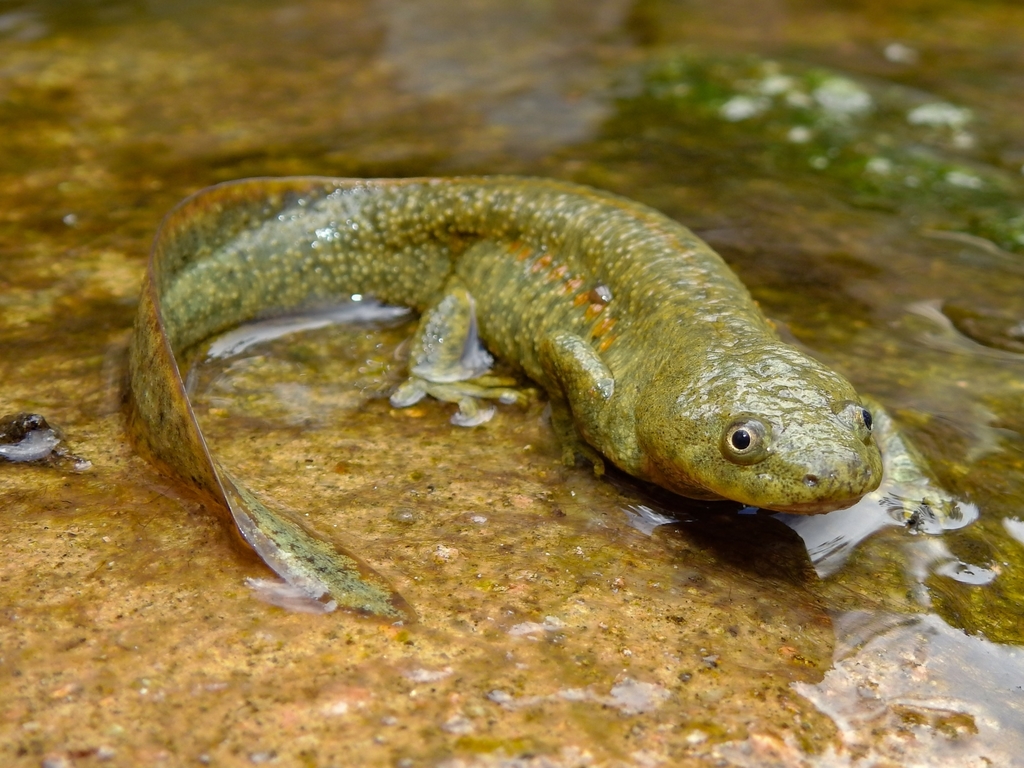
Iberian Ribbed Newt
Pleurodeles waltl
The Iberian ribbed newt (Pleurodeles waltl), also known commonly as the Spanish ribbed newt and gallipato in Spanish, is a species of salamander in the subfamily Pleurodelinae of the family Salamandridae. The species is native to the central and southern Iberian Peninsula and northern Morocco. It is the largest European newt species. It is known for its defense mechanisms where their sharp ribs puncture through its sides when in a defensive state, and as such is also called the sharp-ribbed newt and the sharp-ribbed salamander.
This species should not be confused with a different species with a similar common name, the Iberian newt (Lissotriton boscai).
From the article Iberian ribbed newt on Wikipedia (CC BY-SA), quoted section by section
Description
The Iberian ribbed newt typically have 8 to 10 tubercles that look like orange warts running down each side. Through these, its sharp ribs can puncture through the stretched skin. The size of their ribs are larger than most other salamanders. The ribs act as a defense mechanism, causing little harm to the newt. Iberian ribbed newts generally try to run away from predators, but if they cannot escape they resort to this mechanism. It could be considered as a primitive and rudimentary system of envenomation, but is completely harmless to humans. At the same time as pushing its ribs out the newt begins to secrete a milky and viscous poison from special glands on its body. The poison primarily appears on the neck, the dorsal and lateral trunk, and on the tail. The poison coated ribs create a highly effective stinging mechanism, injecting toxins through the thin skin in predator's mouths. The newt's immune system, collagen coated ribs, and secretion of antimicrobial peptides released from specialized cutaneous glands mean the pierced skin quickly regrows without infection. Similar to most amphibians, Iberian ribbed newts are born in the water and breathe through their gills during the larvae phase. Once they start to grow limbs, they lose their gills and gain the ability to survive on land as well as in water. P. …
Listen
Looking for field recordings…
Where it lives
Recorded sightings
—
geo-referenced records in GBIF, from museums, herbaria and field observers.
Drag the globe to turn it. Dots are where records exist, not a range map; darker means more records.
In the stacks
Searching the stacks…
Every page naming Pleurodeles waltl in the Biodiversity Heritage Library →
This page is assembled live from iNaturalist, GBIF, Wikipedia, the Source Library and the Internet Archive. It is not yet part of the hand-edited codex. iNaturalist taxon 27832.