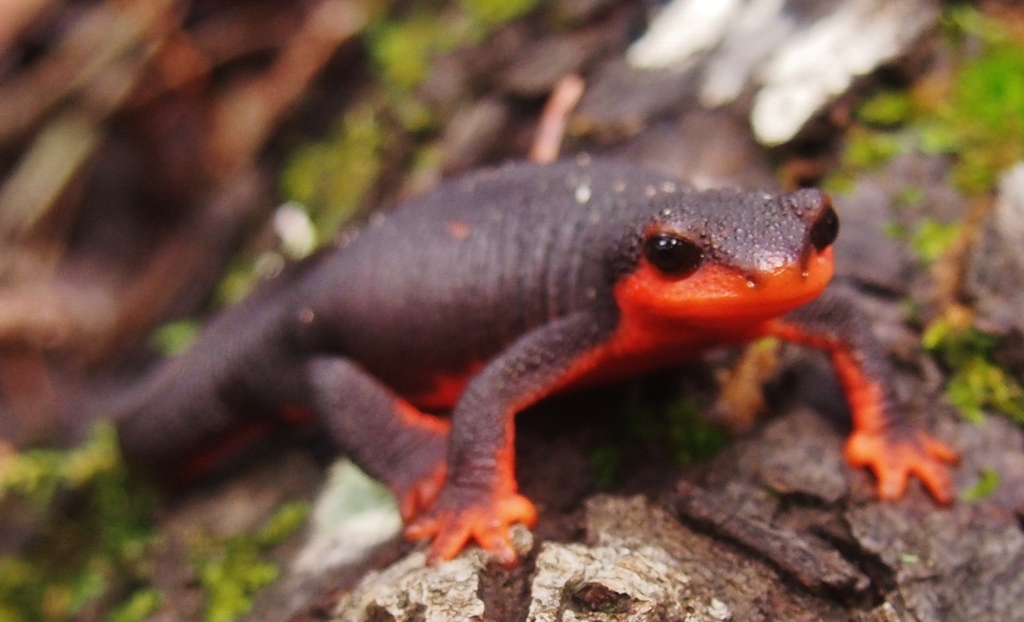
Red-bellied Newt
Taricha rivularis
The red-bellied newt (Taricha rivularis) is a newt that is native to coastal woodlands in northern California and is terrestrial for most of its life.
From the article Red-bellied newt on Wikipedia (CC BY-SA), quoted section by section
Description
When full grown, the red-bellied newt measures between 2.75 to 3.5 in (70 to 89 mm) from its nose to its vent, and between 5.5 and 7.5 in (140 and 190 mm) from its nose to its tail. It has grainy skin, and is brownish-black on top with a tomato-red underbelly. The male red-bellied newt often has a dark, broad coloring across the vent, while females do not. Breeding males develop smooth skin and a flattened tail. The red-bellied newt can be distinguished from other coastal newts by its red belly and a lack of yellow in its eyes.
Range & habitat
The red-bellied newt is found in California along the coast from Bodega in Sonoma County, inland to Lower Lake, and north to Honeydew, Humboldt County. It lives in coastal woodlands, especially in redwood forests. There is a disjunct population 130 kilometres (81 mi) south of Sonoma County in the upper watershed of Stevens Creek in the Santa Cruz Mountains that is genetically identical to the Sonoma County population.
Wikipedia: “Distribution and habitat”
What it does
Newts begin their lives as aquatic larvae similar to tadpoles, though elongated and with external gills. Once newt larvae mature into their adult form, which takes about four to six months, they will leave the water and live underground until they are ready to breed, which is typically in four to six years. Red-bellied newts can live for 20-30 years. After reaching reproductive maturity, male red-bellied newts start congregating at stream banks as early as January or February. One to three weeks later, the females join them and the newts mate. Red-bellied newts lay their eggs in fast-flowing streams or rocky rivers. The females lay their eggs in about 12 streamlined clusters with six to 16 eggs each, and the eggs are typically attached to the bottoms of rocks, or on branches and roots leaning into the stream. When the adults leave the stream, instead of moving directly uphill, they move at an angle that leads them somewhat upstream. The females, unlike the males, do not breed every year.
Wikipedia: “Reproduction and ecology”
Listen
Looking for field recordings…
Where it lives
Recorded sightings
—
geo-referenced records in GBIF, from museums, herbaria and field observers.
Drag the globe to turn it. Dots are where records exist, not a range map; darker means more records.
In the stacks
Searching the stacks…
Every page naming Taricha rivularis in the Biodiversity Heritage Library →
This page is assembled live from iNaturalist, GBIF, Wikipedia, the Source Library and the Internet Archive. It is not yet part of the hand-edited codex. iNaturalist taxon 27824.