Striped Newt
Notophthalmus perstriatus
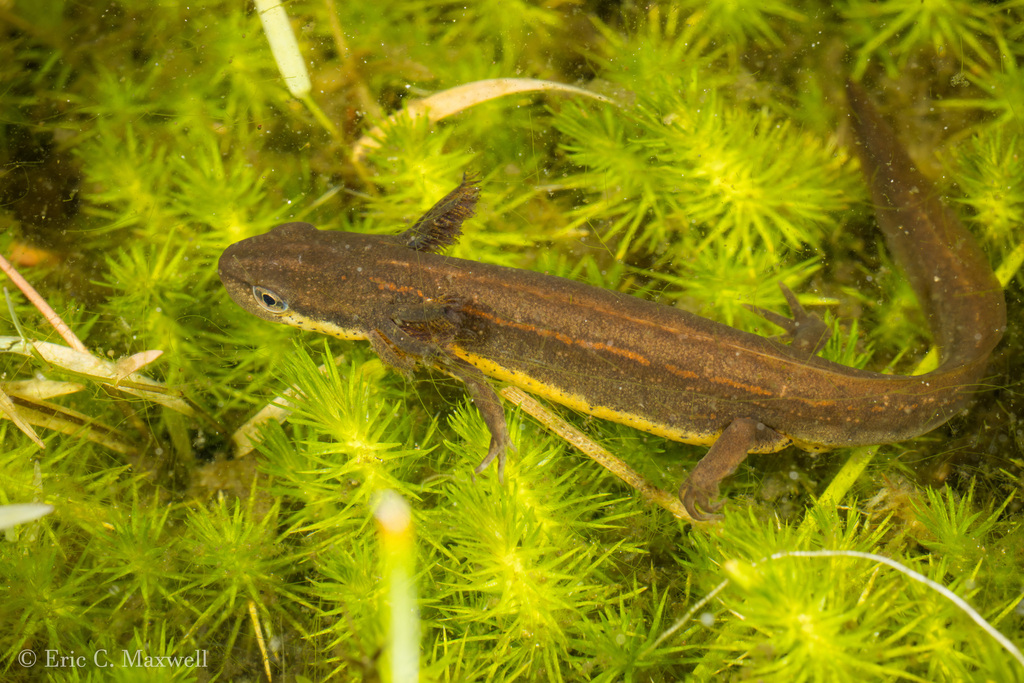
The striped newt, Notophthalmus perstriatus, is a species of aquatic salamander native to the southeastern United States. It is a close relative of the eastern newt, with which it shares territory, and can be distinguished from the latter by the presence of red stripes running down the sides of its back and red spots on its back that lack a black outline.
From the article Striped newt on Wikipedia (CC BY-SA), quoted section by section
Description
Growing from 2.12–4.12 in (5.4–10.5 cm) in length, a fully mature striped newt is yellow-green to olive green to black-brown in color with bright red or orange parallel dorsal stripes. The underside is yellow with black spots. The aquatic larvae are tan, greenish, or brown with bushy external gills and have a distinct light lateral line and dark mottling on the large tail fin. The striped newt can also occur as an eft, which is a terrestrial juvenile stage that spends several years completely on land. Efts can be identified by their light brown or orange coloration and namesake red striping. Neoteny, or paedomorphosis, can be common in populations that live in permanent or semi-permanent fishless ponds. Neotenic adults are yellow-green to brown and often lack the red stripes seen in terrestrial forms.
Range & habitat
This newt is found from southern Georgia southward into central Florida. It typically inhabits fire-maintained habitats with sandy soils such as longleaf pine sandhills, scrub, scrubby flatwoods, and occasionally hammock ponds, where it breeds from late winter through spring.
Wikipedia: “Habitat”
Listen
Looking for field recordings…
Where it lives
Recorded sightings
—
geo-referenced records in GBIF, from museums, herbaria and field observers.
Drag the globe to turn it. Dots are where records exist, not a range map; darker means more records.
In the stacks
Searching the stacks…
Every page naming Notophthalmus perstriatus in the Biodiversity Heritage Library →
This page is assembled live from iNaturalist, GBIF, Wikipedia, the Source Library and the Internet Archive. It is not yet part of the hand-edited codex. iNaturalist taxon 27814.