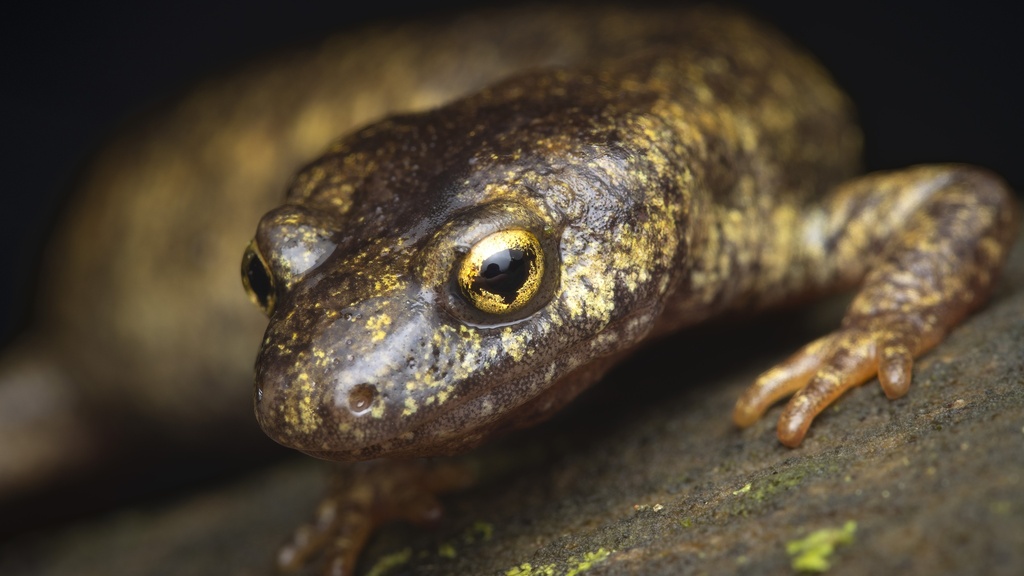
Corsican brook salamander
Euproctus montanus
The Corsican brook salamander or Corsican mountain newt (Euproctus montanus) is a species of salamander in the family Salamandridae. It is endemic to Corsica, an island in the Mediterranean Sea.
The Corsican brook salamander is found primarily in rocky streams, springs, and rivers in forest and maquis at altitudes of over 600 m.
From the article Corsican brook salamander on Wikipedia (CC BY-SA), quoted section by section
Description
The Corsican brook salamander is smaller than other closely related species, such as the Sardinian brook salamander (Euproctus platycephalus) and can grow to around 13 cm (5 in) in length, though a more typical size is 10 cm (4 in). The head is long with a rounded snout, and the tail is oval in cross section and as long as the rest of the animal. The parotoid glands on the side of the neck are distinct. The males have spurs on the hind legs and a backwards-pointing conical cloaca, whereas the females have a cloaca with a ventral opening. The skin is smooth when it is living in the water, but becomes more granular when living on land. The colour is brown or olive, sometimes with mottling of orange, red, or brown, particularly near the spine. It has a paler, fairly uniformly coloured underside, sometimes with white flecks, but is not spotted on the throat. The only other salamander on the island is the Corsican fire salamander (Salamandra corsica) which has distinctive black and yellow colouring.
Range & habitat
The Corsican brook salamander is endemic to the island of Corsica. It is not present in the eastern lowland areas or near much of the coast, but can be found at altitudes up to 2,250 metres (7,382 ft) and is most common in the range 600 to 1,500 m (2,000 to 4,900 ft). It is mainly aquatic, living in lakes, ponds, and the slower-moving parts of streams, often hiding under stones. When on land, it does not stray far from water and inhabits maquis and woods, where it can be found in the undergrowth or under fallen logs and rocks.
Wikipedia: “Distribution and habitat”
Listen
Looking for field recordings…
Where it lives
Recorded sightings
—
geo-referenced records in GBIF, from museums, herbaria and field observers.
Drag the globe to turn it. Dots are where records exist, not a range map; darker means more records.
In the stacks
Searching the stacks…
Every page naming Euproctus montanus in the Biodiversity Heritage Library →
This page is assembled live from iNaturalist, GBIF, Wikipedia, the Source Library and the Internet Archive. It is not yet part of the hand-edited codex. iNaturalist taxon 27798.