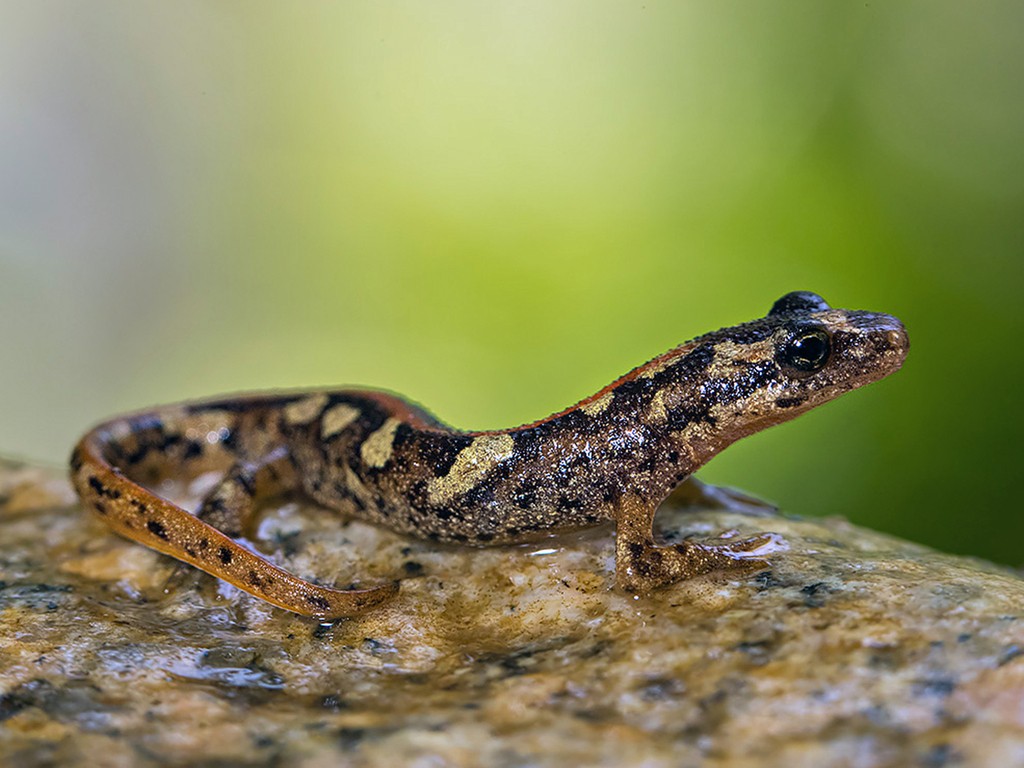
Sardinian brook salamander
Euproctus platycephalus
The Sardinian brook salamander or Sardinian mountain newt (Euproctus platycephalus) is a species of salamander in the Salamandridae family found only in Sardinia, Italy.
From the article Sardinian brook salamander on Wikipedia (CC BY-SA), quoted section by section
Description
The Sardinian brook salamander can grow to about 15 cm (6 in) in length, but adults are usually rather smaller than this, with females being a bit larger than males. It is very similar to the Corsican brook salamander, but the head is flatter, the throat is more spotted, and the paratoid glands are smaller. The lower jaw is shorter than the upper jaw. The skin is smooth apart from a few irregularly placed tubercles. The colour is olive, grey, or reddish-brown, often with red, brown, or black spots and longitudinal streaks, and often a thin yellow or brown stripe occurs along the spine. The underside is paler, often having a red or yellow central region and black spots. The male has a spur on each hind limb. The only species with which it is likely to be confused are cave salamanders in the family Plethodontidae.
Range & habitat
The Sardinian brook salamander is endemic to the mountainous areas on the east side of the island of Sardinia in the Mediterranean Sea. It is found at altitudes between 50 and 1,800 metres (160 and 5,910 ft), with most sightings being in the middle of this range. It is found in slow-moving streams and rivers, small lakes, and ponds, where it hides under stones. When on land, it is usually found in undergrowth or under stones, and usually stays close to water.
Wikipedia: “Distribution and habitat”
Listen
Looking for field recordings…
Where it lives
Recorded sightings
—
geo-referenced records in GBIF, from museums, herbaria and field observers.
Drag the globe to turn it. Dots are where records exist, not a range map; darker means more records.
In the stacks
Searching the stacks…
Every page naming Euproctus platycephalus in the Biodiversity Heritage Library →
This page is assembled live from iNaturalist, GBIF, Wikipedia, the Source Library and the Internet Archive. It is not yet part of the hand-edited codex. iNaturalist taxon 27797.