- Animals
- ›Chordates
- ›Vertebrates
- ›Amphibians
- ›Salamanders
- ›True Salamanders and Newts
- ›Newts
- ›Triturus
- ›Triturus cristatus
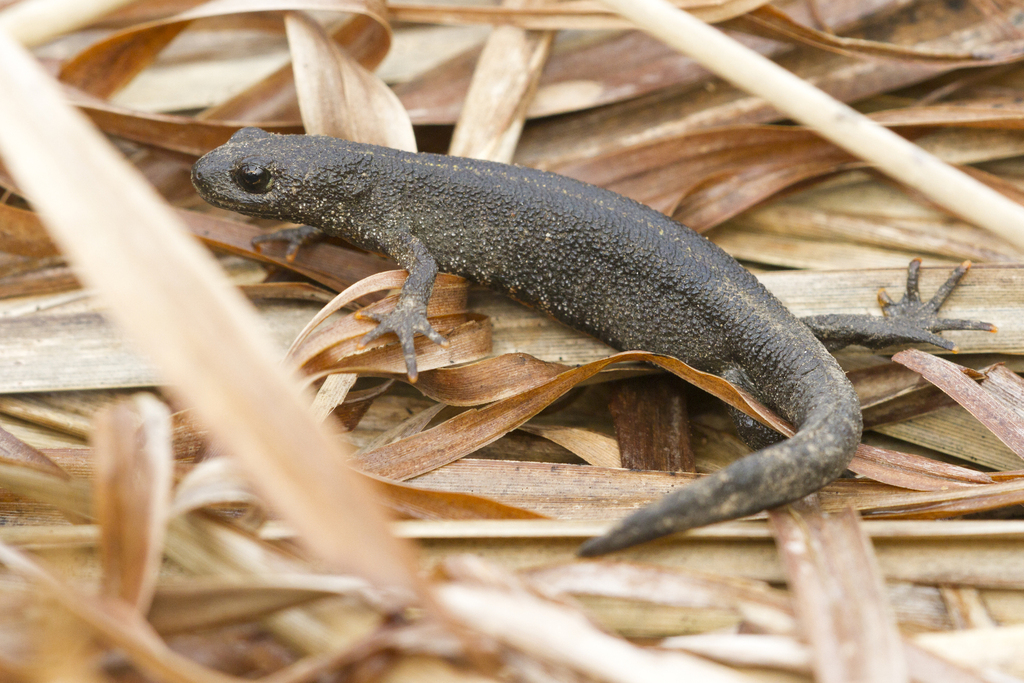
Italian Crested Newt
Triturus carnifex
The Italian crested newt (Triturus carnifex) is a species of newt in the family Salamandridae.
From the article Italian crested newt on Wikipedia (CC BY-SA), quoted section by section
Range & habitat
Triturus carnifex is found in parts of the Balkans and Italy. It is an aquatic breeder that can spend up to four months in the water. The location of the ponds where they breed affects the time when T. carnifex enters the water. T. carnifex prefers living in deep water since it is a nektonic species: it swims freely and is independent of currents. The absence of predatory fish may also explain why T. carnifex is inclined to ponds, rather than other larger bodies of water. They typically prefer ponds in northern Europe, where temperatures are colder . Adult T. carnifex start to arrive between February and May, and leave between July and October. In warmer ponds, adult newts arrive within a month and leave during a two-week period in July. Andreone and Giacoma (1989) speculated that newt migration into the ponds increases after rainy days, since after rainfall, newt activity is not limited by humidity. Higher altitudes, where temperatures begin to decrease, have a direct effect on the size of T. carnifex. Ficetola et al. (2010) discovered that living in colder temperatures resulted a body size increase in both male and female. Females in higher altitudes were found to be larger because they were carrying more oocytes and larger ovaries, which gave them a reproductive advantage over the smaller females. T. …
Wikipedia: “Habitat”
What it does
To avoid competition with other co-occurring newts, T. carnifex tends to reproduce in the deeper parts of a pond and is more nocturnal. Due to their larger size, they can prey on smaller species such as the palmate newt. Reproductive females of T. carnifex were shown to regulate their body temperature more precisely and prefer higher temperatures than non-reproductive females and males.
Wikipedia: “Behaviour and ecology”
Listen
Looking for field recordings…
Where it lives
Recorded sightings
—
geo-referenced records in GBIF, from museums, herbaria and field observers.
Drag the globe to turn it. Dots are where records exist, not a range map; darker means more records.
In the stacks
Searching the stacks…
Every page naming Triturus carnifex in the Biodiversity Heritage Library →
This page is assembled live from iNaturalist, GBIF, Wikipedia, the Source Library and the Internet Archive. It is not yet part of the hand-edited codex. iNaturalist taxon 27717.