- Plants
- ›Vascular Plants
- ›flowering plants
- ›Dicots
- ›saxifrages, stonecrops, and allies
- ›stonecrop family
- ›Sempervivoideae
- ›Sedeae
- ›Dudleya
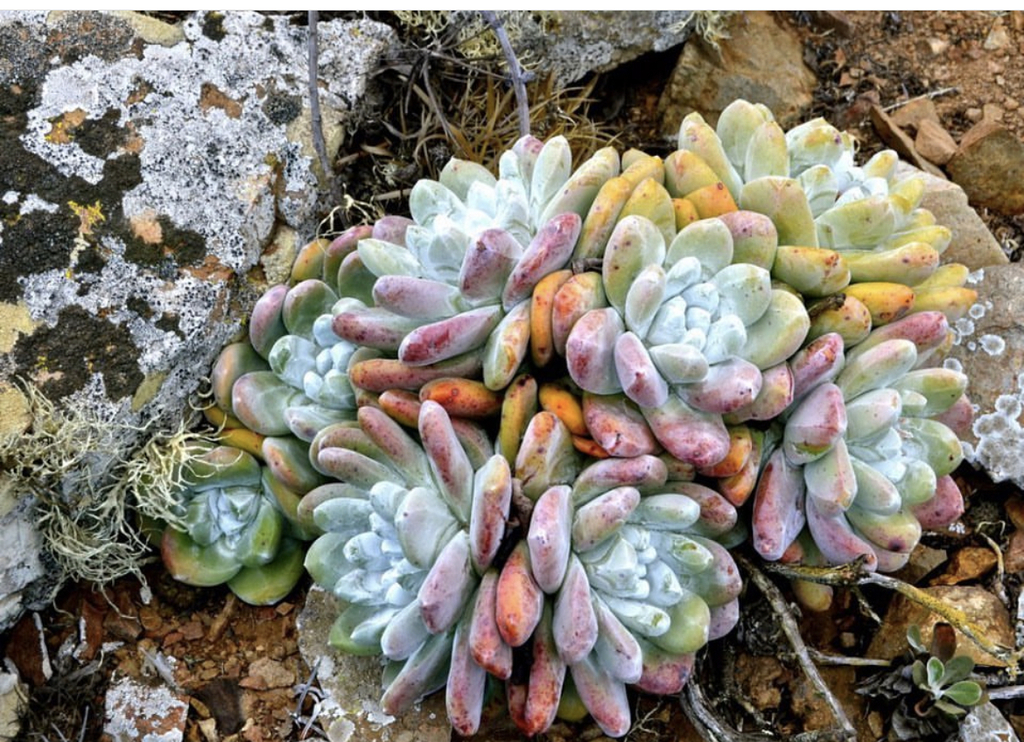
Cedros Liveforever
Dudleya pachyphytum
Dudleya pachyphytum is an insular succulent plant known by the common name Cedros Island liveforever. It is a member of the genus Dudleya, in the family Crassulaceae. Characterized by thick, blunt leaves covered in a white, powdery wax and adorned by white flowers in bloom, it is regarded as one of the most attractive and charismatic members of its genus. It is endemic to the foggy northern end of Mexico's Cedros Island, occupying an ecological niche shared with the Cedros Island Pine.
The plant is endangered due to poaching from organized criminals supplying succulent collectors, many of whom are located in Asia. The poachers include South Korean nationals and criminal gangs operating under the Mexican cartels. The demand from succulent collectors has led to overexploitation of the plant in the wild, and armed confrontations between competing poachers has contributed to several killings.
From the article Dudleya pachyphytum on Wikipedia (CC BY-SA), quoted section by section
Description
This plant is characterized by its distinctive appearance that stands in stark contrast to other Dudleya, as it has extremely thick, blunt, turgid leaves and a pale, desaturated inflorescence. The leaves of this species are the thickest in the genus, making it easily recognizable among the other members. It bears resemblance in the rosette, epicuticular wax and thick leaves to other maritime Dudleya, like D. caespitosa of the central Californian coast, D. candida of the Coronado Islands, and D. farinosa of the northern coast of California, and D. greenei of the Channel Islands.
Vegetative morphology. Dudleya pachyphytum plants can be up to 7 decimeters (dm) wide, with 10 to 50 clusters of rosettes. Caudices are 4 dm or more long, decumbent in age, and 2 to 5 centimeters thick. Dead and dry leaves around 10 cm thick clothe the caudex. Rosettes are compact, 12 to 22 cm wide, with 12 to 25 leaves but up to 55 in cultivated specimens. Leaves are farinose, thick and turgid, ovate to oblong and broadest near the base, rounded to broadly obtuse, and apiculate. The dimensions of the leaf are 5 to 10 cm long, 3 to 5 cm wide, and 1.5 to 2.5 cm thick. Ventrally, the leaves are flattish, with prominent low ridges corresponding to the edges of adjacent leaves in bud. …
Range & habitat
Dudleya pachyphytum exists on the northern end of Cedros Island, the largest of the Baja California's islands on the Pacific coast. In the fog zone, near groves of Pinus radiata, it occurs at an elevation about 100 to 500 m (328 to 984 ft), often with north to northwest-facing exposure. From the Punta Norte, its distribution continues at least 3 km south on the western flank of the island, down to 100 m (328 ft). The southern limit on the species is near the ridges of Cañada de la Mina, and explorations by botanists indicate that the species is probably expanding southwards. It coexists on the island with other species of Dudleya, including D. acuminata, D. albiflora, and D. cochimiana.
Wikipedia: “Distribution”
In human culture
Dudleya pachyphytum was discovered by Michael Benedict, a research associate at the Santa Barbara Botanic Garden, during a trip to Cedros Island in 1971. Benedict found an uprooted rosette in a ravine known as Cañada de la Mina, near the Punta Norte lighthouse on the northern end of the island. Presumably, the rosette had tumbled down the cliffs and into the ravine, where Benedict found it. Excited about his new discovery, Benedict hiked about attempting to find another plant, but his efforts were fruitless. Benedict returned in 1977, bringing some back to flower in Santa Barbara. Towards the end of the decade, natural history tours of Cedros Island, particularly in the northern half, brought more attention to this then undescribed species. The unknown species was further propelled into the limelight after Alfred B. Lau of the Cactus and Succulent Society of America returned with colored pictures and analysis of the species. Finally, after the suggestion of Lau, Benedict, Reid Moran, and their colleagues returned to Cedros Island in 1980, describing and publishing the species Dudleya pachyphytum in Phytologia. This plant was named pachyphytum owing to the resemblance of its thick leaves to another genus in the stonecrop family, Pachyphytum, also native to Mexico.
Wikipedia: “Taxonomic history”
Where it lives
Recorded sightings
—
geo-referenced records in GBIF, from museums, herbaria and field observers.
Drag the globe to turn it. Dots are where records exist, not a range map; darker means more records.
In the stacks
Searching the stacks…
Every page naming Dudleya pachyphytum in the Biodiversity Heritage Library →
This page is assembled live from iNaturalist, GBIF, Wikipedia, the Source Library and the Internet Archive. It is not yet part of the hand-edited codex. iNaturalist taxon 275964.