- Animals
- ›Chordates
- ›Vertebrates
- ›Amphibians
- ›Salamanders
- ›Lungless Salamanders
- ›Plethodontine Salamanders
- ›Speleomantes
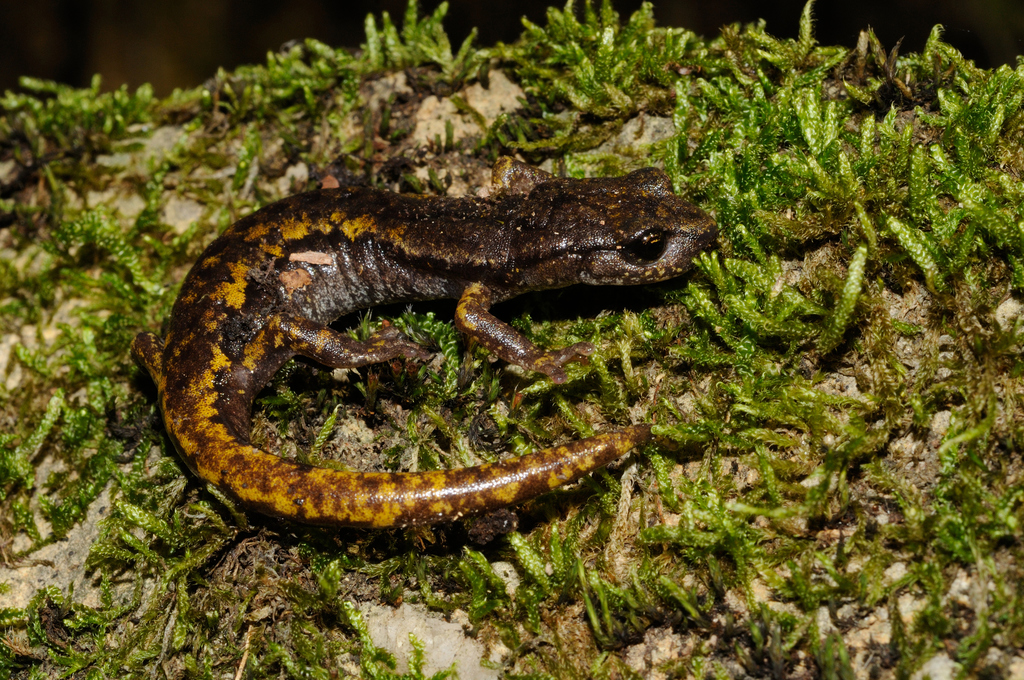
Strinati's Cave Salamander
Speleomantes strinatii
Speleomantes strinatii, the French cave salamander, North-west Italian cave salamander, or Strinati's cave salamander is a small (10–12.5 cm (3.9–4.9 in) long) species of salamander found in northwest Italy and southeast France. It is very similar in appearance to the Italian cave salamander (Speleomantes italicus), but has a paler belly.
From the article Speleomantes strinatii on Wikipedia (CC BY-SA), quoted section by section
Description
S. strinatii is a completely terrestrial plethodontid, meaning that they are a fully land-based species. S. strinatii is one of seven species of plethodontid salamanders found in southern Europe. S. strinatii can vary widely in size. S. strinatii is highly sexually dimorphic. Male S. strinatii average about 96 millimetres (3.8 in) in length, and can grow to up to 116 mm (4.6 in) long. Females average about 100 millimetres (3.9 in) and have been observed at a maximum length of 123 mm (4.8 in). S. strinatii have an oval-shaped head, a rounded snout, and a slight overbite that is more pronounced in males. S. strinatii's hind limbs are slightly longer than their front limbs. The salamanders' hind feet have five digits each, and their front feet only have four digits. The S. strinatii also have highly variable coloration and patterns. S. strinatii are commonly brown and black in color. However, some of these salamanders have different patterns on their skin, such as spots, blotches, or striped reticular patterns in red, yellow, gray, green, or metallic sheen.
Range & habitat
S. strinatii are found in the Southeast region of France as well as in Northwest Italy. This species ranges from Alpes de Haute Provence to Northwest Tuscany, through the Maritime Alps, Ligurian Alps, and Ligurian Apennines. S. strinatii are commonly found at 0 to 2,290 metres (0 to 7,510 ft) above sea level. However, in the Maritime Alps, S. strinatii have been observed at a higher elevation of 2,432 metres (7,980 ft). S. strinatii are not obligate cave dwellers. For example, during times of extreme heat, S. strinatii retreat to underground environments that are cooler and more comfortable. S. strinatii can be active throughout the year. They prefer humid environments, such as the caves for which they are named. The salamander is found in caves, crevices, and other cavities from late spring to summer.
Wikipedia: “Habitat and distribution”
What it does
S. strinatii appear to be opportunistic hunters with a wide range of invertebrate prey. These salamanders tend to eat more in autumn.
Wikipedia: “Diet”
Listen
Looking for field recordings…
Where it lives
Recorded sightings
—
geo-referenced records in GBIF, from museums, herbaria and field observers.
Drag the globe to turn it. Dots are where records exist, not a range map; darker means more records.
In the stacks
Searching the stacks…
Every page naming Speleomantes strinatii in the Biodiversity Heritage Library →
This page is assembled live from iNaturalist, GBIF, Wikipedia, the Source Library and the Internet Archive. It is not yet part of the hand-edited codex. iNaturalist taxon 27519.