- Animals
- ›Chordates
- ›Vertebrates
- ›Amphibians
- ›Salamanders
- ›Lungless Salamanders
- ›Hemidactyliine Salamanders
- ›Gyrinophilus
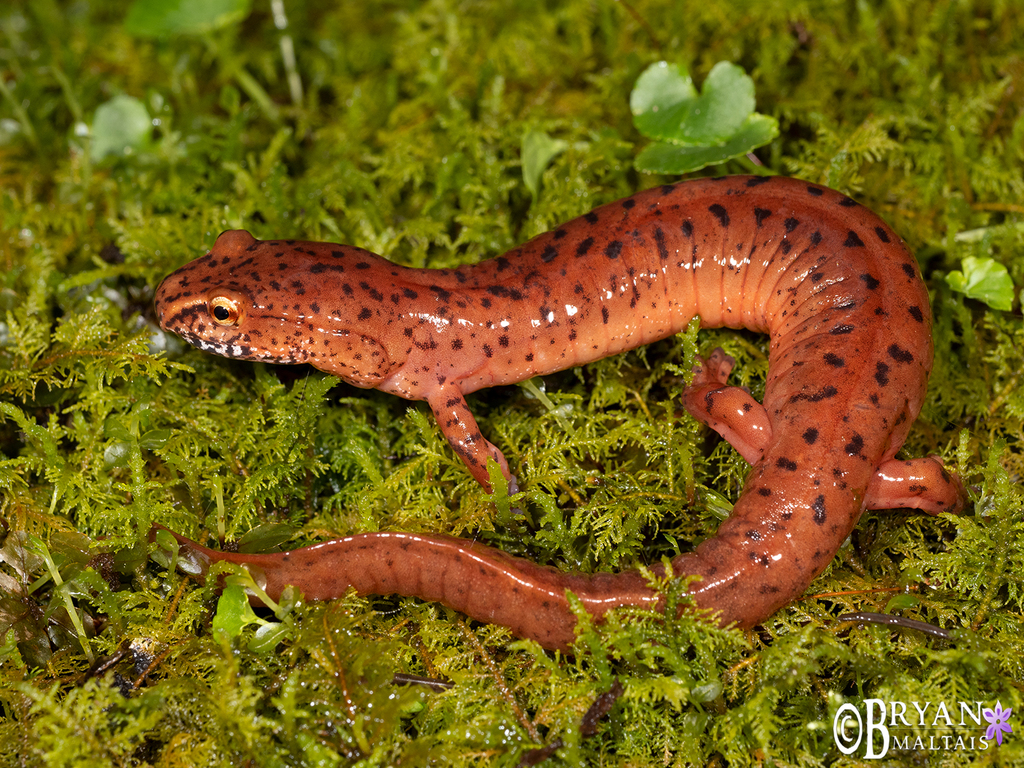
Spring Salamander
Gyrinophilus porphyriticus
The spring salamander (Gyrinophilus porphyriticus) is a species of salamander in the family Plethodontidae (lungless salamanders). It is found in Canada and the United States. The genus, Gyrinophilus, means "tadpole lover" and refers to the long period of time it spends as a gilled larva before maturing. The specific epithet, porphyriticus, is Latin from Greek, meaning the color of porphyry, a purple stone, and this salamander has also been called the purple salamander.
Its natural habitats are temperate forests, rivers, swamps, freshwater marshes, freshwater springs, inland karsts, and caves. In addition to insects, spiders, mites, millipedes, centipedes, slugs, snails, annelid worms, and other small invertebrates, the fairly large spring salamander may also consume smaller stream dwelling salamanders and their eggs, such as two-lined and dusky salamanders, as well as pygmy, ocoee, Jordan's, southern red-backed, southern Appalachian, and red salamanders. They are also known to be cannibalistic.
From the article Spring salamander on Wikipedia (CC BY-SA), quoted section by section
Description
Like all members of the family Plethodontidae these salamanders have a nasolabial groove. The subspecies G. p. porphyriticus and G. p. duryi can be 4.75–7.5 in (12.1–19.1 cm) long. The record length is 9.125 in (23.18 cm). The light line from eye to nostril is bordered below by gray pigment, but the markings are not always conspicuous. The dorsal coloration varies from salmon or light brownish to pink or reddish. The ground color has a cloudy appearance, and the darker markings are vague. The subspecies G. p. danielsi and G. p. dunni can be 5–7.5 in (13–19 cm). The record length is 8.06 in (20.5 cm). Adults reach larger sizes at higher elevations as a consequence of delay in development to maturity after metamorphosis in high-level populations. The white line from eye to nostril, bordered below by a conspicuous black or dark brown line, is distinctive. There also may be a dark line above the white line, often conspicuous. The dorsal coloration can be clear reddish, salmon, or orange-yellow marked with black or brown spots or flecks. 17 to 19 costal grooves. Larvae are aquatic and have stream-type morphology. Juveniles are typically more brightly colored than adults.
Range & habitat
This species is found in cool springs and mountain springs, but is also likely to be found in any wet depression beneath logs, stones, or leaves in the surrounding forest. They require being in areas that provide them with adequate oxygen and moisture because they conduct cutaneous respiration. During the colder months of the year, the salamanders will spend their time in wet soil close to a source of water where they remain somewhat active in burrows, or in the leaf litter near a stream or other body of water.
Wikipedia: “Habitat”
What it does
Spring Salamanders commonly breed in late summer into fall. The courtship begins with the male sliding his head over the female's body. From there, a tail-straddle walk begins. This walk entails the female straddling the male's tail while both walk forward. From there, the male deposits the spermatophore on the substrate. The female then picks it up and will store it until ready to fertilize eggs. Once the spermatophore is deposited, the male walks forward with his tail standing straight up. He then proceeds to undulate his tail while the base of the tail touches the chin of the female. This causes the tail's base to rub over most of the female's chin. The females will lay eggs in the summer following their mating. The eggs are sticky when laid and will allow the egg mass to adhere wherever applied. The egg mass can contain between 16-160 eggs. The females will protect this egg mass until they hatch, usually in late summer or early fall. The larvae may stay around the mother after hatching but do not directly depend on her. Larvae for this species remain in this larval stage for multiple years, some up to four years. It takes the post-metamorphosis individual another four years before reaching sexual maturity.
Wikipedia: “Reproduction”
Listen
Looking for field recordings…
Where it lives
Recorded sightings
—
geo-referenced records in GBIF, from museums, herbaria and field observers.
Drag the globe to turn it. Dots are where records exist, not a range map; darker means more records.
In the stacks
Searching the stacks…
Every page naming Gyrinophilus porphyriticus in the Biodiversity Heritage Library →
This page is assembled live from iNaturalist, GBIF, Wikipedia, the Source Library and the Internet Archive. It is not yet part of the hand-edited codex. iNaturalist taxon 27500.