- Plants
- ›Vascular Plants
- ›flowering plants
- ›Dicots
- ›pinks, cactuses, and allies
- ›cacti
- ›globular cacti, moonlight cacti, torch cacti, and allies
- ›Globular Cactuses
- ›Ferocactus
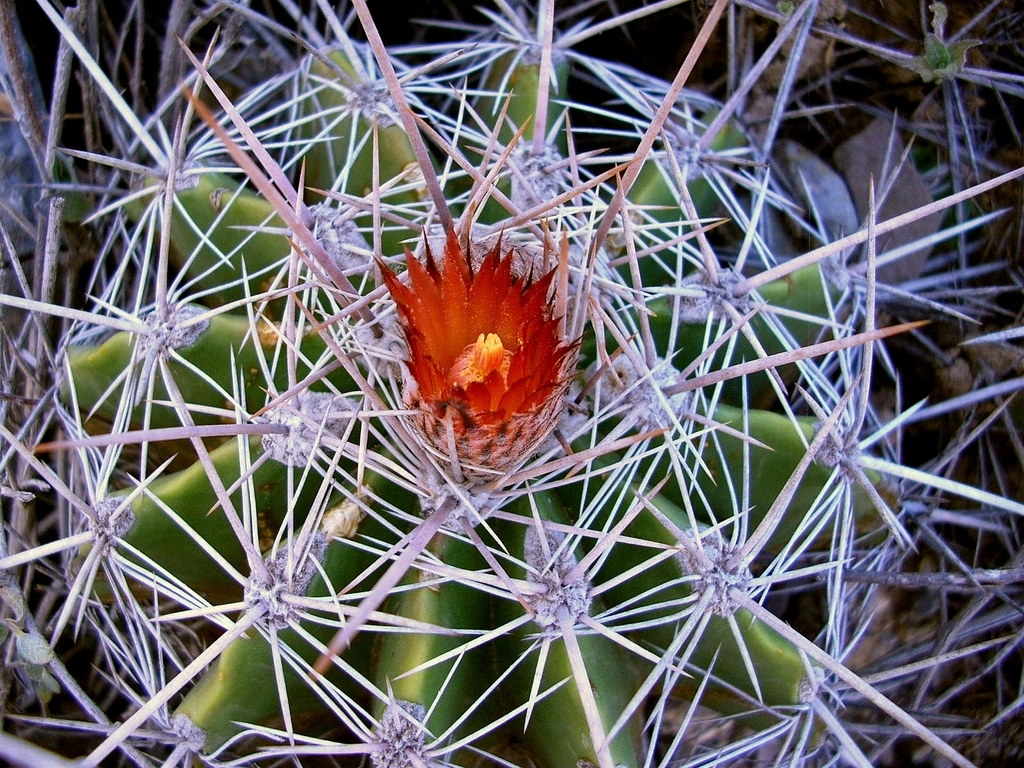
Ferocactus flavovirens
Ferocactus flavovirens is a species of Ferocactus from Mexico.
From the article Ferocactus flavovirens on Wikipedia (CC BY-SA), quoted section by section
Description
Ferocactus flavovirens forms clusters with plants growing up to 1 meter tall and more than 2 meters wide, with numerous spherical to cylindrical shoots. These shoots are light or gray-green, reaching heights of 30 to 40 cm (12 to 16 in) and diameters of up to 40 cm (16 in), with 13 sharp ribs and widely spaced areoles. The needle-like spines are light brown to gray, with the higher spines occasionally lighter and bristle-like. It has four to six central spines up to 8 cm (3.1 in) long, with the lowest directed downwards, and 12 to 20 radial spines. The funnel-shaped, yellow to yellowish-red flowers emerge from younger areoles at the shoot tip, reaching lengths of up to 3 cm (1.2 in) and diameters of 2.5 cm (0.98 in). Its ellipsoid fruits are up to 2.8 cm (1.1 in) long, red, and covered in long, brown, bristly-tipped scales.
Range & habitat
Ferocactus flavovirens is a clustering cactus that grows in Mexico's Puebla and Oaxaca states on dry limestone hillsides.
Wikipedia: “Distribution”
Where it lives
Recorded sightings
—
geo-referenced records in GBIF, from museums, herbaria and field observers.
Drag the globe to turn it. Dots are where records exist, not a range map; darker means more records.
In the stacks
Searching the stacks…
Every page naming Ferocactus flavovirens in the Biodiversity Heritage Library →
This page is assembled live from iNaturalist, GBIF, Wikipedia, the Source Library and the Internet Archive. It is not yet part of the hand-edited codex. iNaturalist taxon 274272.