- Animals
- ›Chordates
- ›Vertebrates
- ›Amphibians
- ›Salamanders
- ›Lungless Salamanders
- ›Plethodontine Salamanders
- ›Aneides
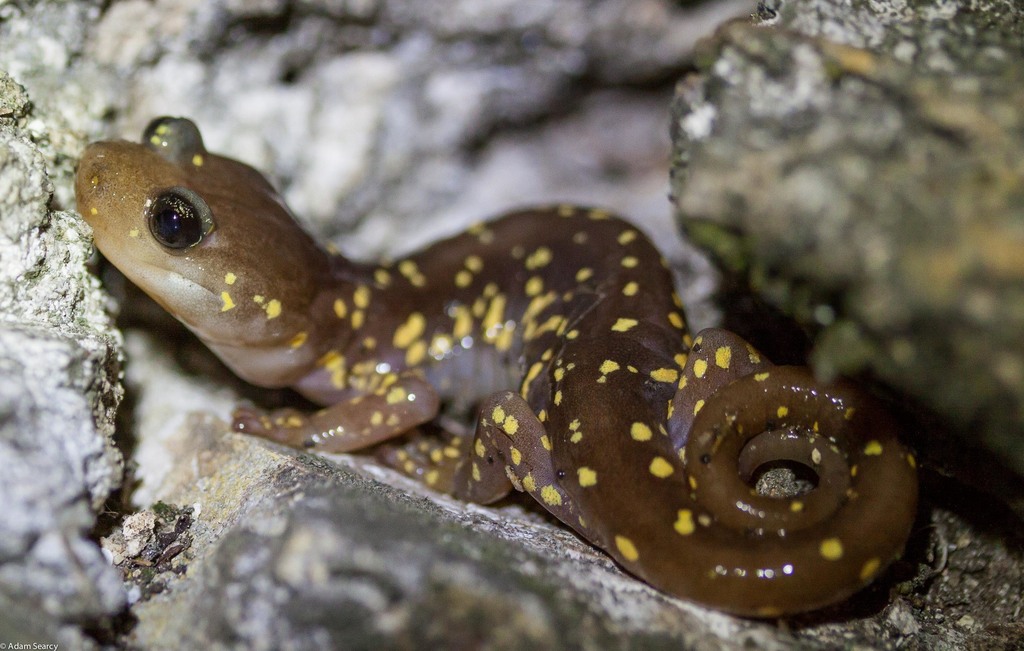
Arboreal Salamander
Aneides lugubris
The arboreal salamander (Aneides lugubris) is a species of climbing salamander. An insectivore, it is native to California and Baja California, where it is primarily associated with oak and sycamore woodlands, and thick chaparral.
From the article Arboreal salamander on Wikipedia (CC BY-SA), quoted section by section
Description
Aneides lugubris is 6.5–10 cm (2.6–3.9 in) SVL (snout-vent length), with plain purplish-brown coloring, usually spotted dorsally with gold or yellow, although it may also be unspotted. This salamander has longer and sharper teeth than many others within the order, Urodela. Aneides lugubris are insectivorous and have been found to eat beetles, caterpillars, sow bugs, ants, and centipedes. The tail is prehensile. The juvenile is dark overall, clouded with greyish color and fine yellow speckling on the back. The male of this species can be distinguished by its broad triangular head, with the front teeth of the jaw extending beyond the bottom lip. A large adult can inflict a painful bite. This species is an excellent climber and difficult to capture. It is nocturnal, spending daylight hours and dry periods in the cavities of oak trees, often with many other individuals of its species. Having their primary habitat being in the trees, arboreal salamanders have been observed to deliberately use their body as a means to protect themselves from falls. The arboreal salamander has shown the ability to use its limbs to glide or parachute when falling. This behavior has been observed in which the arboreal salamander uses its body to create a controlled and directional fall to minimize injury when climbing trees. …
Range & habitat
Arboreal salamanders are nearly California endemic species and they can be found in coastal woodlands, conifer forests, and shrublands. These salamanders are located in Humboldt County, North Baja California, and offshore islands of South Farallon, Los Coronados, Catalina, Año Nuevo, and San Francisco.
Wikipedia: “Distribution and habitat”
What it does
Aneides lugubris will lay eggs in the holes of live oak trees, or under rocks, logs, or other cover on the ground beneath the dirt. Eggs are laid in late spring or early summer, and the clutch can range between 5-24 eggs. After 3–4 months, embryos hatch in August and September.
Courtship behavior. The male will put his mental gland on the back of a female, and use his teeth to scratch the surface of her skin to deliver the pheromones from the mental gland into the females blood stream.
Parental care. Females and males often both present, females can sometimes be found wrapped around the eggs.
Wikipedia: “Reproduction”
Listen
Looking for field recordings…
Where it lives
Recorded sightings
—
geo-referenced records in GBIF, from museums, herbaria and field observers.
Drag the globe to turn it. Dots are where records exist, not a range map; darker means more records.
In the stacks
Searching the stacks…
Every page naming Aneides lugubris in the Biodiversity Heritage Library →
This page is assembled live from iNaturalist, GBIF, Wikipedia, the Source Library and the Internet Archive. It is not yet part of the hand-edited codex. iNaturalist taxon 27427.