- Plants
- ›Vascular Plants
- ›flowering plants
- ›Dicots
- ›pinks, cactuses, and allies
- ›cacti
- ›Opuntioideae
- ›Cylindropuntieae
- ›Pereskiopsis
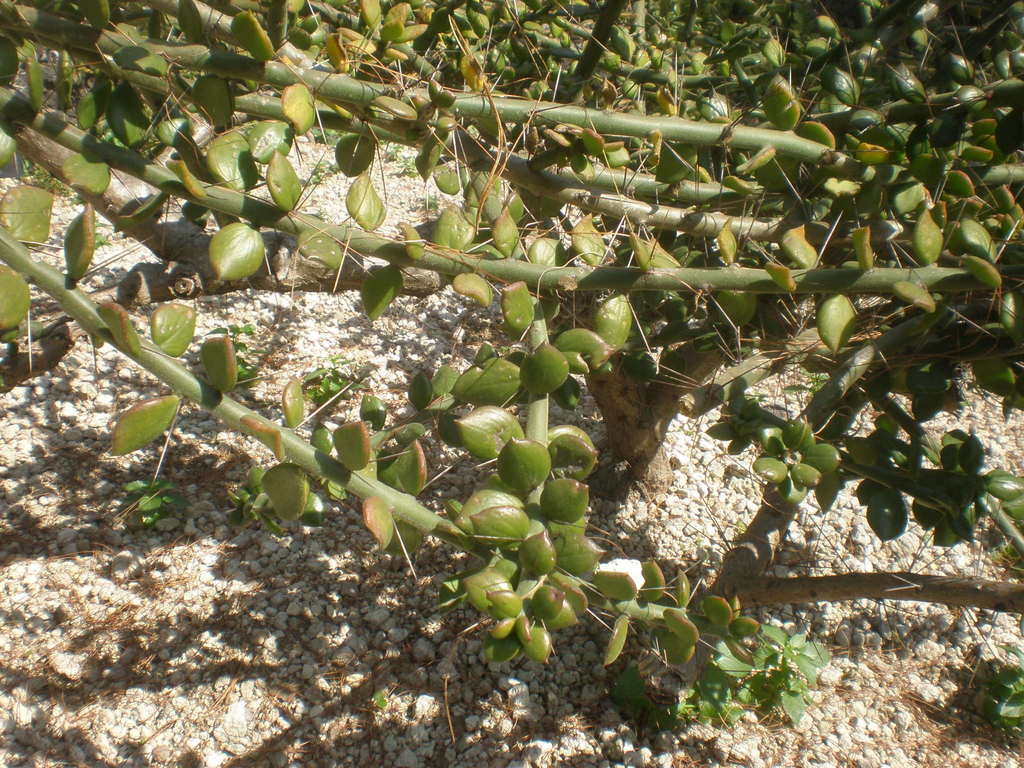
Pereskiopsis diguetii
Pereskiopsis diguetii, commonly known in Spanish as cacto arbusto patilón among other names, is a species of succulent flowering plant in the genus Pereskiopsis, within the family Cactaceae. It is native to the Mexican states of Guanajuato, Guerrero, Jalisco, México, Michoacán, Morelos, Nayarit, Querétaro, and Oaxaca.
From the article Pereskiopsis diguetii on Wikipedia (CC BY-SA), quoted section by section
Description
Pereskiopsis diguetii is a species of cactus with a shrubby growth form that grows to 0.5-2 m in height, although it can occasionally reach 4 m. It exhibits branching from its base and develops a trunk measuring 3-7 cm in diameter, with dark brown to dark gray bark. The branches are semi-climbing, pubescent, and dark green in color; they become tinged with red during dry periods. They measure 4-8 mm in diameter. The leaves are persistent, and measure 2-6 cm in length and 1.5-3 cm in width. They are ovate or occasionally lanceolate in shape. The apices are acuminate or acute. The surfaces of the leaves are pubescent and dark green in color. The veins are more conspicuous on new growth.
The areoles on the branches measure 3-4 mm in length and 2.5-4 mm in width; those on the trunk measure 6-8 mm in length and up to 7 mm in width. They have off-white trichomes, especially on young branches. The glochids are abundant on the branches and are less so on the trunk. They measure approximately 2 mm in length and are light brown to dark brown in color. The areoles on the branches have 1-5 spines each, which measure 2-7 cm in length and 1-1.2 mm thick at the base. The number of spines per areole changes with age. The areoles on the trunk grow 0-12 straight spines, which measure 1.5-7 cm in length. The flowers develop at the tips of the stems, and are yellow in color. …
Range & habitat
Pereskiopsis diguetii is native to Mexico, where it is found in the states of Guanajuato, Guerrero, Jalisco, México, Michoacán, Morelos, Nayarit, Querétaro, and Oaxaca. It is mainly found in the seasonally-dry tropical biome, from altitudes of 0 to 1900 meters above sea level. Its primary habitat consists of deciduous tropical forests, but it also grows in spiny forests, dry scrublands, and disturbed areas.
Wikipedia: “Distribution and habitat”
What it does
Pereskiopsis diguetii has perfect flowers and primarily reproduces via cross-pollination. The characteristics of the flowers, including their diameter, their yellow tepals, and their high pollen production suggest that this species is mainly pollinated by bees and butterflies. The fruits, which contain a small amount of pulp, are part of the diet of birds and small rodents, which widen the distribution of this species by spreading the seeds. Furthermore, the plant may be propagated asexually via the fruit itself; the areoles present on the pericarpel are able to develop stems when the fruit falls off the plant and comes into contact with soil. This high capacity for vegetative propagation has likely contributed to this species' wide distribution and its ability to colonize disturbed areas.
Wikipedia: “Ecology”
How it is grown
Pereskiopsis diguetii is mainly cultivated as an ornamental. It may be propagated vegetatively via cuttings. It may also be used as a living fence due to its vigorous growth and its spines and glochids. Furthermore, it is often sold under its synonym Pereskiopsis spathulata as a grafting stock for small scions (such as seedlings or areoles) of other cactus species since it has the capability to greatly increase the growth rate of these scions due to its own vigorous growth, potentially growing seedlings to flowering size in a matter of months instead of multiple years.
Wikipedia: “Cultivation”
Where it lives
Recorded sightings
—
geo-referenced records in GBIF, from museums, herbaria and field observers.
Drag the globe to turn it. Dots are where records exist, not a range map; darker means more records.
In the stacks
Searching the stacks…
Every page naming Pereskiopsis diguetii in the Biodiversity Heritage Library →
This page is assembled live from iNaturalist, GBIF, Wikipedia, the Source Library and the Internet Archive. It is not yet part of the hand-edited codex. iNaturalist taxon 274209.