- Animals
- ›Chordates
- ›Vertebrates
- ›Amphibians
- ›Salamanders
- ›Lungless Salamanders
- ›Plethodontine Salamanders
- ›Desmognathus
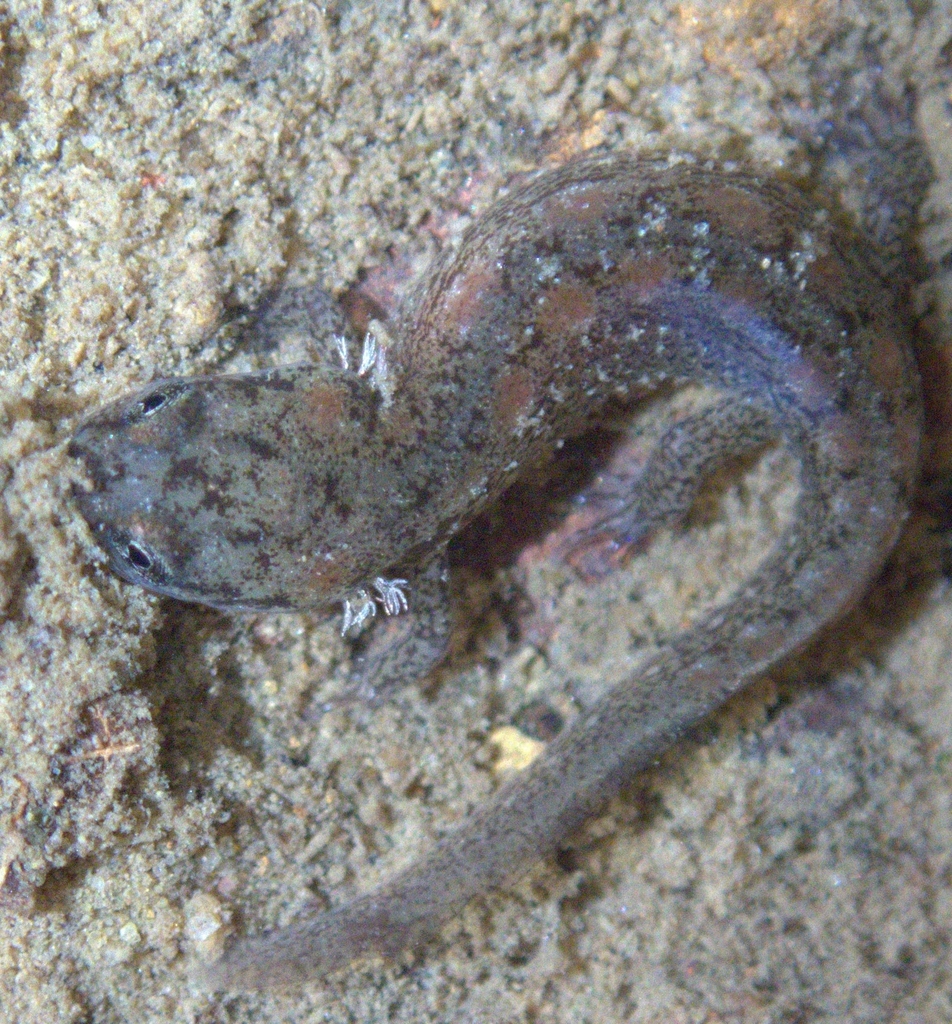
Northern Dusky Salamander
Desmognathus fuscus
Desmognathus fuscus is a species of amphibian in the family Plethodontidae (lungless salamanders). The species is commonly called the dusky salamander or northern dusky salamander to distinguish it from populations in the southern United States which form several distinct species, the southern dusky salamanders (D. auriculatus, D. valentinei). The northern dusky salamander is the most widespread representative of its genus in Canada. It can be found in eastern North America from extreme eastern Canada in New Brunswick south to South Carolina. The size of the species' total population is unknown, but is assumed to easily exceed 100,000. The species' habitat differs somewhat geographically; dusky salamanders in the northern part of the range prefer rocky woodland streams, seepages, and springs, while those in the south favor floodplains, sloughs, and muddy places along upland streams. They are most common where water is running or trickling. They hide under various objects, such as leaves or rocks, either in or near water. Alternatively, they may enter burrows for protection. The dusky salamander lays its eggs close to water under moss or rocks, in logs, or in stream-bank cavities. The larval stage which follows is normally aquatic.
From the article Desmognathus fuscus on Wikipedia (CC BY-SA), quoted section by section
Description
A small but sturdy salamander, the upper body of the northern dusky salamander varies in colour from reddish-brown to gray or olive, with a white or grey underside. The body is sparsely covered with dark spots or mottling concentrated on the sides. It also has a light dorsal stripe or two dark stripes that continue on to the first part of the tail. Juvenile colouring consists of five to eight pairs of dorsal spots or blotches located between the front and hind legs. Older individuals tend to be uniformly dark brown or black. As with all dusky salamander species, both juveniles and adults have a pale single stripe outlined in black that extends from the eye and runs diagonally to the rear of the jaw. Additionally, both have 14 costal grooves, larger hind limbs than forelimbs, and a keeled (knife-like) tail that is triangular in cross-section and compressed laterally at the base. The tail is less than half its body length and is normally lighter in colour in comparison to the body. Adults attain lengths of up to 14 cm, with the average length of adult males and females being 9.4 cm and 8.6 cm, respectively. Being from the family Plethodontidae, the northern dusky salamander is lungless. It absorbs oxygen through the skin and membranous tissue located in the mouth and throat. …
Range & habitat
This species is native to North America, and occurs throughout central-eastern regions of Canada and the United States, from southern New Brunswick, southeastern Quebec and southern Ontario south to South Carolina. Populations south of this range are now thought to belong to other, previously-synonymized species such as D. conanti. The Canadian distribution accounts for approximately 5% of the global range. Within its Canadian range, the northern dusky salamander usually occurs in forested habitat located in high elevation, low-order streams. There are two separate units (DU), the Quebec/New Brunswick DU and the Carolinian DU in Ontario. A comprehensive review of Ohio populations was published in "Amphibians of Ohio" (2013). An isolated breeding population exists in eastern Michigan; however, it is not known whether this population is natural or was introduced.
Wikipedia: “Range”
What it does
Due to their lack of mobility, some populations of dusky salamander are genetically distinct. Breeding is terrestrial and occurs annually in spring or fall and includes elaborate courtship rituals. Adult males have papillose cloacal lips and a small mental gland. These glandular tissues become enlarged when sexually active. Female individuals lack a mental gland and have folded cloacal lips. For reproduction, the male applies the snout, cheeks and mental gland to the snout of the female, who usually responds by picking up the spermatophore. Fecundity increases with body size. Females normally deposit between 10 and 30 eggs under logs, moss or rocks located streamside where soil is saturated with water. Clutch size has been known to vary geographically and can be as large as forty-five, or as few as eight. Females remain with their eggs for an incubation period of six to ten weeks (45 to 60 days) in order to protect them from desiccation and predation . The larvae are predominantly aquatic and approximately 1.5 cm in length upon hatching. The larvae then metamorphose into semi-terrestrial adults, with juvenile salamanders being 2.8 to 4.4 cm in length. Their biphasic life cycle includes an aquatic state of seven to 16 months, followed by a semi-terrestrial adult stage. The northern dusky salamander attains sexual maturity at approximately three to four years of age. …
Wikipedia: “Reproduction and development”
Listen
Looking for field recordings…
Where it lives
Recorded sightings
—
geo-referenced records in GBIF, from museums, herbaria and field observers.
Drag the globe to turn it. Dots are where records exist, not a range map; darker means more records.
In the stacks
Searching the stacks…
Every page naming Desmognathus fuscus in the Biodiversity Heritage Library →
This page is assembled live from iNaturalist, GBIF, Wikipedia, the Source Library and the Internet Archive. It is not yet part of the hand-edited codex. iNaturalist taxon 27420.