- Plants
- ›Vascular Plants
- ›flowering plants
- ›Dicots
- ›pinks, cactuses, and allies
- ›cacti
- ›globular cacti, moonlight cacti, torch cacti, and allies
- ›Globular Cactuses
- ›Mammillaria
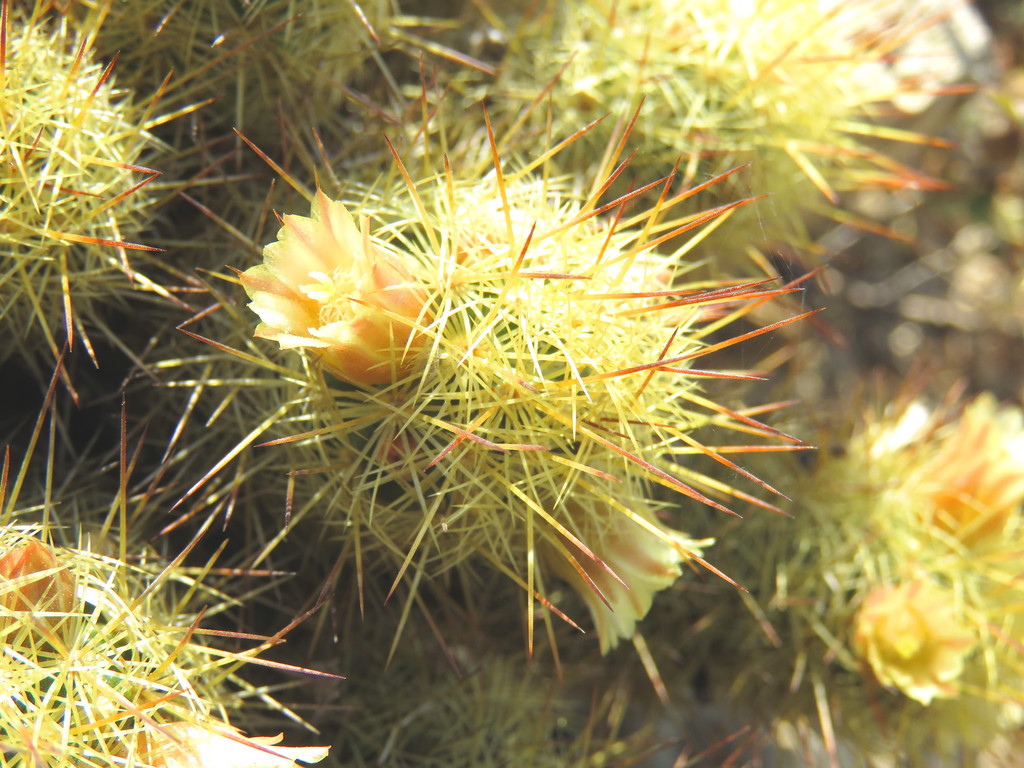
Gold Lace Cactus
Mammillaria elongata
Mammillaria elongata, the gold lace cactus or ladyfinger cactus, is a species of flowering plant in the family Cactaceae, native to central Mexico. Growing to 15 cm (6 in) tall by 30 cm (12 in) wide, it consists of densely packed clusters of elongated oval stems, covered in harmless (although very sharp) yellow or brown spines, and in spring producing white or yellow flowers. It is among the most common and most variable of its genus in nature, and is a popular subject for cultivation. It has gained the Royal Horticultural Society's Award of Garden Merit.
From the article Mammillaria elongata on Wikipedia (CC BY-SA), quoted section by section
Description
The cactus forms dense groups of cylindrical, erect or semi-prostrate stems about 6 to 15 cm long and 1.5 to 3.7 cm in diameter. Its body, bright green, is formed by short conical tubercles (2 to 4 mm) ending in round and woolly areoles in the young segments, unlike tubercular axils that lack wooliness. It has between 15 and 30 short radial spines (6 to 12 mm), curved outwards that intersect with those of the nearby areoles and 1 to 3 central (sometimes absent) yellow or golden color. The flowers arise on the upper part of the stems and are 1.5 cm in length and diameter, with pale yellow or white toothed petals, sometimes with a darker or reddish central line. The fruits are cylindrical to globose, brown or red, with a large number of seeds. Blooms profusely between late winter and early summer.
Where it lives
Recorded sightings
—
geo-referenced records in GBIF, from museums, herbaria and field observers.
Drag the globe to turn it. Dots are where records exist, not a range map; darker means more records.
In the stacks
Searching the stacks…
Every page naming Mammillaria elongata in the Biodiversity Heritage Library →
This page is assembled live from iNaturalist, GBIF, Wikipedia, the Source Library and the Internet Archive. It is not yet part of the hand-edited codex. iNaturalist taxon 273594.