- Animals
- ›Chordates
- ›Vertebrates
- ›Amphibians
- ›Salamanders
- ›Lungless Salamanders
- ›Hemidactyliine Salamanders
- ›Pseudoeurycea
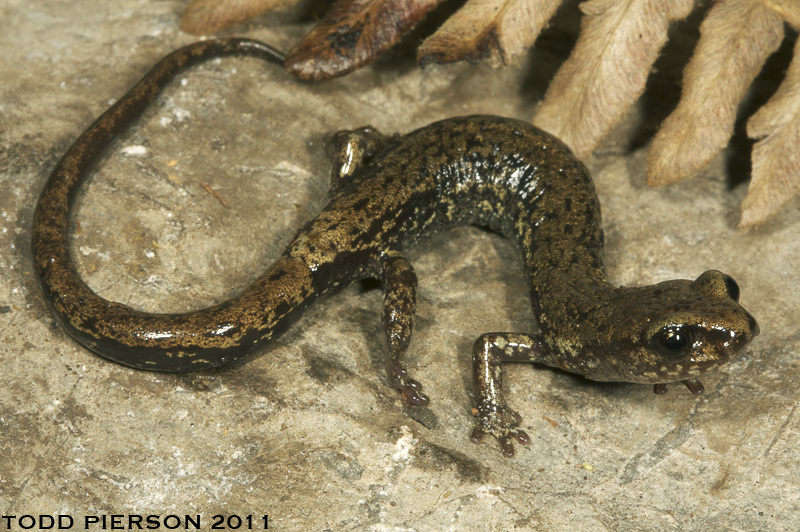
Royal Salamander
Pseudoeurycea rex
Pseudoeurycea rex is a species of salamander in the family Plethodontidae, found mostly in Guatemala and Mexico. Its natural habitats are subtropical or tropical moist montane forests, subtropical or tropical high-altitude grassland, and heavily degraded former forest. The species is threatened by habitat loss.
From the article Pseudoeurycea rex on Wikipedia (CC BY-SA), quoted section by section
Description
Males can reach 89 mm (3.5 in) and females 90 mm (3.5 in) in total length; the tail makes up just above one half of the total length. The head is bluntly oval. The tail is circular in cross section and constricted at the base. The limbs are well-developed. Both the fingers and the toes have basal webbing. The body is pinkish gray above, shading into gray in sides of body and tail. The tail has some white marbling and is light gray beneath. The throat has white marbling, and the upper surface of the snout has some light marbling too.
Range & habitat
Pseudoeurycea rex occurs in coniferous forests of the temperate forest zone, par-like forest, and above tree line in open bunchgrass communities; its altitudinal range is 2,450–4,000 m (8,040–13,120 ft) above sea level, although it mostly occurs above 2,800 m (9,200 ft). It can survive in degraded forest. Development is direct, without free-living larval stage. The types were collected from under logs. Pseudoeurycea rex used to be the most abundant Guatemalan salamander that could reach very high densities, but it has declined dramatically and is now extremely rare. The reasons for this dramatic decline are unknown. It is threatened by habitat loss caused by overgrazing by livestock, clear-cutting of forest, and human settlement. Its range overlaps with several protected areas.
== References ==
Wikipedia: “Habitat and conservation”
Listen
Looking for field recordings…
Where it lives
Recorded sightings
—
geo-referenced records in GBIF, from museums, herbaria and field observers.
Drag the globe to turn it. Dots are where records exist, not a range map; darker means more records.
In the stacks
Searching the stacks…
Every page naming Pseudoeurycea rex in the Biodiversity Heritage Library →
This page is assembled live from iNaturalist, GBIF, Wikipedia, the Source Library and the Internet Archive. It is not yet part of the hand-edited codex. iNaturalist taxon 27308.