- Animals
- ›Chordates
- ›Vertebrates
- ›Amphibians
- ›Salamanders
- ›Lungless Salamanders
- ›Plethodontine Salamanders
- ›Ensatina
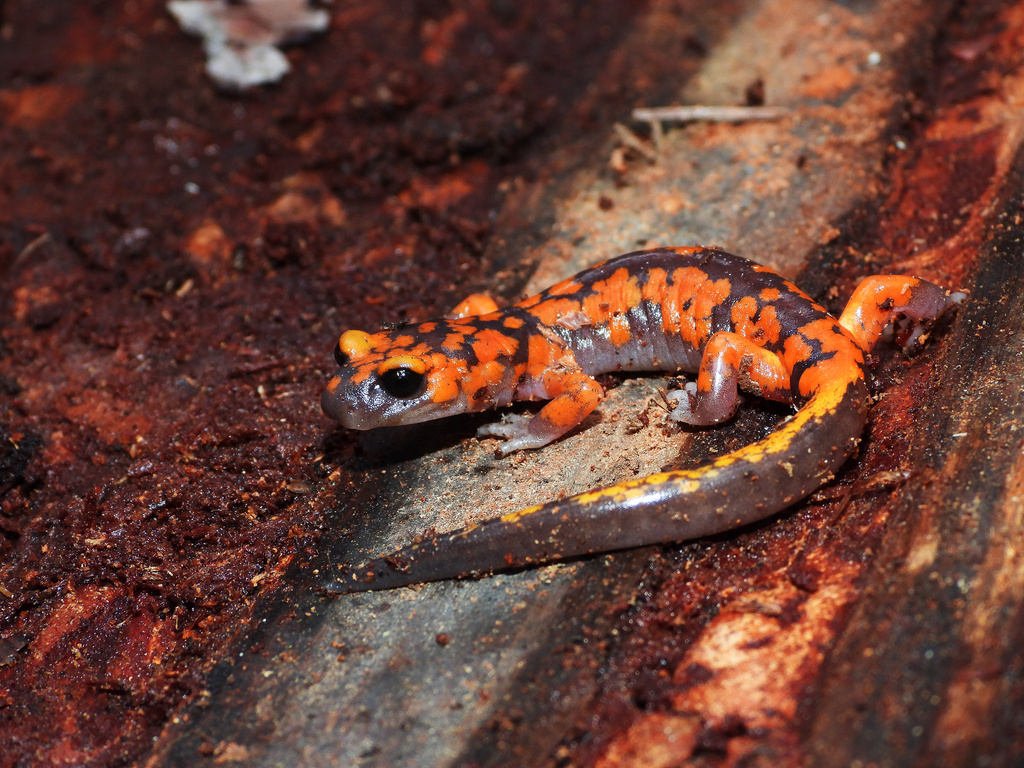
Ensatina
Ensatina eschscholtzii
The ensatina (Ensatina eschscholtzii) is a species complex of plethodontid (lungless) salamanders found in coniferous forests, oak woodland and chaparral from British Columbia, through Washington, Oregon, across California (where all seven subspecies variations are located), all the way down to Baja California in Mexico. The genus Ensatina originated approximately 21.5 million years ago. It is usually considered as monospecific, being represented by a single species, Ensatina eschscholtzii, with several subspecies forming a ring species.
From the article Ensatina on Wikipedia (CC BY-SA), quoted section by section
Description
The subspecies Ensatina e. eschscholtzii, the Monterey ensatina, can be found in Santa Cruz and Monterey Counties and into the California coastal mountains. With a head-to-tail length of just between 3–5 in (7.6–12.7 cm), E. e. eschecholtzi can be identified primarily by its tail, which is narrower at the base; it is the only subspecies that has such a tail structure, as well as five toes on the hind limbs. Males often have longer tails than the females, and many of these salamanders have lighter-colored limbs, compared to the rest of the body. The adult females lay eggs underground, often in sets of threes, which hatch directly into fully-formed salamanders, skipping the usual aquatic juvenile phase. The subspecies Ensatina eschscholtzii klauberi, or the large-blotched ensatina, can be found along the mountain ranges of Southern California, and south into a small region of the Sierra Juarez in northern Baja California. E. e. klauberi is similar in size to E. e. eschscholtzii; it is mid-sized, with adults growIng a total length of 3–6 in (7.6–15.2 cm). Females tend to have shorter, wider bodies compared to the males. However, this subspecies differs from E. e. eschscholtzii in its coloration—nearly black, with blotches of orange, tail, and dark eyes.
As a ring species. …
Range & habitat
They are generally thought to be found in high elevations, from 520 to 2400m, in conifer forests and oak woodlands. However, populations were discovered along the coast in Volcán Riveroll, a volcanic area located in Baja California. It is thought that they are able to survive in this anomalous region due to the high moisture that comes in from the coast. It is unclear how these populations were able to end up in this coastal region, but it is hypothesized that "the subspecies was once more broadly distributed and became isolated as a result of climate change during the late Pleistocene and Holocene." If this is true, then it is estimated that Ensatina klauberi has been living in this region for thousands of years.
Wikipedia: “Distribution and habitat”
Listen
Looking for field recordings…
Where it lives
Recorded sightings
—
geo-referenced records in GBIF, from museums, herbaria and field observers.
Drag the globe to turn it. Dots are where records exist, not a range map; darker means more records.
In the stacks
Searching the stacks…
Every page naming Ensatina eschscholtzii in the Biodiversity Heritage Library →
This page is assembled live from iNaturalist, GBIF, Wikipedia, the Source Library and the Internet Archive. It is not yet part of the hand-edited codex. iNaturalist taxon 27250.