- Animals
- ›Chordates
- ›Vertebrates
- ›Amphibians
- ›Salamanders
- ›Lungless Salamanders
- ›Plethodontine Salamanders
- ›Plethodon
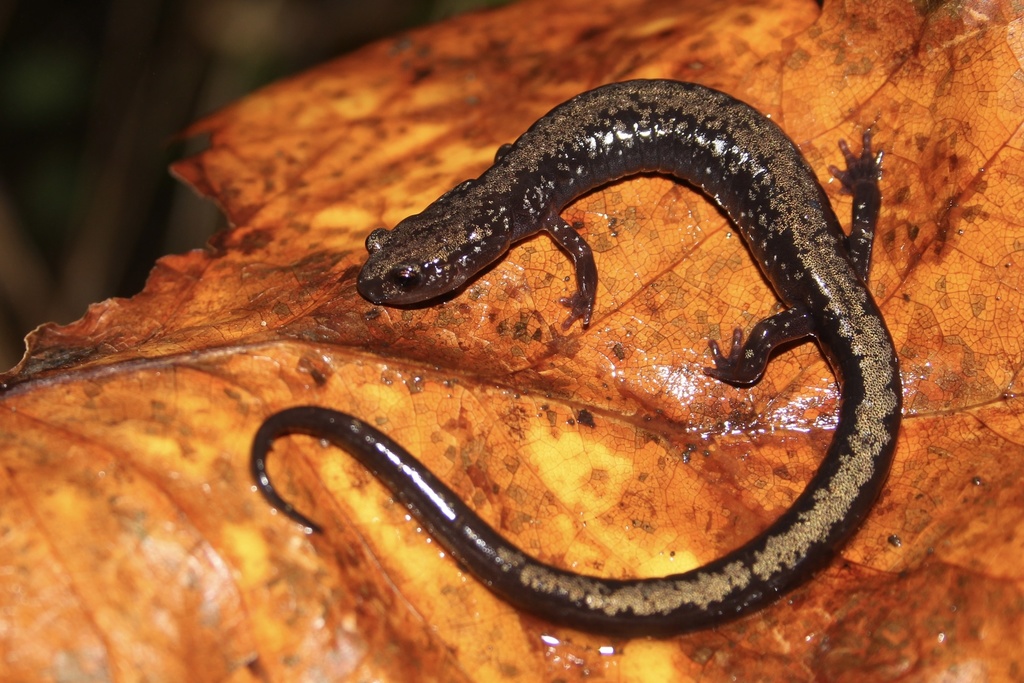
Peaks of Otter Salamander
Plethodon hubrichti
The Peaks of Otter salamander (Plethodon hubrichti) is a species of salamanders in the family Plethodontidae. It is endemic to the Peaks of Otter area in the Blue Ridge Mountains of Virginia. It is a montane salamander found at elevations above
442 m (1,450 ft), but more commonly above 760 m (2,490 ft). It can be locally common, but its distribution is small and patchy. This makes it vulnerable to local threats such as timber harvesting, recreational development, defoliation by gypsy moths, and spraying to control the latter.
From the article Peaks of Otter salamander on Wikipedia (CC BY-SA), quoted section by section
Description
The adult Peaks of Otter salamander is characterized by a dark-brown dorsum with heavy brassy flecking down its entire length. The dorsum and sides of P. hubrichti may also be lightly speckled with white, while the venter is not spotted and ranges from light to charcoal grey in color. Males have small mental glands immediately behind the chin. While the Peaks of Otter salamander is superficially similar to the Cheat Mountain salamander (P. nettingi), the two species are differentiated by a higher concentration of metallic flecking on the dorsum of P. hubrichti, and the presence of a usual 19 costal grooves compared to the variable 17–19 costal grooves of P. nettingi. Although Petranka stated that hatchlings have a distinct dorsal stripe consisting of reddish spots, this was never seen in over 100 neonates observed, which have a uniform dark-grey dorsum. Brassy flecks begin to appear when salamanders reach about 25 mm snout-to-vent length. In the early 1950s, the P. cinereus group of small Plethodon species was made up of only three species: the southern ravine salamander (P. richmondi), the Cheat Mountain salamander (P. nettingi), and the eastern red-backed salamander (P. cinereus). Numerous other members of the genus have since been described, including the Peaks of Otter salamander.
Range & habitat
The Peaks of Otter salamander is endemic to a 19-km stretch along the Blue Ridge Parkway in the Peaks of Otter area of the Blue Ridge Mountains in Bedford, Botetourt, and Rockbridge Counties of west-central Virginia. P. hubrichti occupies forest floor habitats and is generally found at elevations above 845 m.
Distribution in allopatry. When not in sympatry with the Eastern Red-backed salamander (P. cinerus), P. hubrichti surface-active salamander densities decreased with elevation. Reichenbach and Brophy performed a study between 2008 and 2010 on allopatric populations of P. hubrichti at elevations ranging from 488 to 1143 m. They measured eggs/female, % gravid females, surface-active salamander density, temperature and relative humidity. Surface-active salamander densities, survival rates, growth rates, eggs/female and reproductive output decreased with elevation. Decreases were related to increases in temperature and a decrease in relative humidity associated with decline in elevation. Being a montane species, P. hubrichti is affected by even slight changes in the aforementioned environmental factors. …
Wikipedia: “Distribution”
What it does
The first observations of a P. hubrichti nest were made in spring and summer of 2005, at a study site near Onion Mountain in Bedford County A cluster of about 10, 5.5-mm-diameter eggs, attended by the brooding female, was found beneath a rock embedded in the soil, hanging from the soil chamber ceiling. After 42–48 days of development, motile embryos with visible eyes were observed in the eggs, and 16 days later, hatchlings were found at the nest site. The number of eggs per female ranged from 1 to 12 with a mean of 8.5 (95% CI 8.2–8.9). The number of eggs per female P. hubrichti increased directly with mass and elevation to a maximum of 12 eggs per female at 1000 m and then decreased slightly above 1000 m. While females found at higher elevations, near optimal elevations, typically produced more eggs per individual there was a greater percentage of females gravid at lower elevations. Combining data on salamander densities, number of eggs per female, and % gravid females (percentage of females in a population that are carrying eggs) allowed for the calculation of reproductive output for populations of salamanders at various elevations. …
Wikipedia: “Reproduction”
Listen
Looking for field recordings…
Where it lives
Recorded sightings
—
geo-referenced records in GBIF, from museums, herbaria and field observers.
Drag the globe to turn it. Dots are where records exist, not a range map; darker means more records.
In the stacks
Searching the stacks…
Every page naming Plethodon hubrichti in the Biodiversity Heritage Library →
This page is assembled live from iNaturalist, GBIF, Wikipedia, the Source Library and the Internet Archive. It is not yet part of the hand-edited codex. iNaturalist taxon 27202.