- Animals
- ›Chordates
- ›Vertebrates
- ›Amphibians
- ›Salamanders
- ›Lungless Salamanders
- ›Plethodontine Salamanders
- ›Plethodon
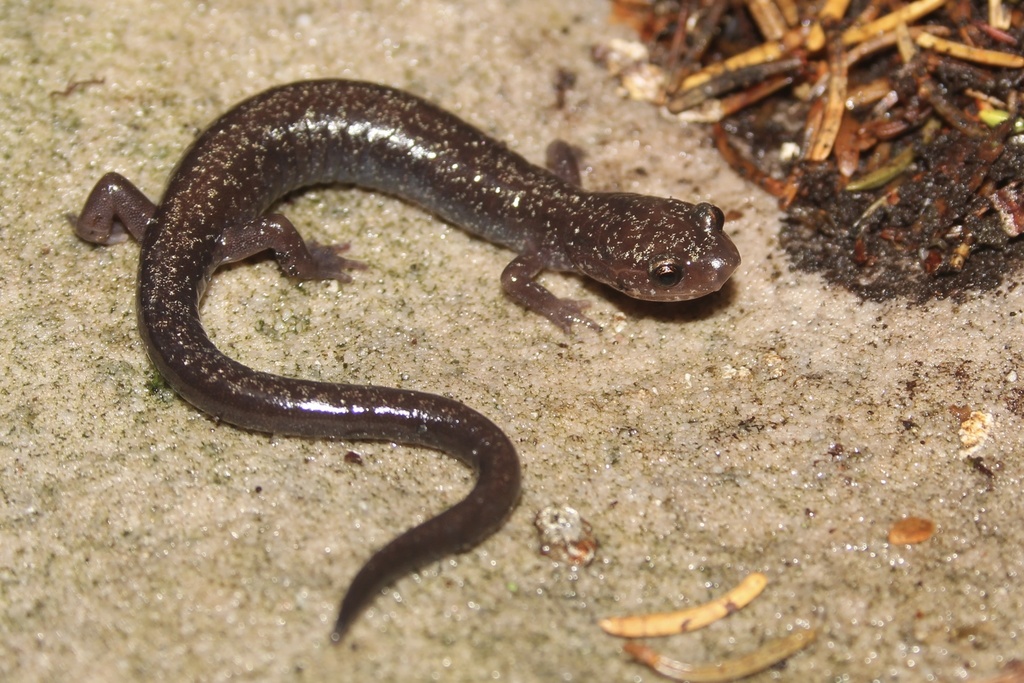
Cheat Mountain Salamander
Plethodon nettingi
The Cheat Mountain salamander (Plethodon nettingi) is a species of small woodland salamander in the family Plethodontidae. The species is found only on Cheat Mountain, and a few nearby mountains, in the eastern highlands of West Virginia. It and the West Virginia spring salamander (Gyrinophilus subterraneus) are the only vertebrate species with geographic ranges restricted to that state.
The Cheat Mountain salamander has decreased in population due to destruction of its original red spruce forest habitat, as well as by pollution, drought, forest storm damage, and by competition with other salamanders, especially its relative, the red-backed salamander (P. cinereus).
From the article Cheat Mountain salamander on Wikipedia (CC BY-SA), quoted section by section
Description
The Cheat Mountain salamander is smallish, similar in size to the red-backed salamander, 3 to 4¾ inches (7½ to 12 cm) in total length (including tail), but is distinct in its black or dark brown dorsum (back) which is boldly marked with numerous small brassy, silver or white flecks. It lacks a dorsal stripe. The belly is dark gray to black. The tail is about the same length as its body, which has 17 to 19 costal grooves (vertical grooves along its sides).
Range & habitat
P. nettingi is restricted to a small portion of the high Allegheny Mountains in eastern West Virginia. Initially, in the 1930s and '40s, its range was thought to be limited to Cheat Mountain at elevations above 3,500 feet (1,100 m) in Randolph County — and in Pocahontas County, where it was also found at Thorny Flat (Cheat's highest point). Later inventories, conducted in the 1970s and '80s, expanded the known range to include Pendleton and Tucker Counties (e.g., Backbone Mountain, Dolly Sods). More recently, the range has been shown to include the eastern edge of Grant County where it is found as low as 2,640 feet (800 m) elevation. Most populations are found above 3,500 feet (1,100 m). The entire P. nettingi range encompasses only about 935 square miles (2,420 km2), but not continuously throughout even this area (about 60 isolated populations are known). Much of this range is within the Monongahela National Forest.
Wikipedia: “Geographic range”
What it does
Cheat Mountain salamanders spend the winter underground where temperatures remain above freezing. Depending on soil temperature, they emerge from winter refugia at the end of March or early April and retreat to underground refugia again in mid-October. During the above ground period, they are especially active at night in humid weather. During the day, they remain under rocks and in or under logs; and sometimes among wet leaves. Aestivation only occurs during unusual drought conditions.
Wikipedia: “Behavior”
In human culture
The specific name, nettingi, is in honor of American herpetologist M. Graham Netting. P. nettingi was discovered by Netting and Leonard Llewellyn on White Top, a summit of Cheat Mountain in Randolph County, West Virginia, in 1935. It was described and named by N. Bayard Green in 1938. This salamander and the Peaks of Otter salamander (P. hubrichti), which has a similarly restricted range in Virginia, were once considered subspecies of a single species, "Netting's salamander", but since 1979 they (along with the Shenandoah salamander, P. shenandoah) have been considered separate, full species. Their geographic ranges were probably much larger in the past. The circumstances surrounding the discovery and formal description of P. nettingi are related by Maurice Brooks in his classic natural history book, The Appalachians (1965).
Wikipedia: “Etymology and taxonomy”
Listen
Looking for field recordings…
Where it lives
Recorded sightings
—
geo-referenced records in GBIF, from museums, herbaria and field observers.
Drag the globe to turn it. Dots are where records exist, not a range map; darker means more records.
In the stacks
Searching the stacks…
Every page naming Plethodon nettingi in the Biodiversity Heritage Library →
This page is assembled live from iNaturalist, GBIF, Wikipedia, the Source Library and the Internet Archive. It is not yet part of the hand-edited codex. iNaturalist taxon 27162.