- Animals
- ›Chordates
- ›Vertebrates
- ›Amphibians
- ›Salamanders
- ›Lungless Salamanders
- ›Plethodontine Salamanders
- ›Plethodon
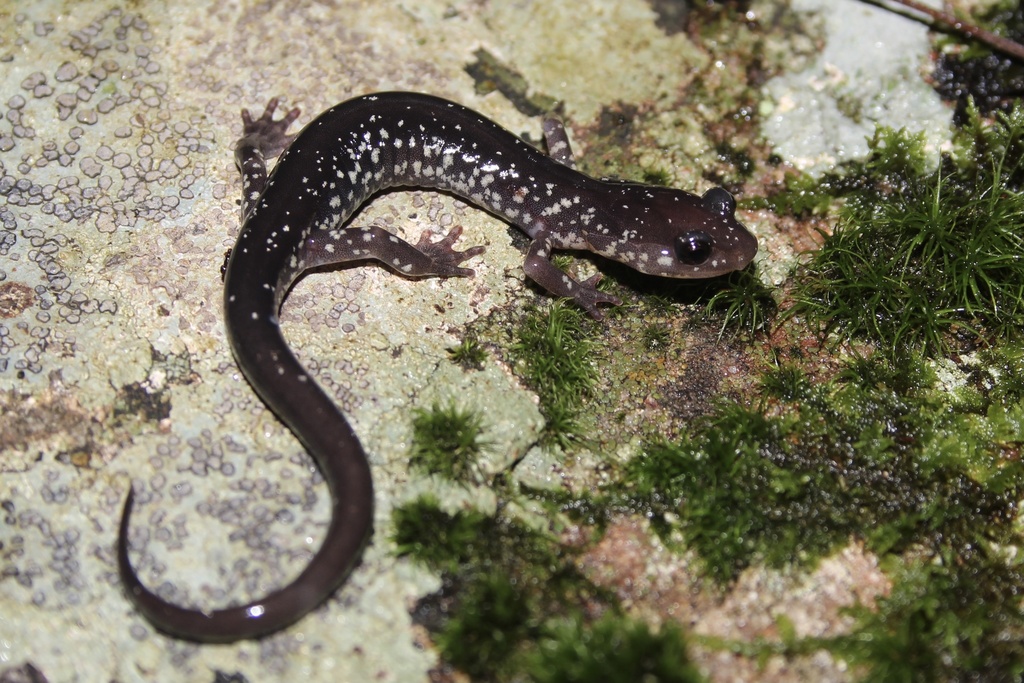
Cow Knob Salamander
Plethodon punctatus
Plethodon punctatus, commonly known as the Cow Knob salamander or white-spotted salamander (not to be confused with P. cylindraceus, the white-spotted slimy salamander), is a species of salamander in the family Plethodontidae. It is endemic to high mountain forests on the border of Virginia and West Virginia in the United States. Nearly all occurrences are on Shenandoah Mountain, Nathaniel Mountain and Great North Mountain in George Washington National Forest. Cow Knob salamanders are a member of the P. wehrlei species complex, which includes many other Appalachian salamanders historically referred to Plethodon wehrlei (Wehrle's salamander).
Major threats to Plethodon punctatus include habitat loss and climate change, and it is rated as Near Threatened by the IUCN. Although not protected by the Endangered Species Act, Cow Knob salamanders benefit from a 1994 conservation agreement between the U.S. Forest Service and the U.S. Fish and Wildlife Service. The species' threatened condition has helped to secure ecosystem conservation goals on Shenandoah Mountain and nearby ridges, such as redirecting the planned route of the Atlantic Coast Pipeline. Despite their restricted range, Cow Knob salamanders are abundant in localities with ideal environmental conditions, such as rocky old-growth hemlock forests.
From the article Cow Knob salamander on Wikipedia (CC BY-SA), quoted section by section
Description
The Cow Knob salamander is a moderately large plethodontid. The largest recorded length is 17.1 cm (6.7 in), though most adults have a total length smaller than 15.7 cm (6.2 in). Around half of the total length is tail. The base coloration is dark brown or greyish-black. The sides and legs are colored with large white or cream spots, which may extend onto a portion of the belly. The back is typically speckled with smaller and more scattered spots. The species name 'punctatus' ("spotted") is in reference to these dorsal spots. The throat has a light pink or pale coloration which transitions to the grey belly. The white-spotted slimy salamander (Plethodon cylindraceus) is similar in size and color, but differs in many other respects. Plethodon punctatus can differentiated by its more slender build, slightly webbed toes, protuberant eyes, a higher number of costal grooves (usually 17–18), and a lighter throat. It is very similar in appearance to closely related salamanders in the Plethodon wehrlei group, though it is slightly larger and completely lacks distinctive coloration patterns such as red spots, brassy flecks, or large yellow dorsal spots.
Range & habitat
Cow Knob salamanders are adapted to live in high-elevation hardwood forests with dense canopy cover and talus. Old-growth forests and hemlock stands are greatly preferred, while young pine monocultures and clearings are avoided. They typically occur at an elevation of 900–1,200 m (3,000–3,900 ft), with some reports as low as 735 m (2,411 ft). They are particularly abundant on north-facing slopes with an ample supply of rocks for cover. Rocks with large gaps underneath are the preferred form of refuge, followed by fallen logs.
Wikipedia: “Habitat”
What it does
The salamanders are most active in the spring (April–June) and fall (September–October), sheltering during the harsher months of the summer and winter. In West Virginia, their peak season extends into the early summer. They forage on cool wet nights, prioritizing the forest floor but also venturing onto trees or rocks. A wide range of small invertebrates are taken as prey. Plethodon punctatus is a host to Cepedietta michiganensis (a ciliate) and Batracholandros magnavulvaris (a nematode), both of which are fairly benign gut parasites common among Appalachian salamanders. Cow Knob salamanders are direct developers, mating via spermatophore in the late winter or early spring. A clutch of 7-16 eggs can be laid every other year, though the precise timing is unknown. Juveniles hatch in the fall and reach sexual maturity within 3 or 4 years, with females maturing later and at a larger body size. This species is not migratory on an individual basis, and most adults have a range of only a few meters throughout their lifetime. Plethodon punctatus coexists alongside the ecologically similar Shenandoah Mountain salamander (Plethodon virginia, previously referred to Plethodon hoffmani). The two species do not show any competitive exclusion, despite P. punctatus juveniles overlapping the size range of P. virginia adults. …
Wikipedia: “Ecology and behavior”
Listen
Looking for field recordings…
Where it lives
Recorded sightings
—
geo-referenced records in GBIF, from museums, herbaria and field observers.
Drag the globe to turn it. Dots are where records exist, not a range map; darker means more records.
In the stacks
Searching the stacks…
Every page naming Plethodon punctatus in the Biodiversity Heritage Library →
This page is assembled live from iNaturalist, GBIF, Wikipedia, the Source Library and the Internet Archive. It is not yet part of the hand-edited codex. iNaturalist taxon 27148.