- Animals
- ›Chordates
- ›Vertebrates
- ›Amphibians
- ›Salamanders
- ›Asian Salamanders
- ›Hynobiine Salamanders
- ›Hynobius
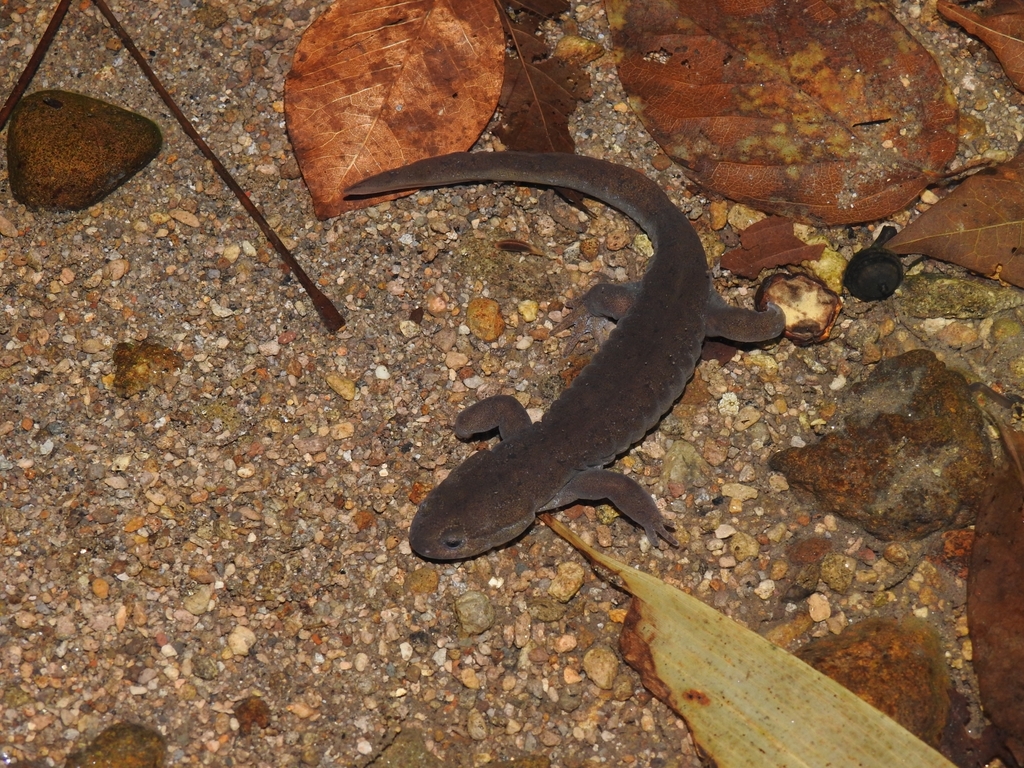
Dunn's Oriental Salamander
Hynobius dunni
The Oita salamander (Hynobius dunni) is a species of salamander in the family Hynobiidae endemic to Japan. Named after Ōita Prefecture, its natural habitats are temperate forests, rivers, intermittent rivers, freshwater marshes, intermittent freshwater marshes, and irrigated land in western Japan. It is threatened by habitat loss, due to the increasing construction of homes within its habitat. The Oita salamander is considered to be vulnerable by the (IUCN) Red List of Threatened Species with a declining population.
Across Japan, the Oita salamander genetically differs based on their location. The DNA diversity was most apparent when comparing both the Northern and Southern species across Japan.
From the article Oita salamander on Wikipedia (CC BY-SA), quoted section by section
Description
The Oita salamander tends to be greenish-grey in color, some even being brown. On their dorsal, they typically have black dots with a lot of the salamanders lacking dots. Those with dots will fade as they enter adulthood. Unlike the dorsal surface, the ventricle surface tends to be a blueish-grey that becomes lighter at the salamander's throat. Young Oita salamanders have a blue iridescent highlight to them, until they eventually fade with adulthood. In wetter environments the blue iridescent color is more pronounced than those in dryer locations. This salamander unlike most animals have only 11 coastal grooves, compared to the normal 12. Those with 11 grooves are documented. Their (SVL) snout to vent length 6–8 cm with a maximum of 10–16 cm, their bodies tend to be around this range also.
Range & habitat
Like prefaced before, its natural habitats are temperate forests, rivers, intermittent rivers, freshwater marshes, intermittent freshwater marshes, and irrigated land in western Japan. This species can be found exclusively in the Japanese Island groups of Shikoku and Kyushu. The live in secondary forests and bamboo woods. Outside of the mating season, they can be found under stones and leaves.
Wikipedia: “Habitat”
What it does
The Oita salamander enjoys eating insects, i.e., earthworms, miniature mealworms, fly maggots, spiders, mosquito larvae, woodlice, millipedes, etc. However, this salamander does not eat slugs, compared to the other types of salamanders. They eat quite a lot during the winter, and don't use much energy. They end up looking chubbier.
Wikipedia: “Feeding”
Listen
Looking for field recordings…
Where it lives
Recorded sightings
—
geo-referenced records in GBIF, from museums, herbaria and field observers.
Drag the globe to turn it. Dots are where records exist, not a range map; darker means more records.
In the stacks
Searching the stacks…
Every page naming Hynobius dunni in the Biodiversity Heritage Library →
This page is assembled live from iNaturalist, GBIF, Wikipedia, the Source Library and the Internet Archive. It is not yet part of the hand-edited codex. iNaturalist taxon 26876.