 NL·0392
Herbarium of the Nature Library
- Name
- Andrias davidianus
- Family
- Cryptobranchidae
- Native to
- Mountain streams of central and southern China; genetic studies suggest the old 'davidianus' is several species (A. sligoi, A. jiangxiensis and others), with A. davidianus in the narrow sense restricted to part of this range
- Habitat
- Mountain streams, Rivers
Chinese giant salamander
Andrias davidianus
Also calledDàní 大鲵 (Chinese) · Wáwáyú 娃娃鱼, 'baby fish' (Chinese)
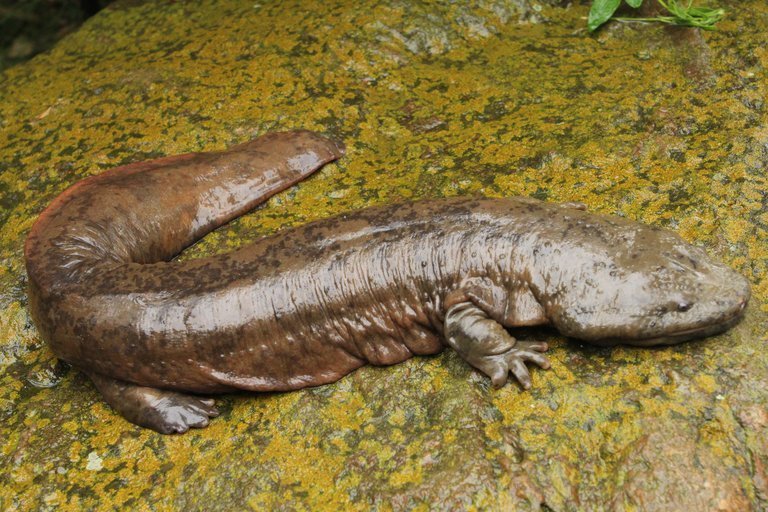
Among the largest amphibians alive, recorded at up to 1.8 m. This brown, wrinkled salamander lives in cold mountain streams of China. It is Critically Endangered, mainly because of hunting and farming for meat, and farm-bred animals of mixed origin have been released into wild rivers.
The Chinese giant salamander is the largest salamander and the largest amphibian in the world. It is fully aquatic, and is endemic to rocky mountain streams and lakes in the Yangtze river basin of central China. It has also been introduced to Kyoto Prefecture in Japan, and possibly to Taiwan. It is considered critically endangered in the wild due to habitat loss, pollution, and overcollection, as it is considered a delicacy and used in traditional Chinese medicine. On farms in central China, it is extensively farmed and sometimes bred, although many of the salamanders on the farms are caught in the wild. It has been listed as one of the top-10 "focal species" in 2008 by the Evolutionarily Distinct and Globally Endangered project. Wikipedia
What it can do
- iBreathes mainly through its wrinkled skin
- iiDetects prey with sensory nodes along its head and body, sensing water movement
- iiiCan live for decades; over 50 years in captivity
- ivMales guard eggs in underwater dens
In the field
Field marks
- aHuge, flattened, brown salamander with wrinkled skin
- bBroad, flat head with tiny eyes
- cFold of skin along the sides of the body
- dShort limbs
- Not to be confused with
- The Japanese giant salamander (A. japonicus) is very similar and lives only in Japan; the two are best told apart by where they are found. The North American hellbender (Cryptobranchus) is much smaller.
- Where to see it
- Rarely seen in the wild; nature reserves in Zhangjiajie (Hunan), Shaanxi's Qinling Mountains; also in zoos
- When
- Resident; breeds in late summer
Listen
Looking for field recordings…
Life & habits
- Diet
- Fish, frogs, crabs, shrimp, worms, insects
- Habitat
- Clear, cold, rocky mountain streams and rivers
- Size
- Usually ~1 m; historically up to ~1.8 m
- Lifespan
- Decades; 50+ years recorded in captivity
Hides by day in crevices and dens and ambushes prey at night with a fast suction gulp.
Where it lives
Recorded sightings
—
geo-referenced records in GBIF, from museums, herbaria and field observers.
Native range
Mountain streams of central and southern China; genetic studies suggest the old 'davidianus' is several species (A. sligoi, A. jiangxiensis and others), with A. davidianus in the narrow sense restricted to part of this range
Drag the globe to turn it. Dots are where records exist, not a range map; darker means more records.
In the old herbals & bestiaries
Woodcuts and engravings matched from the Source Library’s scanned books by name. Plates marked “relative” show a close kin rather than this exact species. Click a plate to read the page it came from, with translation.

In the stacks
Searching the stacks…
Every page naming Andrias davidianus in the Biodiversity Heritage Library →
Marginalia
Its Chinese name 'baby fish' refers to its cry, said to sound like a human baby. It was described in 1871 from specimens sent by the French missionary-naturalist Armand David.
Curiosity
Millions are raised on farms in China for meat, but surveys across its range found few wild animals left.
Kinship




Photographs: iNaturalist contributors under the licences shown. Records: GBIF.org. Historical plates: Source Library (CC BY-SA 4.0; originals public domain). Summary text: Nature Library editors and Wikipedia (CC BY-SA). Medicinal and edibility notes are historical and educational, not advice. iNaturalist taxon 26813.