- Animals
- ›Chordates
- ›Vertebrates
- ›Amphibians
- ›Frogs and Toads
- ›African Box-headed Frogs
- ›Pyxicephalinae
- ›Pyxicephalus
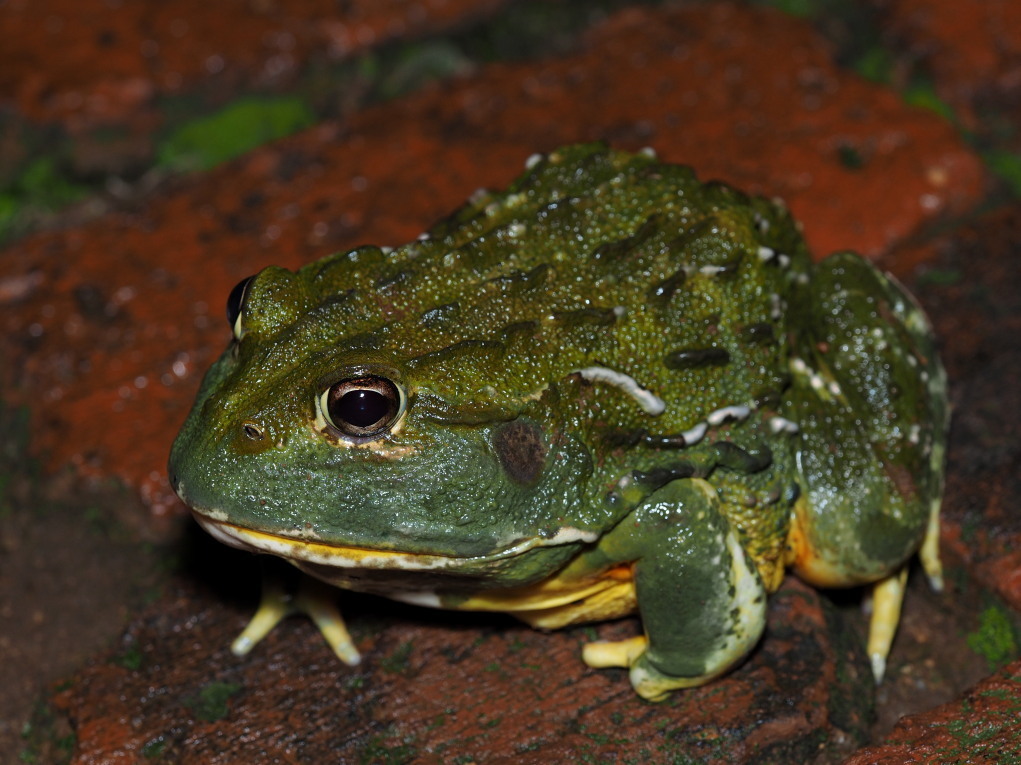
Giant African Bullfrog
Pyxicephalus adspersus
The African bullfrog (Pyxicephalus adspersus), also known as the giant bullfrog or the South African burrowing frog, is a species of frog in the family Pyxicephalidae. It is also known as the pixie frog due to its scientific name. It is found in Angola, Botswana, Kenya, Malawi, Mozambique, Namibia, South Africa, Tanzania, Uganda, Zambia, Zimbabwe, and possibly the Democratic Republic of the Congo. It has been extirpated from Eswatini. It has long been confused with the edible bullfrog (P. edulis), and species boundaries between them, including exact range limits, are not fully understood. Additionally, P. angusticeps of coastal East Africa only was revalidated as a separate species in 2013.
The natural habitat of the African bullfrog is moist to dry savanna, subtropical to tropical dry shrubland, intermittent freshwater lakes, intermittent freshwater marshes, arable land, pastureland, canals, and flooded ditches. It is among the largest anurans on the planet, sixth only to the goliath frog, the helmeted water toad, the Lake Junin frog, Blyth's river frog, and the cane toad.
From the article African bullfrog on Wikipedia (CC BY-SA), quoted section by section
Description
The males weigh up to 1.4 kg (3.1 lb) and grow to 24.5 cm (9.6 in) in snout–to–vent length. Females are half the size of males, which is unusual, considering that most female amphibians are (generally) larger than males, to help the amplexus. The dorsum is dark olive-green in adults. Juveniles have bright green coloration with a yellow stripe down the back. The abdomen is white to creamy-yellow with breeding males having yellow forelimbs.
Wikipedia: “Appearance”
What it does
The African bullfrog is a voracious carnivore, eating insects and other invertebrates, small rodents, reptiles, small birds, fish, and other amphibians that can fit in their mouths. It is also a cannibalistic species—the male African bullfrog is known for occasionally eating the tadpoles he guards, and juveniles also eat tadpoles. An African bullfrog kept at the Pretoria Zoo in South Africa once ate 17 juvenile Rinkhals snakes (Hemachatus haemachatus). When exposed to dry conditions, they become dormant and may form a cocoon which covers the entire body surface except the external nostrils. The cocoon significantly decreases the rate of evaporative water loss. When it rains, the water softens the cocoon and the frog crawls out.
Wikipedia: “Feeding and habits”
Listen
Looking for field recordings…
Where it lives
Recorded sightings
—
geo-referenced records in GBIF, from museums, herbaria and field observers.
Drag the globe to turn it. Dots are where records exist, not a range map; darker means more records.
In the stacks
Searching the stacks…
Every page naming Pyxicephalus adspersus in the Biodiversity Heritage Library →
This page is assembled live from iNaturalist, GBIF, Wikipedia, the Source Library and the Internet Archive. It is not yet part of the hand-edited codex. iNaturalist taxon 26196.