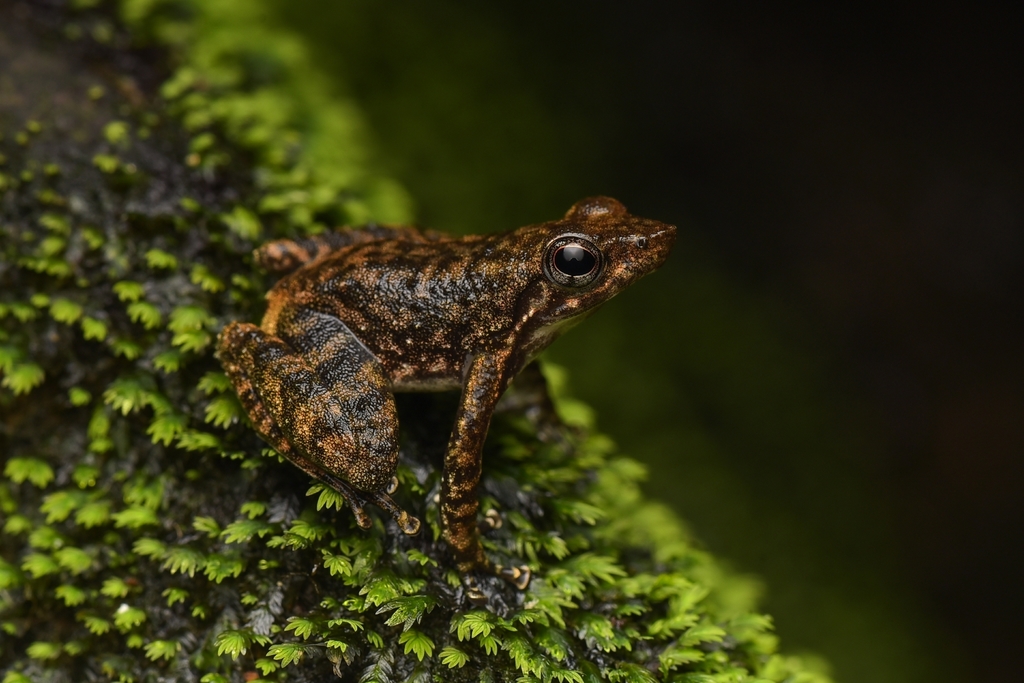
Malabar Tropical Frog
Micrixalus saxicola
Micrixalus saxicola (black torrent frog, Malabar tropical frog, Jerdon's olive-brown frog, or small torrent frog) is a species of frog in the family Micrixalidae, found in forest streams in the Western Ghats of India. This frog has a brown colored dorsum and a white ventral side with irregular white specks on its dark brown throat and chest. Its smooth skin and cryptic coloration allow it to blend into its surroundings while resting or calling. The males of the species are territorial, and will use calling, foot tapping, and foot flagging to warn off competition.M. saxicolais is described by the IUCN as a vulnerable species due to habitat loss, fragmentation, and human interference. The frog also threatened by infection by the fungus Batrachochytrium dendrobatidis.
From the article Micrixalus saxicola on Wikipedia (CC BY-SA), quoted section by section
Range & habitat
M. saxicola is endemic to the Western Ghats mountain range in India, specifically within the south Indian states of Kerala and Karnataka. Reports indicate this frog is typically found at altitudes between 11° and 14°N and at elevations between 400 and 1400 m above mean sea level. Populations of the species are found throughout the Western Ghats, but they are widely separated. The species inhabits moist semi-evergreen and moist deciduous forests, and can often be found on the rocks along streams and riverbanks in the hills. While M. saxicola is most commonly found near clear torrential streams. Leaf litter on the forest floor may also offer an important place of refuge for frogs during dry seasons. M. saxicola prefers areas with lower air, water, and soil temperatures. Such low air and water temperatures tend to be associated with thicker forest canopy cover as well, indicating this species prefers areas with low penetration of light onto the forest floor. A study conducted in 2001 also showed that M. saxicola tends to favor slightly acidic water and soil that also have high concentrations of dissolved oxygen and low concentrations of carbon dioxide. This species tends to co-occur with the amphibians Nyctibatrachus major, N. aliciae, Rana beddomi, and Rana temporalis.
Wikipedia: “Habitat and distribution”
What it does
M. saxicola is a diurnal species that can often be found attached to flat surfaces of rocks in fast-moving streams. They have also been observed to move away from the torrents during the height of the monsoon season to avoid being swept away by the current. Adults communicate with one another in large social groups.
Courtship. Males of this species occupy elevated rock perches – about 2 to 8 cm above the water level – near streams and waterfalls to attract females, which they do primarily by calling. This call has been described as sounding like "Chir… chir… chir… chir… ri… ri… ri… ri ri.." and can be heard by humans up to 10 to 14 m away. On average, males call at a rate of 13.25 calls per minute, with the highest calling rates being observed during the breeding season during the monsoon months between July and October. Males call for 3 to 8 minutes in one direction, then rotate 90 to 180 degrees and call in that direction continuously before repeating the process. Longer calls are thought to attract females while also demonstrating a male's ability and willingness to defend his territory. Females do not have any known vocalizations. M. saxicola's habitats are characterized by high amounts of ambient noise from both the environment and other males' calls, so the species has evolved multimodal stimuli to improve specific communication beyond just the auditory calls. …
Wikipedia: “Behavior”
Listen
Looking for field recordings…
Where it lives
Recorded sightings
—
geo-referenced records in GBIF, from museums, herbaria and field observers.
Drag the globe to turn it. Dots are where records exist, not a range map; darker means more records.
In the stacks
Searching the stacks…
Every page naming Micrixalus saxicola in the Biodiversity Heritage Library →
This page is assembled live from iNaturalist, GBIF, Wikipedia, the Source Library and the Internet Archive. It is not yet part of the hand-edited codex. iNaturalist taxon 26111.