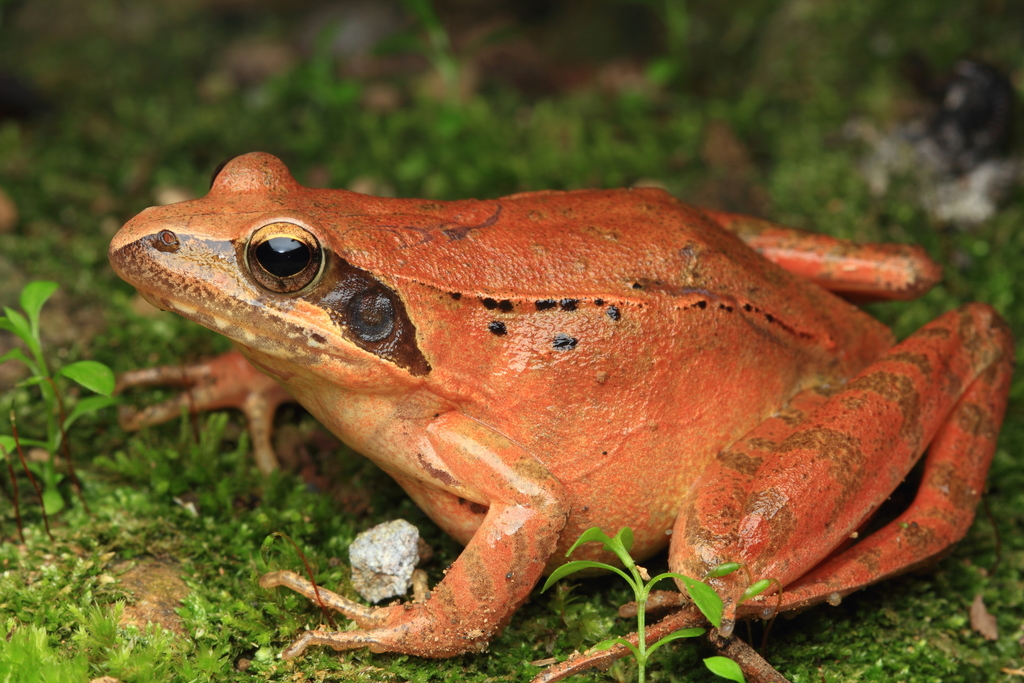
Taipa Frog
Rana longicrus
Rana longicrus, also known as the Taipa frog or long-legged brown frog, is a species of frog in the family Ranidae. It is distributed to northern and central Taiwan.
From the article Rana longicrus on Wikipedia (CC BY-SA), quoted section by section
Description
Rana longicrus is a slender-bodied frog with relatively long legs. Males measure 42–56 mm (1.7–2.2 in) and females 58–65 mm (2.3–2.6 in) in snout–vent length.
Range & habitat
Rana longicrus occurs in subtropical broad-leaf forests as well as cultivated fields below 1,000 m (3,300 ft) elevation. Breeding takes place in marshes, pools, and ponds. It is threatened by habitat loss, in particular due to infrastructure development, but also pollution. It is currently protected in the Yangmingshan National Park.
== References ==
Wikipedia: “Habitat and conservation”
What it does
The breeding season in Aoti, northern Taiwan, is from November to March. The smallest mature male measured 33 mm (1.3 in) SVL and smallest gravid female 32 mm (1.3 in) SVL. Both sexes appear to reach this size by the end of their first year. Peak breeding occurred in December but is probably influenced by rain. Egg clutches of 600–2,000 eggs are laid in water. Metamorphosis occurs after about two months. However, survival to metamorphosis is low because of disturbance by human activities (plowing of ricefields) and by the desiccation.
Wikipedia: “Reproduction”
Listen
Looking for field recordings…
Where it lives
Recorded sightings
—
geo-referenced records in GBIF, from museums, herbaria and field observers.
Drag the globe to turn it. Dots are where records exist, not a range map; darker means more records.
In the stacks
Searching the stacks…
Every page naming Rana longicrus in the Biodiversity Heritage Library →
This page is assembled live from iNaturalist, GBIF, Wikipedia, the Source Library and the Internet Archive. It is not yet part of the hand-edited codex. iNaturalist taxon 25661.