- Animals
- ›Cnidarians
- ›True Jellies
- ›Discomedusans
- ›Flag-mouth Jellies
- ›Ulmarid Jellies
- ›Deepstariinae
- ›Deepstaria
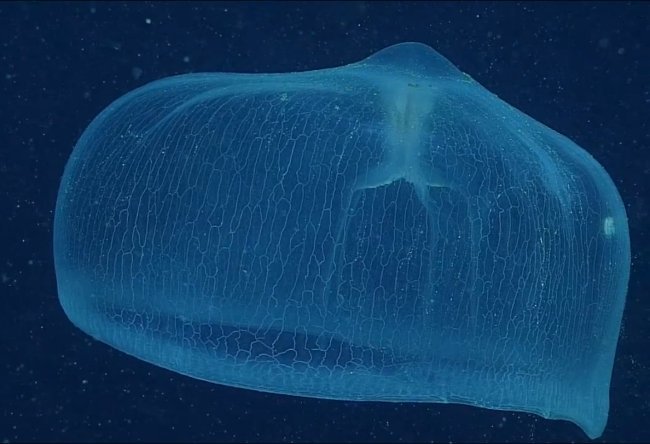
Deepstaria Jelly
Deepstaria enigmatica
Deepstaria enigmatica, is a jellyfish of the family Ulmaridae first described in 1967 by F.S. Russel. The bell of this jellyfish is very thin and wide (up to approx. 10 m), and resembles a translucent, undulating sheet or lava lamp as the animal moves. They are usually found in Antarctic and near-Antarctic seas but have been spotted in waters near the United Kingdom, at depths of 829 to 1830 meters.
From the article Deepstaria enigmatica on Wikipedia (CC BY-SA), quoted section by section
Description
The Deepstaria enigmatica has a wide, thin bell (up to 60 cm or 2 ft), transparent in appearance, which undulates as the jellyfish moves. They are usually found in Antarctic and near-Antarctic seas, but have been spotted in waters near the United Kingdom and Gulf of Mexico, at depths of 600–1,750 metres (1,970–5,740 ft). Unlike many other jellyfish, they lack tentacles. They also are solitary creatures, contrary to the group living style of many jellyfish. The large bell of the jellyfish has been proposed as used for either locomotion or feeding when closed. The Deepstaria also features a geometric mesh pattern throughout its bell; this mesh, being the gastrovascular system, delivers nutrients to the entire jelly as it stretches and contracts to move and capture prey.
What it does
Deepstaria open and close their bell, or stomach cavity, allowing them to both move and take in prey. This motion also allows isopods (a member of the crustacean family) to enter and live inside the jellyfish. Although the nature of this relationship is not fully understood, scientists currently believe that the isopod rides along and gains nutrients from the Deepstaria while being protected from predators. When the isopod and Deepstaria were seen together in a 1967 dive, scientists reported that the isopod was bright red, around 8 cm (3.1 in) in length, and appeared active, suggesting some form of beneficial symbiotic relationship. This dive and other findings were recorded in a 1969 article by E.G. Barham and G.V. Pickwell. Their paper identifies the isopod as member of the genus Anuropus. The authors also suggest the possibility of the symbiotic relationship being parasitic.
Wikipedia: “Symbiotic relationship with isopods”
Where it lives
Recorded sightings
—
geo-referenced records in GBIF, from museums, herbaria and field observers.
Drag the globe to turn it. Dots are where records exist, not a range map; darker means more records.
In the stacks
Searching the stacks…
Every page naming Deepstaria enigmatica in the Biodiversity Heritage Library →
This page is assembled live from iNaturalist, GBIF, Wikipedia, the Source Library and the Internet Archive. It is not yet part of the hand-edited codex. iNaturalist taxon 255964.