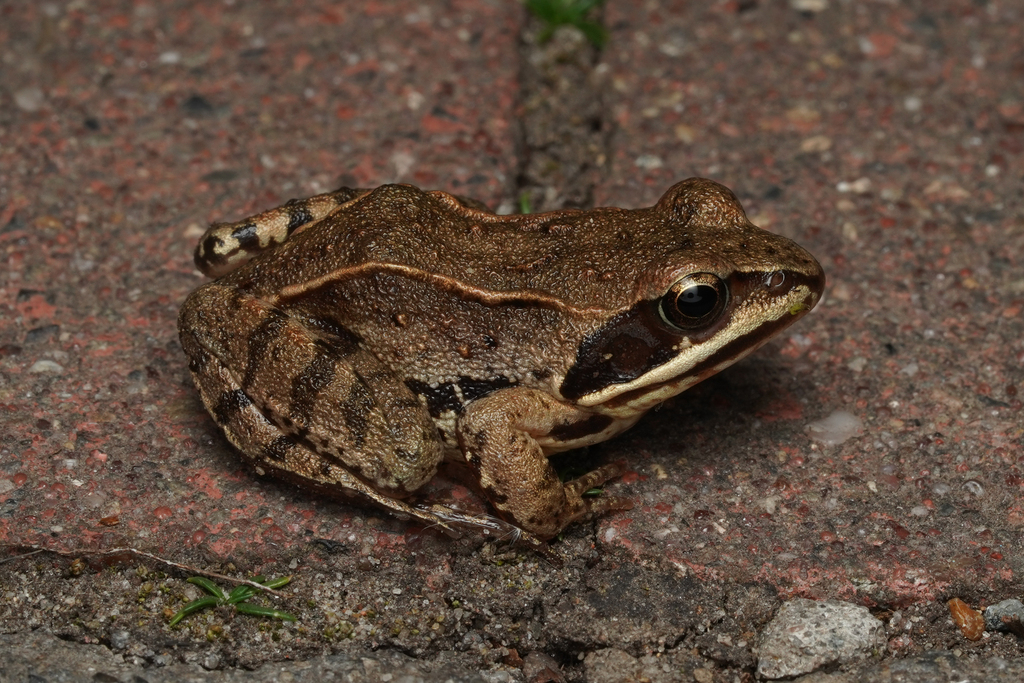
Moor Frog
Rana arvalis
The moor frog (Rana arvalis) is a slim, reddish-brown, semiaquatic amphibian native to Europe and Asia. Moor frogs are known for their ability to freeze solid and survive thawing. The frog makes use of various cryoprotectants i.e. antifreeze that decrease its internal freezing temperature. The species is distributed over a large range, covering a significant portion of Eurasia. Male moor frogs are known to turn blue temporarily during the height of mating season. This coloration is assumed to signal a mate's fitness. Moor frogs typically mate through multimale amplexus, a form of polyandry.
The moor frog spawns its eggs in large batches in still bodies of acidic waters. Human-caused pollution is causing excessive acidification of habitat which harms egg health. The moor frog's habitat is also under destruction due to a variety of other anthropogenic means. The species has an IUCN listing of Least Concern. However, a majority of European states independently consider the conservation status of the moor frog to be unfavorable. The moor frog, like other members of Rana, is omnivorous and will consume anything that it can physically ingest.
From the article Moor frog on Wikipedia (CC BY-SA), quoted section by section
Description
The moor frog is a medium to large bog frog, characterized by a mixture of brown (back) and white (front) coloration, with small dark spots on the throat. The species is reddish-brown, but can also be yellow, grey, or light-olive. Common traits include white or yellow pigmentation on its underside and black stripes from its nostrils along the sides of its head. The Moor frog ranges from 5.5 to 6.0 cm (2.2 to 2.4 in) long, but can reach up to 7.0 cm (2.8 in) in length. Their heads are more tapered than those of the common frog (Rana temporaria), but the most reliable way to tell the species apart is by looking at their metatarsal tubercle, a small spur on the hind feet next to the innermost toe: in common frog it is soft and small, less than a third of the length of the innermost toe, while in moor frog it is hard and approximately half the length of the innermost toe. Common frog and moor frog also have different calls, and for a short period during the breeding season moor frog males may become blue in color, while common frog males at most get a faint blueish tint. The skin on their flanks and thighs is smooth, and their tongue is forked and free. Pupils are horizontally oriented, feet are partially webbed, and back legs are shorter than those in the same family of frogs. Males, unlike females, have nuptial pads on their first fingers and paired guttural vocal sacs.
Range & habitat
The moor frog can be found over a vast majority of mainland, central Eurasia; its longitudinal range extends from northeastern France and northern Belgium all the way east to the Lena River in Siberia, in and around the city of Novosibirsk. Their latitudinal distribution extends from the 69th parallel in Finland south through the Pannonian Basin and the inland Balkans in Central Europe. The moor frog can be found surviving at varied levels of altitudes; in the western, more European areas of its range, the frog can be found as high as 900 metres (3,000 ft) above sea level. Further east in its range, such as in the Altai Mountains, the moor frog is found as high up as 2 kilometres (6,600 ft) above sea level. Within the higher-elevation ranges, the species is often found near bodies of still (or very slow-moving) water, with adequate riparian or littoral vegetation surrounding it. These water sources are often rich in decomposing organic material, resulting in a considerably acidic pH level, often at, or below, a 6. The diversity of habitats demonstrates the frog's plasticity. Moor frogs can live in near-tundra conditions, taiga, conifer forest, forest steppe, dry steppe, open forest, glades, chaparral-like (arid) areas, swamp, meadows, fields, bushland, and private farms or water gardens (though they tend to prefer areas away from humans and predators). …
Wikipedia: “Distribution and habitat”
What it does
An adult moor frog's diet consists of any mobile and terrestrial animals that they can physically ingest. Moor frogs most commonly consume beetles; however, other insects from the orders hemiptera (true bugs), hymenoptera, and diptera (flies) are consumed as well. Moor frogs also consume non-insect invertebrates from the orders gastropoda (snails and slugs), arachnida, and myriapoda (centipedes and millipedes). Beetles make up the majority of the moor frog's diet due to their abundance. Large moor frogs do appear to have a preference for beetles because they are larger than most other insect prey. Large moor frogs tend to consume large prey and small moor frogs consume small prey. This behavior is assumed to have evolved to reduce competition between moor frogs or to maximize net energy gained from feeding, as large moor frogs consuming both large and small prey would leave little food for smaller moor frogs. Aside from size preferences, individual moor frogs do not appear to prefer more energetically favorable prey over less energetically favorable prey of equal size. The moor frog will ingest any animal that it is able to swallow. Moor frogs are opportunistic predators that wait for prey to appear before consuming them, as opposed to intentional predators that actively hunt for prey. …
Wikipedia: “Diet”
Listen
Looking for field recordings…
Where it lives
Recorded sightings
—
geo-referenced records in GBIF, from museums, herbaria and field observers.
Drag the globe to turn it. Dots are where records exist, not a range map; darker means more records.
In the stacks
Searching the stacks…
Every page naming Rana arvalis in the Biodiversity Heritage Library →
This page is assembled live from iNaturalist, GBIF, Wikipedia, the Source Library and the Internet Archive. It is not yet part of the hand-edited codex. iNaturalist taxon 25488.