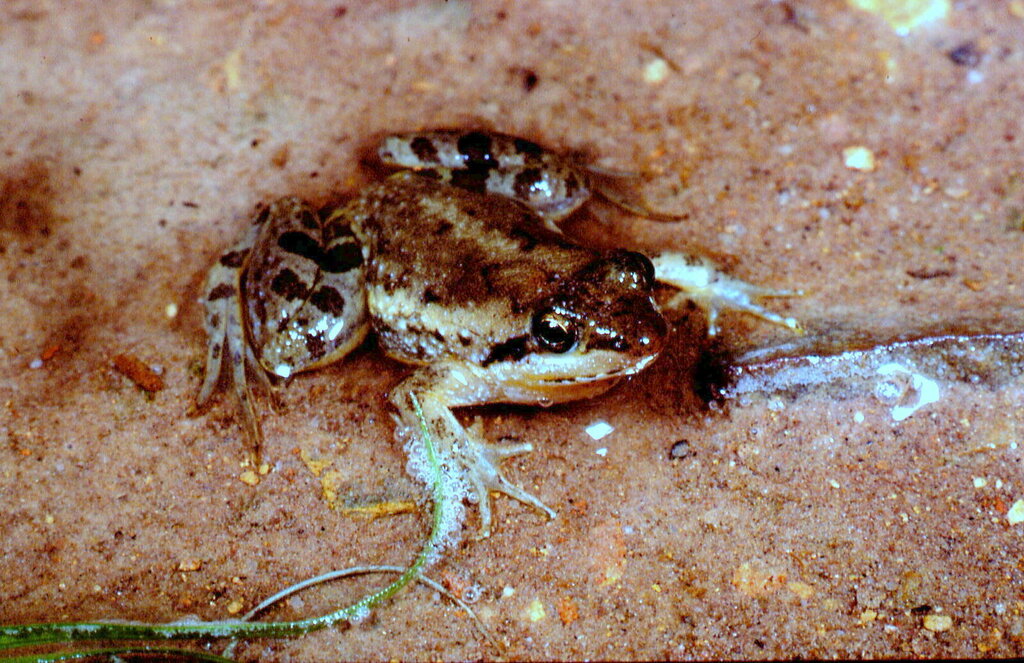
Phrynobatrachus perpalmatus
Phrynobatrachus perpalmatus is a species of frog in the Petropedetidae family. It is found in Democratic Republic of the Congo, Malawi, Mozambique, Sudan, Tanzania, Zambia, possibly Burundi, and possibly Zimbabwe. Its natural habitats are subtropical or tropical moist lowland forests, dry savanna, moist savanna, subtropical or tropical moist shrubland, subtropical or tropical seasonally wet or flooded lowland grassland, swamps, freshwater marshes, intermittent freshwater marshes, arable land, pastureland, plantations, rural gardens, heavily degraded former forest, ponds, seasonally...
From the article Phrynobatrachus perpalmatus on Wikipedia (CC BY-SA), quoted section by section
Description
Males grow to 25 mm (1.0 in) and females to 30 mm (1.2 in) in snout–vent length. The body is elongated but short. The snout is rounded. The finger tips are not dilated whereas the toe tips bear small discs; the toes are fully or almost fully webbed. The dorsum is brown and may have a light vertebral stripe. Black, pale-edged bands run from behind the eyes to the groin. Males have a subgular vocal sac that is unpigmented or has black speckling. The male advertisement call is metallic clicking or a very coarse croak.
Range & habitat
Phrynobatrachus perpalmatus occurs in permanently wet habitats in humid savanna, grassland, and rainforest as well as degraded former forest at elevations less than 800 m (2,600 ft) above sea level. It has particular affinity to flooded grassland interspersed with reeds, its presumed breeding habitat. Phrynobatrachus perpalmatus can be locally very abundant, but its distribution tends to be patchy. Believed to be able to survive in wet areas in agricultural land (including rice paddies), it is probably adaptable and not facing other than localized threats. It is present in a number of protected areas.
Wikipedia: “Habitat and conservation”
Listen
Looking for field recordings…
Where it lives
Recorded sightings
—
geo-referenced records in GBIF, from museums, herbaria and field observers.
Drag the globe to turn it. Dots are where records exist, not a range map; darker means more records.
In the stacks
Searching the stacks…
Every page naming Phrynobatrachus perpalmatus in the Biodiversity Heritage Library →
This page is assembled live from iNaturalist, GBIF, Wikipedia, the Source Library and the Internet Archive. It is not yet part of the hand-edited codex. iNaturalist taxon 25400.