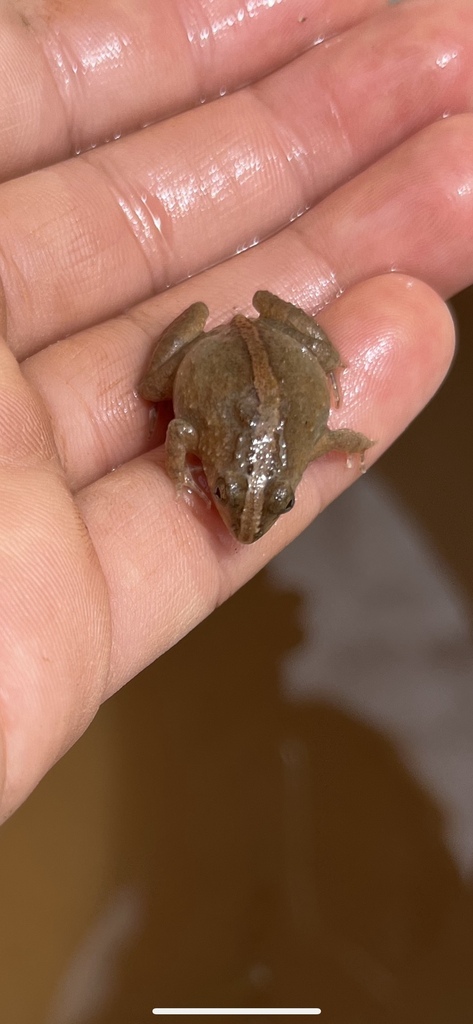
Phrynobatrachus graueri
Phrynobatrachus graueri is a species of frog in the Petropedetidae family. It is found in Democratic Republic of the Congo, Kenya, Rwanda, and Uganda. Its natural habitats are subtropical or tropical moist lowland forests, subtropical or tropical moist montane forests, shrub-dominated wetlands, swamps, and freshwater marshes. It is threatened by habitat loss.
From the article Phrynobatrachus graueri on Wikipedia (CC BY-SA), quoted section by section
Description
Adult males can grow to 23 mm (0.9 in) and adult females 28 mm (1.1 in) in snout–vent length. The snout is short. The tympanum is distinct and about one-half of the eye width. The fingers and toes have distinct discs. The toes are slightly webbed. The dorsum is dark olive. A darker band runs from the nostril to the forearm. There might be a narrow or wide vertebral stripe. A pair of light lines are flanking the vent. Males have black throat. The base of the hind limb is often yellow.
Range & habitat
Phrynobatrachus graueri occurs in montane forest interior and edges at elevations greater than 1,000 m (3,300 ft), often in association with swampy forest. The eggs are deposited in water, generally in swampy situations. Where present, it is a common species. It is probably affected by habitat loss caused by agriculture, livestock, wood extraction, and human settlements. It is present in the Kibale and Bwindi National Parks in Uganda and Kakamega National Reserve in Kenya.
== References ==
Wikipedia: “Habitat and conservation”
Listen
Looking for field recordings…
Where it lives
Recorded sightings
—
geo-referenced records in GBIF, from museums, herbaria and field observers.
Drag the globe to turn it. Dots are where records exist, not a range map; darker means more records.
In the stacks
Searching the stacks…
Every page naming Phrynobatrachus graueri in the Biodiversity Heritage Library →
This page is assembled live from iNaturalist, GBIF, Wikipedia, the Source Library and the Internet Archive. It is not yet part of the hand-edited codex. iNaturalist taxon 25371.