- Animals
- ›Molluscs
- ›Bivalves
- ›Autobranchia
- ›Heteroconchia
- ›Euheterodonta
- ›Imparidentia
- ›True Cockles, Tellins, and Allies
- ›Tellins, Sunset Clams, and Allies
- ›Furrow-shells
- ›Abra
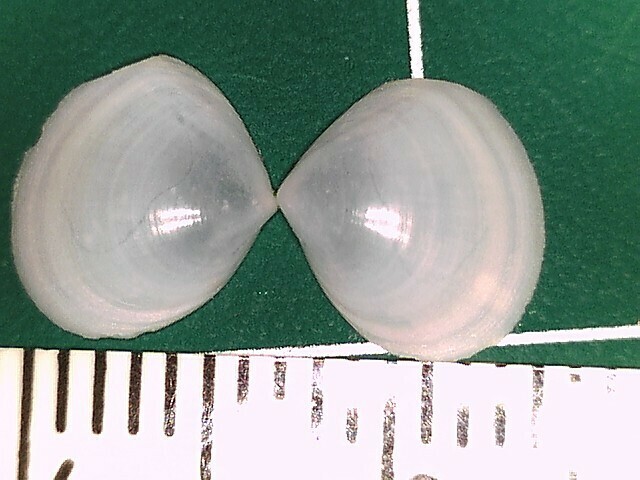
Common Atlantic Abra
Abra aequalis
Abra aequalis, also known as the atlantic abra, is a species of marine bivalve found in the west Atlantic Ocean.
From the article Abra aequalis on Wikipedia (CC BY-SA), quoted section by section
Description
Abra aequalis is a small species with plain, white, mostly smooth shells which are slightly round, but triangular in outline. Due to their small size (about 7 millimetres [0.28 in]), A. aequalis is one of several unremarkable, similar-looking species fondly called "little white clams" by amateur shell collectors. The shells are quite thin and fragile, and Robert Parr Whitfield summarized their appearance thus: "it is a very neat and pretty shell, and moderately abundant".
Range & habitat
Abra aequalis is found along the southeastern coast of the United States, the Gulf of Mexico, the Caribbean Sea, and the coast of southeastern Brazil. The Global Biodiversity Information Facility records observations from as far north as Long Island. It is abundant along the American coast, around Florida, and is also found around Mexico and the Caribbean Islands. In South America, it is found on the coasts of Venezuela, Suriname, and Panama, as well as on the Brazilian coast from São Paulo to Pelotas. A. aequalis is usually found in shallow waters of depth less than 73 metres (240 ft). It has also been observed on seamounts and underwater knolls. A 1973 study off Sapelo Island, United States, found that A. aequalis became the dominant species in spring. A. aequalis is the most significant food source for Luidia senegalensis in Florida.
Wikipedia: “Distribution, habitat, and ecology”
Where it lives
Recorded sightings
—
geo-referenced records in GBIF, from museums, herbaria and field observers.
Drag the globe to turn it. Dots are where records exist, not a range map; darker means more records.
In the stacks
Searching the stacks…
Every page naming Abra aequalis in the Biodiversity Heritage Library →
This page is assembled live from iNaturalist, GBIF, Wikipedia, the Source Library and the Internet Archive. It is not yet part of the hand-edited codex. iNaturalist taxon 253575.