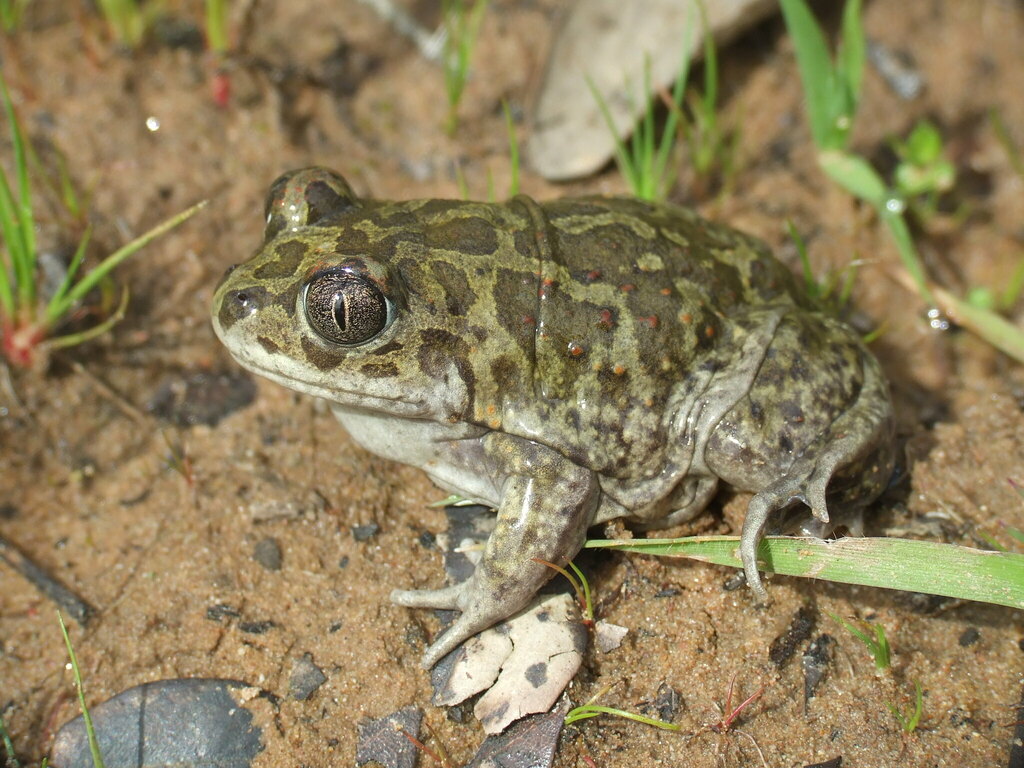
Moroccan Spadefoot
Pelobates varaldii
Pelobates varaldii, the Moroccan spadefoot toad, Moroccan spadefoot, or Varaldi's spadefoot toad, is a species of frog in the family Pelobatidae. As currently known, it is endemic to the coastal north-western Morocco, although there is an unconfirmed record from the Spanish territory of Melilla that could possibly represent this species. The specific name varaldii honours Marcel Varaldi who collected amphibians and reptiles in Morocco.
From the article Pelobates varaldii on Wikipedia (CC BY-SA), quoted section by section
Description
Males grow to 65 mm (2.6 in) and females to 70 mm (2.8 in) in snout–vent length. The overall appearance is stocky. The snout is sharp. The tympanum is present but inconspicuous. No parotoid glands are present. The dorsum is finely glandular and smooth; colouration is grey-brown with irregular darker markings. There can be red speckles above the eyes. The ventral side of the body is white. The hind feet have enlarged metatarsal tubercles (used in digging) and webbed toes. The male advertisement call is aloud, harsh clucking. The tadpoles can reach 130 mm (5.1 in) in length.
Range & habitat
Pelobates varaldii occurs in lowland sandy uncultivated soils, sometimes in the vicinity of cork woodlands, at elevations below 350 m (1,150 ft). It is generally fossorial. Spawning typically takes place in temporary bodies of standing water (e.g., dayas and rain puddles). The tadpoles are aquatic and feed on plankton and detritus. This species does not occur in modified habitats. It is threatened by habitat loss and degradation caused by the conversion of land to livestock pasture as well as the pollution of ponds with livestock droppings. Also the introduced Gambusia holbrooki is a threat. This species might be present in the Merja Zerga Biological Reserve.
Wikipedia: “Habitat and conservation”
Listen
Looking for field recordings…
Where it lives
Recorded sightings
—
geo-referenced records in GBIF, from museums, herbaria and field observers.
Drag the globe to turn it. Dots are where records exist, not a range map; darker means more records.
In the stacks
Searching the stacks…
Every page naming Pelobates varaldii in the Biodiversity Heritage Library →
This page is assembled live from iNaturalist, GBIF, Wikipedia, the Source Library and the Internet Archive. It is not yet part of the hand-edited codex. iNaturalist taxon 25310.