- Animals
- ›Chordates
- ›Vertebrates
- ›Amphibians
- ›Frogs and Toads
- ›Narrow-mouthed Frogs
- ›American Narrow-mouthed and Sheep Frogs
- ›Stereocyclops
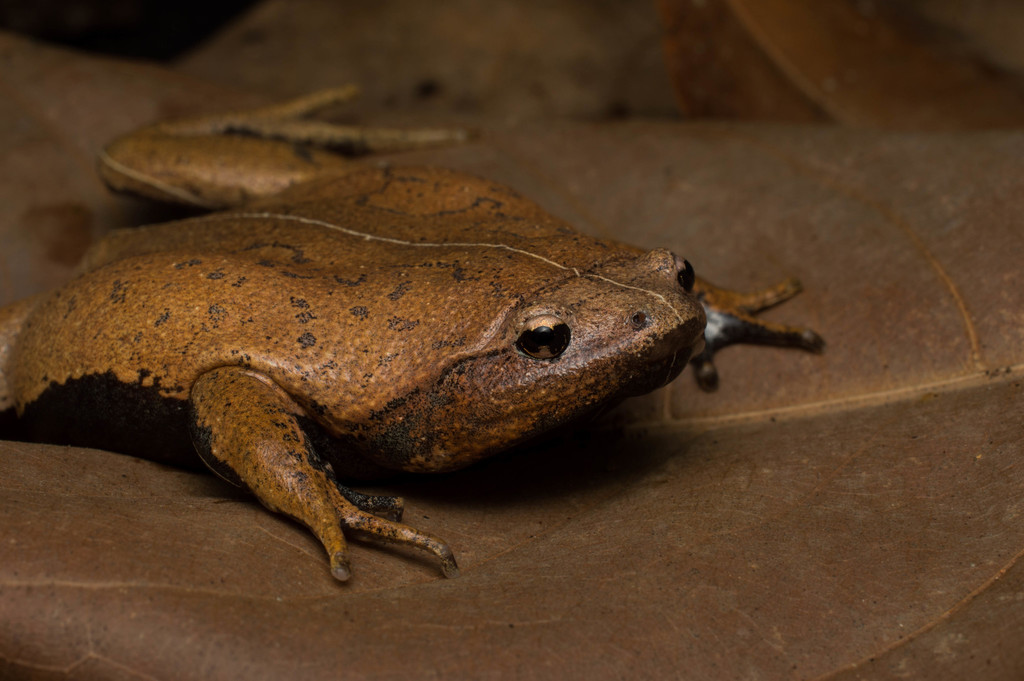
Brazilian Dumpy Frog
Stereocyclops incrassatus
Stereocyclops incrassatus is a species of frog in the family Microhylidae. It is endemic to eastern Brazil and is known from Pernambuco and Alagoas in the north and then southward through Bahia to Minas Gerais and Espírito Santo. Earlier records from São Paulo state are now recognized as Stereocyclops parkeri. Common name Brazilian dumpy frog has been coined for this species.
From the article Stereocyclops incrassatus on Wikipedia (CC BY-SA), quoted section by section
Description
The holotype, an adult male, measures 41 mm (1.6 in) in snout–vent length (SVL). In a population in Linhares observed at the time of breeding, adult males measured 37–46 mm (1.5–1.8 in) and females 38–45 mm (1.5–1.8 in) in SVL. The body is very stout. The snout is short, rounded in dorsal view but more acute in profile. The eyes are small and the tympanum is indistinct. The fingers are fairly long and have no webbing. The toes are long and have basal webbing. Skin is smooth except for a few granules on the sides.
Range & habitat
Its natural habitats are primary and secondary forests at elevations below 550 m (1,800 ft). It is a nocturnal species living in leaf litter. They prey on a range of small invertebrates. The dominant prey items in Linhares were ants, followed by beetles and isopods. Breeding seems to be explosive. Breeding takes place in small, temporary ponds inside the forest; the species is not found in open habitat outside forest. Stereocyclops incrassatus can be very common at breeding sites. Habitat loss is the major threat to this species. It occurs in several protected areas, e.g., Rio Doce State Park.
== References ==
Wikipedia: “Habitat and conservation”
Listen
Looking for field recordings…
Where it lives
Recorded sightings
—
geo-referenced records in GBIF, from museums, herbaria and field observers.
Drag the globe to turn it. Dots are where records exist, not a range map; darker means more records.
In the stacks
Searching the stacks…
Every page naming Stereocyclops incrassatus in the Biodiversity Heritage Library →
This page is assembled live from iNaturalist, GBIF, Wikipedia, the Source Library and the Internet Archive. It is not yet part of the hand-edited codex. iNaturalist taxon 24905.