- Animals
- ›Chordates
- ›Vertebrates
- ›Amphibians
- ›Frogs and Toads
- ›Narrow-mouthed Frogs
- ›Asterophryinae
- ›Cophixalus
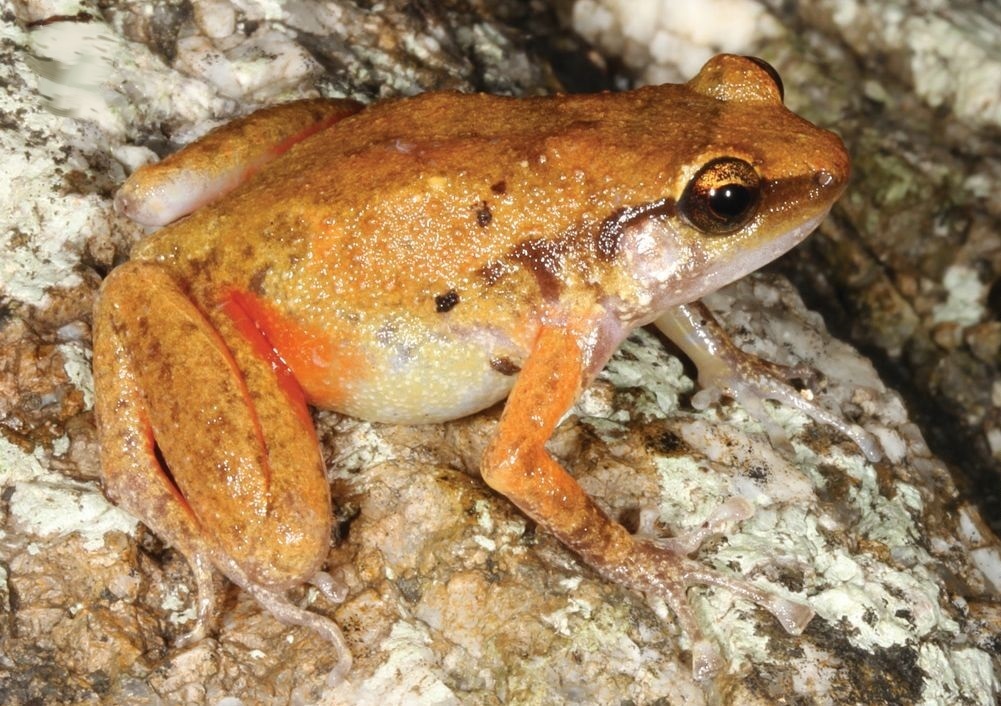
Cape Melville Boulder Frog
Cophixalus zweifeli
Cophixalus zweifeli is a species of frog in the family Microhylidae. It is endemic to northern Queensland, Australia, and only known from the area of its type locality in the Cape Melville National Park. The species was named to honour American herpetologist Richard G. Zweifel. Common name Zweifel's frog has been coined for it. It is one of the five northeast Australian Cophixalus species that are specialized in boulder field habitats.
From the article Cophixalus zweifeli on Wikipedia (CC BY-SA), quoted section by section
Description
Adult males measure 36–38 mm (1.4–1.5 in) and adult females 40–49 mm (1.6–1.9 in) in snout–vent length. The snout is elongated, truncated in dorsal view and straight, slightly projecting laterally. The tympanum is large but obscured dorsally. Fingers II–IV have greatly enlarged, truncated discs. The toe discs are also enlarged but smaller than those of the fingers. The dorsum is tan with some darker brown spots. A dark canthal stripe runs from the tip of the snout to slightly beyond the tympanum. The male advertisement call is a single high-pitched "yelp" composed of hundreds of fine pulses.
Range & habitat
Cophixalus zweifeli live in boulder fields amongst and adjacent to rainforest. They are nocturnal. Males call from boulders on the ground. The types were found in a boulder field near a creek, at the base of rocks and on a rock in a creek at 40–80 m (130–260 ft) above sea level. Cophixalus zweifeli is sympatric with Cophixalus petrophilus, but the latter is restricted to boulder fields largely devoid of vegetation, whereas the former is associated with boulders under or near rainforest. In the past, logging was a threat to this species. At present, a more likely threat is habitat degradation caused by increased visitation to the Cape Melville National Park.
== References ==
Wikipedia: “Habitat and conservation”
Listen
Looking for field recordings…
Where it lives
Recorded sightings
—
geo-referenced records in GBIF, from museums, herbaria and field observers.
Drag the globe to turn it. Dots are where records exist, not a range map; darker means more records.
In the stacks
Searching the stacks…
Every page naming Cophixalus zweifeli in the Biodiversity Heritage Library →
This page is assembled live from iNaturalist, GBIF, Wikipedia, the Source Library and the Internet Archive. It is not yet part of the hand-edited codex. iNaturalist taxon 24780.