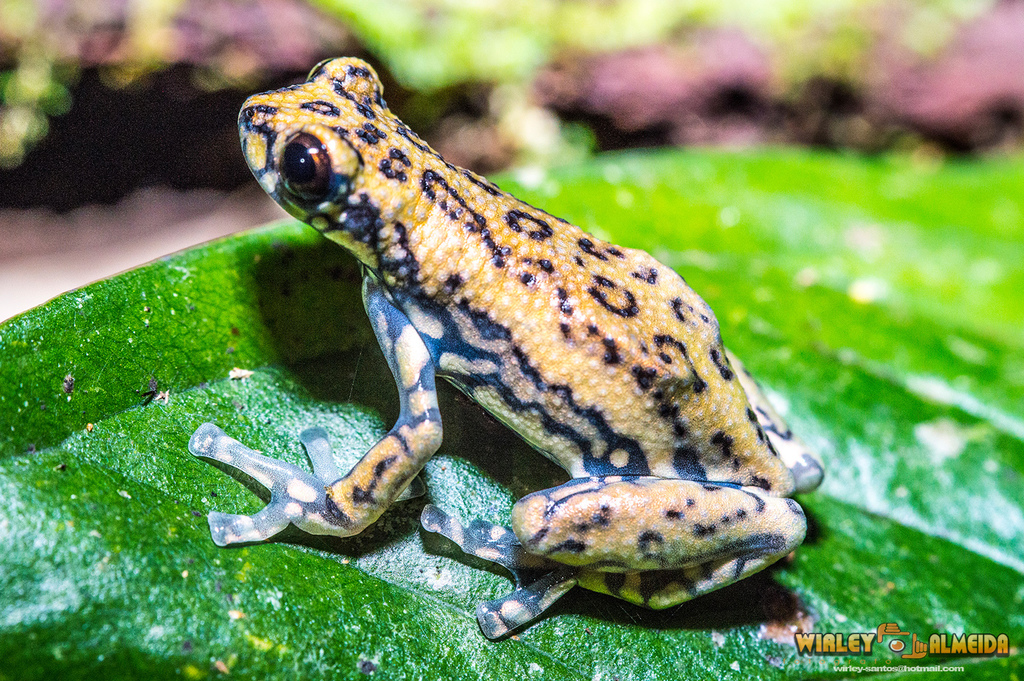
Tukeit Hill Frog
Allophryne ruthveni
The Tukeit Hill frogs are three species of frog in the genus Allophryne. Originally erected for the species Allophryne ruthveni, the genus was placed as the only member of the subfamily Allophryninae, which was in turn placed in the family Centrolenidae, but they are now considered as the only genus in the monotypic family Allophrynidae.
These frogs live in Guyana, Venezuela, Suriname, Brazil and Bolivia. The holotype was discovered at Tukeit Hill, below Kaieteur Falls, Guyana, hence the common English name.
From the article Tukeit Hill frog on Wikipedia (CC BY-SA), quoted section by section
Description
The Tukeit Hill frog is a small frog of variable colouration, either black, with stripes and spots which can be golden or dull yellow, or a dull yellow or golden ventral surface, with black strips and spots. It has a flat body, and small, flat head. It has a single, submandibular vocal sac. The toe pads are enlarged, wider than the fingers, and the tympanum is visible. The Tukeit Hill frog is superficially similar to the tree frogs, but the ends of their phalanges differ in shape.
What it does
The Tukeit Hill frog is semiarboreal, spending some times low in the trees, 1–3 m high, and some of the time on the ground. They are explosive breeders, taking advantage of small water ponds formed on the forest floor after periods of rain. This frog inhabits sparse forest, and may be restricted to forested areas, avoiding cleared land.
Wikipedia: “Behaviour”
Listen
Looking for field recordings…
Where it lives
Recorded sightings
—
geo-referenced records in GBIF, from museums, herbaria and field observers.
Drag the globe to turn it. Dots are where records exist, not a range map; darker means more records.
In the stacks
Searching the stacks…
Every page naming Allophryne ruthveni in the Biodiversity Heritage Library →
This page is assembled live from iNaturalist, GBIF, Wikipedia, the Source Library and the Internet Archive. It is not yet part of the hand-edited codex. iNaturalist taxon 24600.