- Plants
- ›Vascular Plants
- ›flowering plants
- ›Dicots
- ›Buttercups, Poppies, and Allies
- ›buttercup family
- ›Anemones, buttercups, larkspurs and allies
- ›anemones and allies
- ›Anemone
- ›Anemone
- ›Anemone
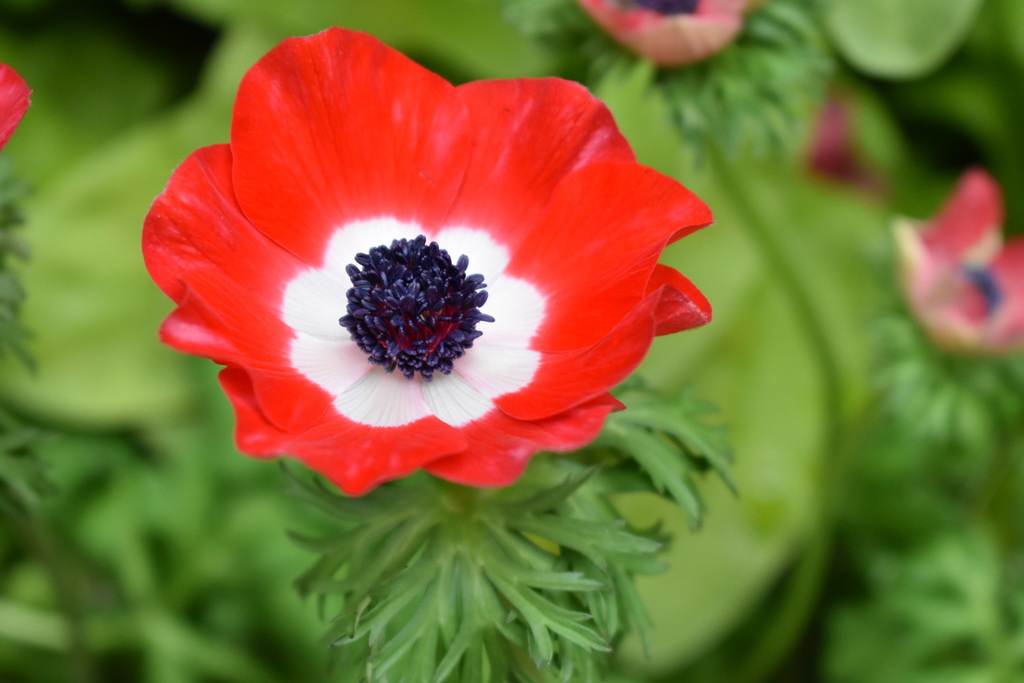
poppy anemone
Anemone coronaria
Anemone coronaria, the poppy anemone, or garden anemone, is a species of flowering plant in the buttercup family Ranunculaceae, native to the Mediterranean region.
From the article Anemone coronaria on Wikipedia (CC BY-SA), quoted section by section
Description
Anemone coronaria is a herbaceous perennial tuberous plant growing to 20–40 cm (7.9–15.7 in) tall, rarely to 60 cm (24 in), spreading to 15–23 cm (5.9–9.1 in), with a basal rosette of a few leaves, the leaves with three leaflets, each leaflet deeply lobed. The flowers which bloom from April to June are borne singly on a tall stem with a whorl of small leaves just below the flower; the flower is 3–8 cm in diameter, with 5–8 red (but may be white or blue) showy petal-like tepals and a black centre. The pollen is dry, has an unsculpted exine, is less than 40µm in diameter, and is usually deposited within 1.5 m of its source. This central mound consists of tightly packed pistils in the centre, with a crown-like ring of stamens surrounding this, giving the species its specific epithet coronaria. The flowers produce 200–300 seeds. The plants form hard black tubers as storage organs. Aside from its flowers resembling poppies, the red single wild form flowers resemble the flowers of the red single wild form of Ranunculus asiaticus. Although widely called the 'poppy anemone' and sometimes rendered simply 'poppy' in English translations of Arabic sources, A. coronaria is an anemone (Ranunculaceae), not a poppy (Papaveraceae); the corn poppy it resembles is Papaver rhoeas, called khashkhash in Arabic.
Range & habitat
Mediterranean littoral, from Greece, Albania, southern Turkey, Syria, Iraq, Northern Arabia to the Sinai Peninsula with sporadic extension east to Iran and west along the Mediterranean shores of Italy, southern France and North Africa. Although they have been nurtured for two millennia, including early mention of cultivation by Pliny the Elder in ancient Rome, they still exist as well as wild flowers, particularly in Israel, southern Turkey, Syria, and Greece.
Wikipedia: “Distribution and habitat”
What it does
The flowers bloom in winter to early spring in the plant's native Mediterranean range (later, in spring, where grown in cooler climates). It is cross pollinated by bees, flies and beetles, which can carry pollen over long distances. Certain colours of A. coronaria attract one insect over another; both honey bees and mining bees are attracted to both white and purplish blue, while flies prefer only white. Scarab beetles show an overwhelming preference for red A. coronaria, which is also pollinated by other insects, such as honeybees. Anemone coronaria was introduced into England prior to 1596, being described in John Gerard's Herball, first published in 1597 and was popular during the time of Queen Elizabeth I; Thomas Johnson's enlarged and corrected edition appeared in 1633. By the beginning of the eighteenth century, breeders in France and Italy had already considerably improved the range of colours available. Anemone coronaria is widely grown for its decorative flowers, and has a hardiness of USDA zones 7–10, preferring full sun to part shade. Although perennial in its native climate, A. coronaria is usually grown as an annual in cooler climates, from tubers. Planting is usually in the autumn if kept in pots in a greenhouse through the winter or in the ground in spring once the risk of frost has passed.
Cultivars. …
Wikipedia: “Ecology”
In human culture
Anemone coronaria means crown anemone, referring to the central crown of the flower. The genus name Anemone and the English "windflower" are conventionally derived from the Greek ánemos ("wind"), the etymology reflected in the common name for some species in the genus. The binomial was established by Linnaeus in Species Plantarum (1753), making it the most recent of the plant's names. In Hebrew, the anemone is kalanit metzuya. "Kalanit" comes from the Hebrew word kala (כלה) which means "bride", "metzuya" means "common". The kalanit earned its name because of its beauty and majesty, evoking a bride on her wedding day. In Israel, after the rainfall, the Negev Desert is blanketed in red due to the plethora of Anemone coronaria, while wild flowers in the northern part of the country, such as the Galilee, sport a variety of other colours. One proposed source of the name traces back to the Mesopotamian shepherd-god, Tammuz, (Sumerian Dumuzid), a deity of fertility and vegetation, whose Phoenician epithet was "Nea'man". Tammuz is generally considered to have been drawn into the Greek pantheon as Adonis, who died of his wounds while hunting wild boar. The deity is transformed into a flower, stained by the blood of Adonis. …
Wikipedia: “Etymology”
Where it lives
Recorded sightings
—
geo-referenced records in GBIF, from museums, herbaria and field observers.
Drag the globe to turn it. Dots are where records exist, not a range map; darker means more records.
In the stacks
Searching the stacks…
Every page naming Anemone coronaria in the Biodiversity Heritage Library →
This page is assembled live from iNaturalist, GBIF, Wikipedia, the Source Library and the Internet Archive. It is not yet part of the hand-edited codex. iNaturalist taxon 244745.