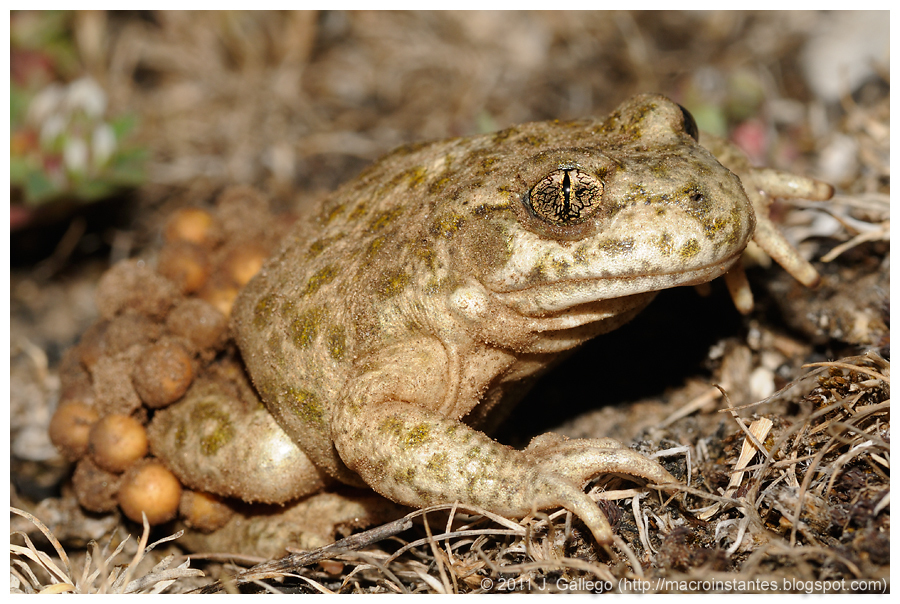
Betic Midwife Toad
Alytes dickhilleni
The Betic midwife toad or Sapo Partero Bético (Alytes dickhilleni) is a species of frog in the Alytidae family (formerly Discoglossidae). It is endemic to mountainous in south eastern Spain. Its natural habitats are temperate forests, freshwater marshes, intermittent freshwater marshes, pastureland, ponds, and aquaculture ponds. It is threatened by habitat loss.
From the article Betic midwife toad on Wikipedia (CC BY-SA), quoted section by section
Description
The Betic midwife toad is grey, finely mottled with dark and pale specks. Its length may be about 3.5 centimetres (1.4 in) and it has bulging eyes with vertical slit pupils. There is a distinctive grey area between the eyes and the parotoid glands are relatively small. There is a lateral line of whitish glandular tubercles on the body but an absence of the orange glandular spots found in other members of the genus.
Range & habitat
The Betic midwife toad is native to the Sierra Nevada Mountains in south eastern Spain. The population is fragmented as different mountains support separate populations. It is fairly common on Alcaraz, Segura and Cazorla mountains but less common on the drier Filabres, Baza and Gádor peaks. It is generally found in oak and pine forests and in open rocky areas, mostly on limestone, at elevations between 700 and 2,000 metres (2,300 and 6,600 ft). In drier parts it tends to be near springs.
Wikipedia: “Distribution and habitat”
Listen
Looking for field recordings…
Where it lives
Recorded sightings
—
geo-referenced records in GBIF, from museums, herbaria and field observers.
Drag the globe to turn it. Dots are where records exist, not a range map; darker means more records.
In the stacks
Searching the stacks…
Every page naming Alytes dickhilleni in the Biodiversity Heritage Library →
This page is assembled live from iNaturalist, GBIF, Wikipedia, the Source Library and the Internet Archive. It is not yet part of the hand-edited codex. iNaturalist taxon 24474.