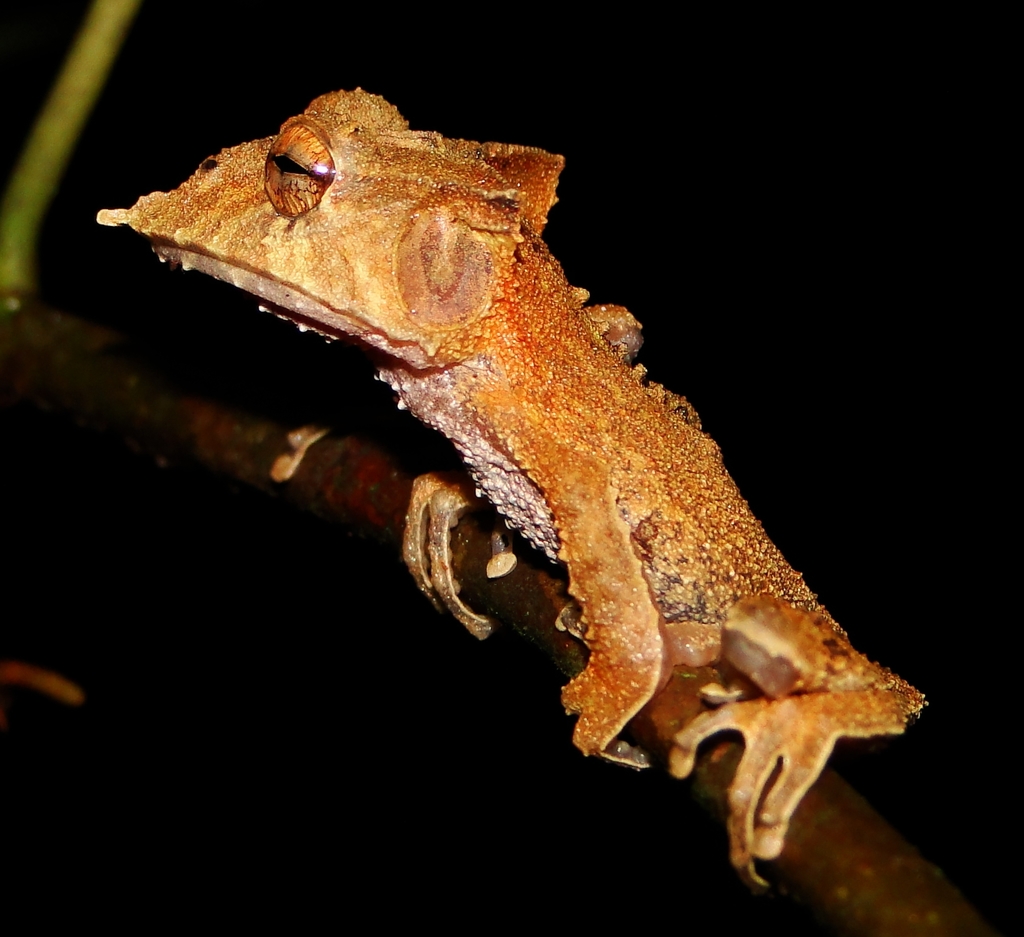
Ecuador Horned Treefrog
Hemiphractus bubalus
Hemiphractus bubalus, or the Ecuador horned treefrog, is a species of frog in the Hemiphractidae family. It is found in the upper Amazon Basin and lower Amazonian slopes of the Andes in northern Peru, Ecuador, and southern Colombia (Cordillera Oriental in Caquetá and Putumayo Departments). Its natural habitats are dense cloud forests. It is typically found perching on branches of bushes and small trees. It is assumed to be a predator of other frog species. It...
From the article Hemiphractus bubalus on Wikipedia (CC BY-SA), quoted section by section
Description
The adult male frog averages 43.8 mm in snout-vent length and the adult female frog about 57.9 mm long.
Range & habitat
Its natural habitat is dense cloud forest. It is typically found perching on branches of bushes and small trees. It is assumed to be a predator of other frog species. It is only present in places with high densities of other frogs. Scientists have seen the frog between 300 and 2,000 m (980 and 6,560 ft) above sea level. Scientists have seen the frog in protected places, for example, Parque Nacional Cayambe-Coca and Parque Nacional Sumaco Napo-Galeras.
Wikipedia: “Habitat”
What it does
The female frog carries her eggs on her back. This frog breeds through direct development. Its eggs hatch into small froglets, not swimming tadpoles.
Wikipedia: “Reproduction”
Listen
Looking for field recordings…
Where it lives
Recorded sightings
—
geo-referenced records in GBIF, from museums, herbaria and field observers.
Drag the globe to turn it. Dots are where records exist, not a range map; darker means more records.
In the stacks
Searching the stacks…
Every page naming Hemiphractus bubalus in the Biodiversity Heritage Library →
This page is assembled live from iNaturalist, GBIF, Wikipedia, the Source Library and the Internet Archive. It is not yet part of the hand-edited codex. iNaturalist taxon 24428.