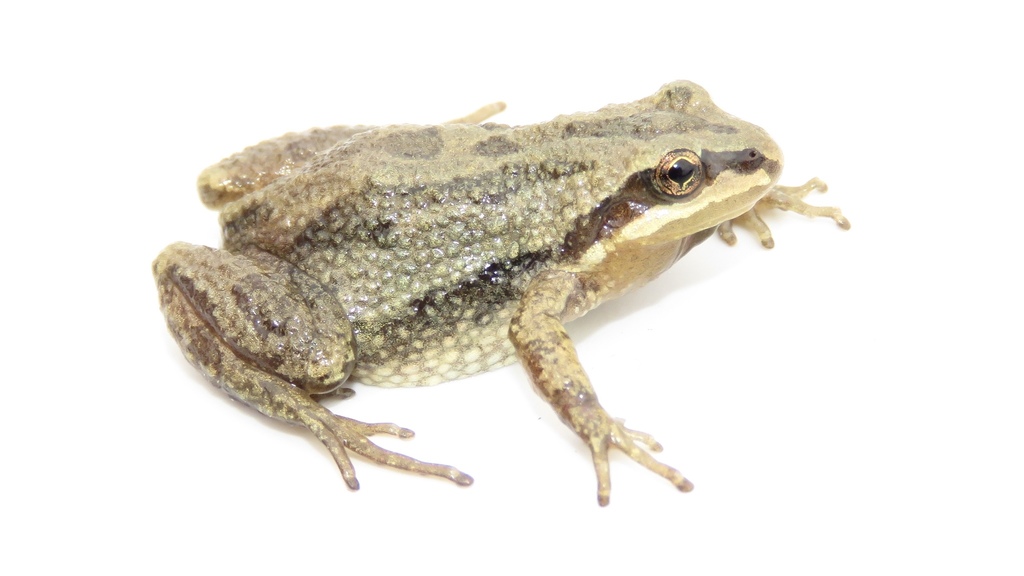
Boreal Chorus Frog
Pseudacris maculata
The boreal chorus frog (Pseudacris maculata) is a species of chorus frog native to Canada from central Quebec to eastern British Columbia and north to the Northwest Territories and the southern portion of the Yukon. It occurs in the USA throughout Montana, Minnesota, northwestern Wisconsin, northeastern Arizona, northern New Mexico, and southwestern Utah.
From the article Boreal chorus frog on Wikipedia (CC BY-SA), quoted section by section
Description
This small species of frog reaches about 30 mm in length. It is highly variable, but is normally brown, and can be green on the dorsal surface, with three broken dorsal stripes; these stripes can be very distinct to quite faint. A dark band is present from the snout, across the eye, and continuing down the side. It has slightly enlarged toe pads to help in climbing small grasses and vegetation. This species is very similar to the western chorus frog (Pseudacris triseriata). It can be distinguished from this species by having shorter legs.
What it does
This species can be found around permanent water bodies in cleared land and forest. Males make a "reeeek" call from grasses, vegetation, or ground around the water body from April through to September. This call is characteristic of the trilling frog clade that is present in the genus Pseudacris. This clade is so named because the call of each individual is different, each having its own series of pulses. Within the trilling frog clade, they are further divided into "dynamic" and "static" groups, and recent studies have placed P. maculata into the static grouping. The static grouping is distinguished by a lack of variability in one's call and the ability to somewhat control the direction of their calls. Amphibians' songs or calls to one another are commonly used for sexual selection, but in Bee, et al. 2010, the researchers found no correlation that linked directly to sexual selection. They found a link between the lowest note in the song and body size, but insufficient evidence to draw any conclusions from it. Every call was different in the study, but the differences were subtle and required complex technology to pick up. The similarity in the calls results in the frogs not being able to distinguish individuals from each other. …
Wikipedia: “Ecology and behaviour”
Listen
Looking for field recordings…
Where it lives
Recorded sightings
—
geo-referenced records in GBIF, from museums, herbaria and field observers.
Drag the globe to turn it. Dots are where records exist, not a range map; darker means more records.
In the stacks
Searching the stacks…
Every page naming Pseudacris maculata in the Biodiversity Heritage Library →
This page is assembled live from iNaturalist, GBIF, Wikipedia, the Source Library and the Internet Archive. It is not yet part of the hand-edited codex. iNaturalist taxon 24255.