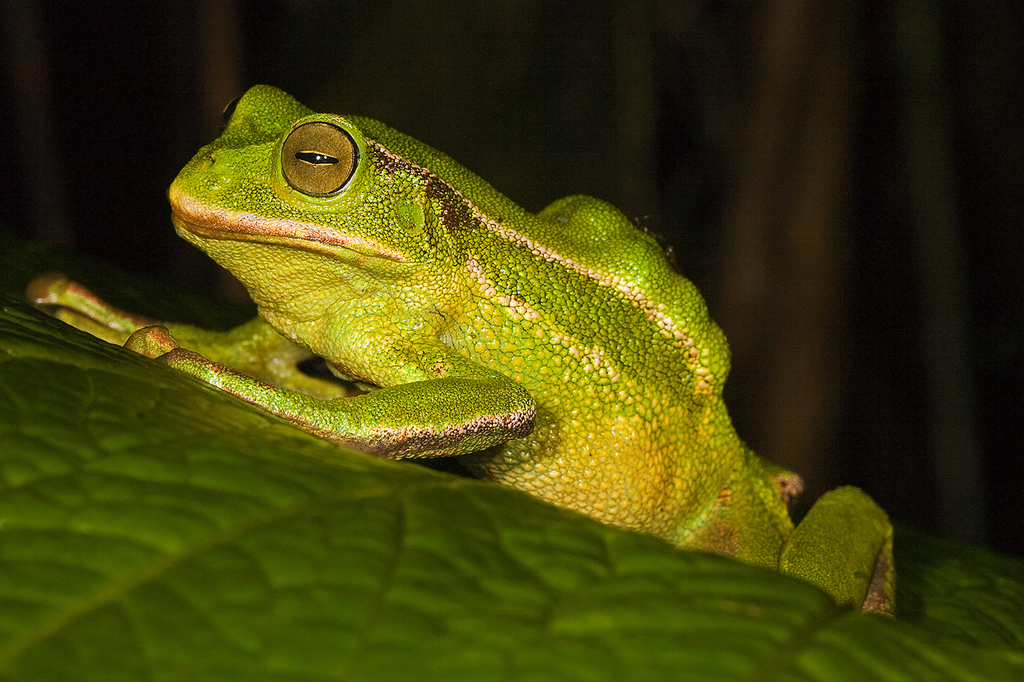
Silver Marsupial Frog
Gastrotheca plumbea
The silver marsupial frog (Gastrotheca plumbea; in Spanish: rana marsupial bromelícola) is a species of frog in the Hemiphractidae family. It is endemic to the Pacific slopes of Andes in northern and central Ecuador. It is a nocturnal, arboreal inhabitant of cloud forests that can also be found in forest edge and secondary, degraded habitats. It is closely associated with arboreal bromeliads. It is threatened by habitat loss.
From the article Silver marsupial frog on Wikipedia (CC BY-SA), quoted section by section
Description
The adult male frog measures 42.1–61.0 mm long in snout-vent length and the adult female frog 58.2–73.0 mm. The skin of the dorsum is green in color with or without marks. The throat can be light green or yellow-brown in color. There is brown color on the legs with bronze marks. The feet are green or brown in color. The belly is broze or brown or yellow-green during the day and cream-white at night. Where the legs meet the body, thre is bronze and blue or green and blue color during the day and blue by itself at night. The iris of the eye is light olive-green in color.
Range & habitat
This frog is arboreal and nocturnal. It lives in cloud forests but people sometimes see it in secondary forest. Scientists have seen the frog between 1,300 and 3,200 m (4,300 and 10,500 ft)above sea level. Scientists have reported the frog in protected places: Reserva Ecológica Los Ilinizas, Reserva Ecológica Cotacachi-Cayapas, Estación Científica Río Guajalito, Bosque Protector Mindo-Nambillo, and Bosque Protector Cashca Totoras.
Wikipedia: “Habitat”
What it does
The female frog carries her eggs in a pouch on her back. Scientists have seen 20 to 28 eggs on one female at a time. After 8-10 months, the young emerge as small froglets. This frog is a direct developer with no free-swimming tadpole stage.
Wikipedia: “Reproduction”
In human culture
Scientists gave the frog the Latin name plumbeus, for the metal lead, because the holotype appeared lead-gray in color in preservative.
Wikipedia: “Etymology”
Listen
Looking for field recordings…
Where it lives
Recorded sightings
—
geo-referenced records in GBIF, from museums, herbaria and field observers.
Drag the globe to turn it. Dots are where records exist, not a range map; darker means more records.
In the stacks
Searching the stacks…
Every page naming Gastrotheca plumbea in the Biodiversity Heritage Library →
This page is assembled live from iNaturalist, GBIF, Wikipedia, the Source Library and the Internet Archive. It is not yet part of the hand-edited codex. iNaturalist taxon 24160.