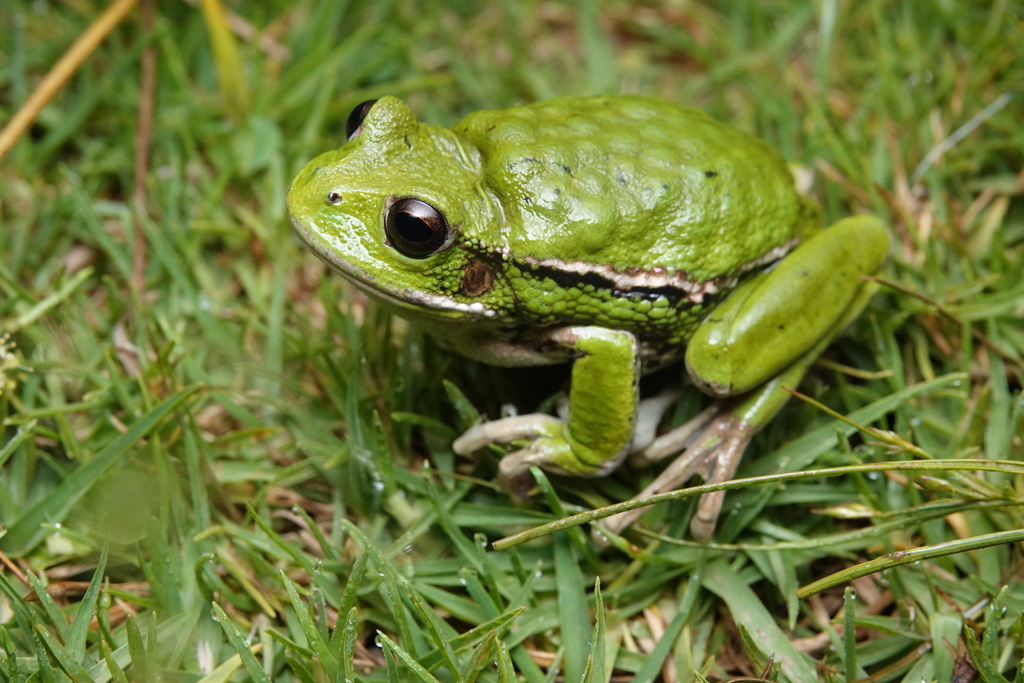
San Lucas Marsupial Frog
Gastrotheca pseustes
Gastrotheca pseustes is a species of frog in the Hemiphractidae family. It is endemic to Ecuador. Its natural habitats are subtropical or tropical moist montane forests, subtropical or tropical high-altitude shrubland, subtropical or tropical high-altitude grassland, rivers, freshwater marshes, intermittent freshwater marshes, pastureland, and heavily degraded former forest. It is threatened by habitat loss.
From the article Gastrotheca pseustes on Wikipedia (CC BY-SA), quoted section by section
Description
The adult male frog measures 38.3–54.4 mm in snout-vent length and the adult female frog 36.0–62.4 mm. Individual frogs can vary considerably in coloration. For most, the skin of the dorsum is green in color with brown or darker green marks. They can also be gray or brown with dark brown or bronze marks. They can be green with black or brown marks. They can be brown with green marks. They can be all brown or all yellow-green. The flanks can be gray or bronze in color with some blue-green color or blue-gray color. The axilla and inguinal areas can have bright blue marks. The belly is white, cream-white, gray, or other colors. It can have gray or black marks. The iris of the eye is gold or bronze in color with black reticulations.
Range & habitat
This frog is found in primary cloud forests and paramo but also secondary forest, and pastureland. Scientists have seen the frog between 2,200 and 4,708 m (7,218 and 15,446 ft) above sea level. Scientists have reported this frog in some protected places: Reserva Ecológica Antisana, Parque Nacional Cotopaxi, Parque Nacional Llanganates, Reserva de Producción Faunística Chimborazo, Parque Nacional Sangay, and Parque Nacional Cajas.
Wikipedia: “Habitat”
What it does
The female frog carries her eggs in a pouch on her back. She brings the tadpoles to small bodies of water. Females have been reported with 49-197 eggs at a time. The eggs are about 4.5 mm in diameter.
Wikipedia: “Reproduction”
In human culture
Scientists gave this frog the Latin name puestes for "lying" or "liar" because of its resemblance to G. riobambe, for which it had long been considered conspecific.
Wikipedia: “Etymology”
Listen
Looking for field recordings…
Where it lives
Recorded sightings
—
geo-referenced records in GBIF, from museums, herbaria and field observers.
Drag the globe to turn it. Dots are where records exist, not a range map; darker means more records.
In the stacks
Searching the stacks…
Every page naming Gastrotheca pseustes in the Biodiversity Heritage Library →
This page is assembled live from iNaturalist, GBIF, Wikipedia, the Source Library and the Internet Archive. It is not yet part of the hand-edited codex. iNaturalist taxon 24152.