- Animals
- ›Chordates
- ›Vertebrates
- ›Amphibians
- ›Frogs and Toads
- ›African Reed Frogs
- ›Running Frogs and Wot-wots
- ›Semnodactylus
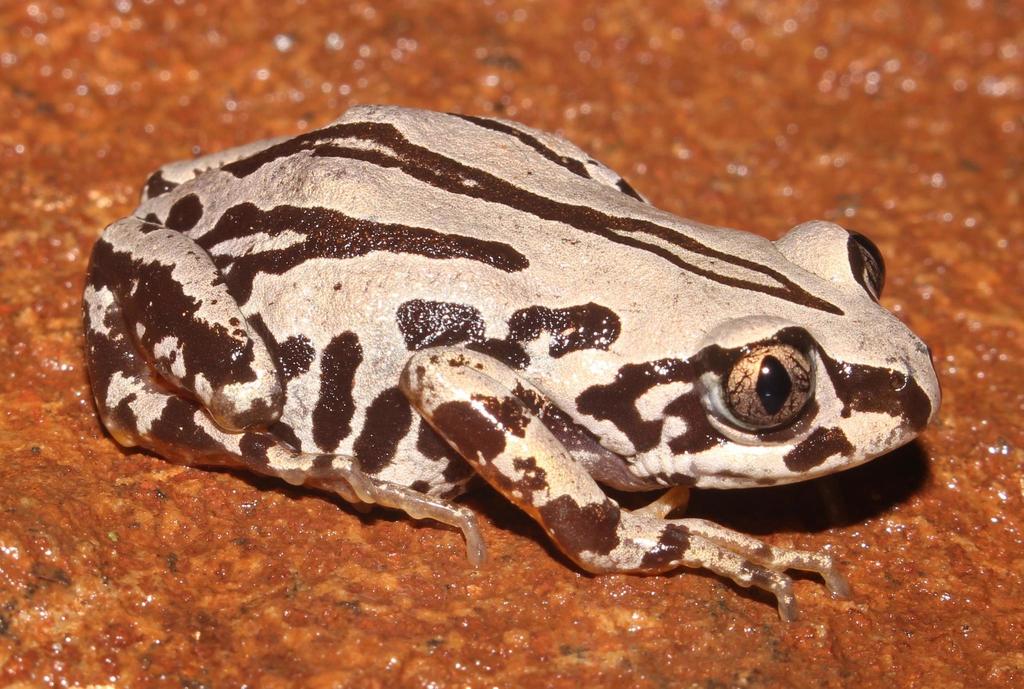
Weale's Running Frog
Semnodactylus wealii
Weale's running frog (Semnodactylus wealii), also known as Weale's frog, rattling frog, and many other commons names, is a species of frog in the family Hyperoliidae. It is monotypic within the genus Semnodactylus. It is found in southern and eastern South Africa, Lesotho, and Eswatini.
From the article Weale's running frog on Wikipedia (CC BY-SA), quoted section by section
Description
Semnodactylus wealii grow to 44 mm (1.7 in) in snout–vent length. The limbs are thin and long. The dorsum is yellowish-brownto grey and has three dark longitudinal bands, each with a pale center. The flanks have a dark stripe or a series of blotches. The concealed parts of the limbs are yellow to orange. The throat in breeding males is black. The male advertisement call is a low-pitched creak, resembling the sound of a cork being removed from a bottle.
Range & habitat
Weale's running frog is a common frog mostly occurring in grassland habitats at elevations below 1,700 m (5,600 ft); in Western Cape it is also found in fynbos heath. It breeds in all sort of ponds (both permanent and temporary, and natural and artificial) that have emergent vegetation. It is present in many protected areas, tolerates disturbance, and is not facing any major threats.
== References ==
Wikipedia: “Habitat and conservation”
In human culture
The specific name wealii honours James Philip Mansel Weale, an English amateur entomologist who farmed in Bedford, Eastern Cape, and sent specimens to England.
Wikipedia: “Etymology”
Listen
Looking for field recordings…
Where it lives
Recorded sightings
—
geo-referenced records in GBIF, from museums, herbaria and field observers.
Drag the globe to turn it. Dots are where records exist, not a range map; darker means more records.
In the stacks
Searching the stacks…
Every page naming Semnodactylus wealii in the Biodiversity Heritage Library →
This page is assembled live from iNaturalist, GBIF, Wikipedia, the Source Library and the Internet Archive. It is not yet part of the hand-edited codex. iNaturalist taxon 23528.