- Animals
- ›Chordates
- ›Vertebrates
- ›Amphibians
- ›Frogs and Toads
- ›African Reed Frogs
- ›Typical Reed Frogs
- ›Afrixalus
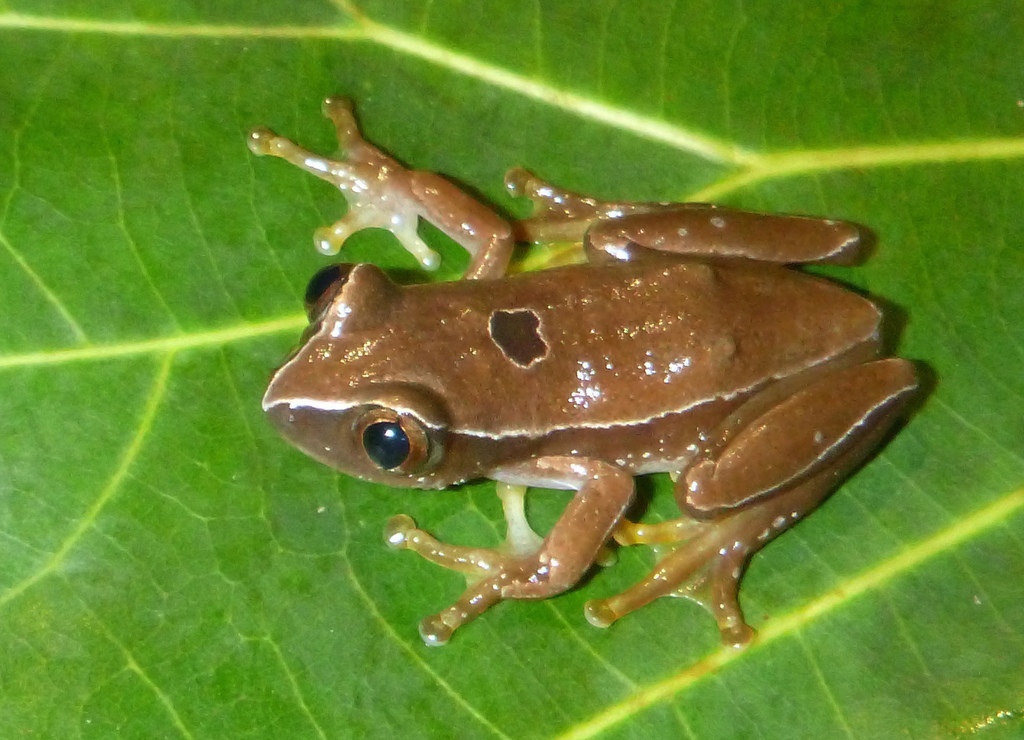
Congo Banana Frog
Afrixalus equatorialis
Afrixalus equatorialis, also known as the Congo banana frog, is a species of frog in the family Hyperoliidae. It is found in the central parts of the Congo Basin in the Democratic Republic of the Congo and south-eastern Cameroon, and is likely to be found in the Republic of the Congo and the Central African Republic as well. It might be conspecific with Afrixalus nigeriensis and is closely related to Afrixalus leucostictus.
From the article Afrixalus equatorialis on Wikipedia (CC BY-SA), quoted section by section
Description
Adult males measure 25–34 mm (1.0–1.3 in) and adult females 30–38 mm (1.2–1.5 in) in snout–vent length. The dorsal pattern consists of an almost square dark spot. This species is quite similar to Afrixalus nigeriensis from West Africa but lacks the dark lumbar band which is almost always present in the latter species. The male advertisement call consists of an initial sound and a small number of identical figures with a peak frequency intensity of 2000–2500 Hz, emitted at a rate of 15–20 per second.
Range & habitat
Afrixalus equatorialis occurs in lowland rainforest. The Cameroon record is from a swampy forest. Its breeding biology is unknown, but it presumably lays the eggs on leaves above water; the tadpoles fall into the water and develop there. This species is unlikely to be tolerant of alteration to its habitat. While it can locally be threatened by shifting agriculture, most of its habitat remains intact. It is also present in the Salonga National Park (Democratic Republic of the Congo).
== References ==
Wikipedia: “Habitat and conservation”
Listen
Looking for field recordings…
Where it lives
Recorded sightings
—
geo-referenced records in GBIF, from museums, herbaria and field observers.
Drag the globe to turn it. Dots are where records exist, not a range map; darker means more records.
In the stacks
Searching the stacks…
Every page naming Afrixalus equatorialis in the Biodiversity Heritage Library →
This page is assembled live from iNaturalist, GBIF, Wikipedia, the Source Library and the Internet Archive. It is not yet part of the hand-edited codex. iNaturalist taxon 23472.