- Animals
- ›Chordates
- ›Vertebrates
- ›Amphibians
- ›Frogs and Toads
- ›African Reed Frogs
- ›Typical Reed Frogs
- ›Afrixalus
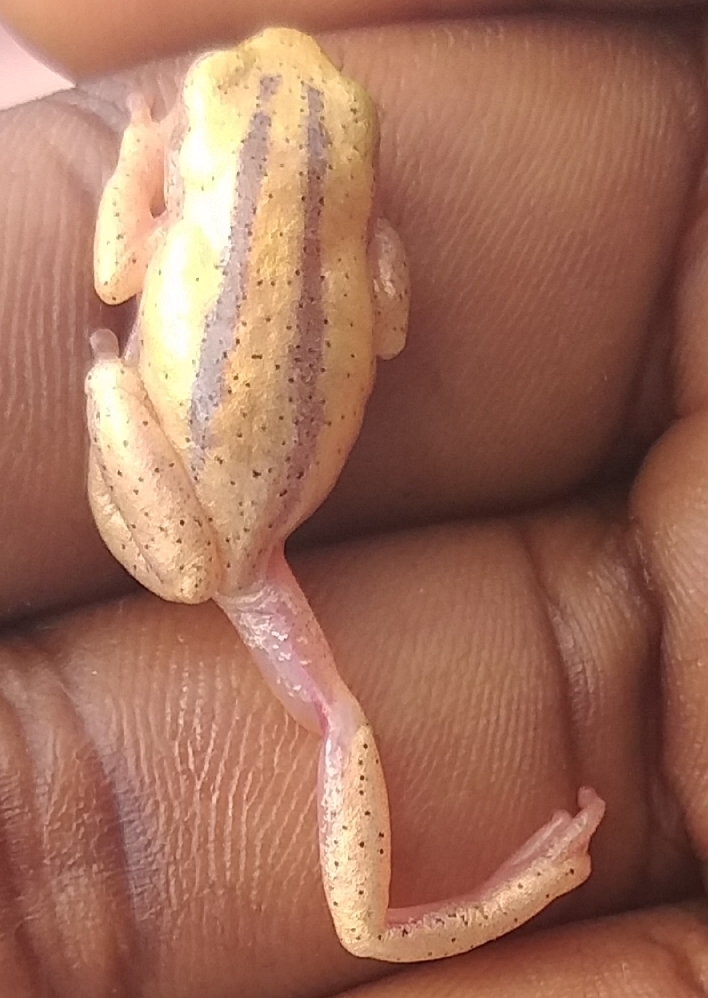
Kivu Banana Frog
Afrixalus orophilus
Afrixalus orophilus is a species of frog in the Hyperoliidae family. It is found in Burundi, Democratic Republic of the Congo, Rwanda, and Uganda. Its natural habitats are subtropical or tropical moist montane forests, subtropical or tropical high-altitude grassland, and swamps. It is threatened by habitat loss.
From the article Afrixalus orophilus on Wikipedia (CC BY-SA), quoted section by section
Description
Adult males measure 19–27 mm (0.7–1.1 in) and adult females 22–27 mm (0.9–1.1 in) in snout–vent length. The dorsum has narrow stripes on lighter background (but showing little contrast to the ground colour) that converge on the head as well as posteriorly.
Range & habitat
Afrixalus orophilus occurs in montane grasslands, montane bamboo forests, and in wetland areas in reeds and papyrus, probably largely higher than 1,500 m (4,900 ft) above sea level; its specific habitat requirements are not well known. Knowledge on the population status of this species is sketchy; there are some recent records, but it has not been found again at its type locality, despite recent surveys. It is probably impacted by ongoing loss of habitat caused by agriculture and human settlements. Also pet trade and mining could be threats. It is present in the Bwindi National Park in Uganda and in the Virunga National Park in the Democratic Republic of Congo, although presently the latter is not effectively managed.
== References ==
Wikipedia: “Habitat and conservation”
Listen
Looking for field recordings…
Where it lives
Recorded sightings
—
geo-referenced records in GBIF, from museums, herbaria and field observers.
Drag the globe to turn it. Dots are where records exist, not a range map; darker means more records.
In the stacks
Searching the stacks…
Every page naming Afrixalus orophilus in the Biodiversity Heritage Library →
This page is assembled live from iNaturalist, GBIF, Wikipedia, the Source Library and the Internet Archive. It is not yet part of the hand-edited codex. iNaturalist taxon 23459.