- Animals
- ›Chordates
- ›Vertebrates
- ›Amphibians
- ›Frogs and Toads
- ›African Reed Frogs
- ›Acanthixalinae
- ›Acanthixalus
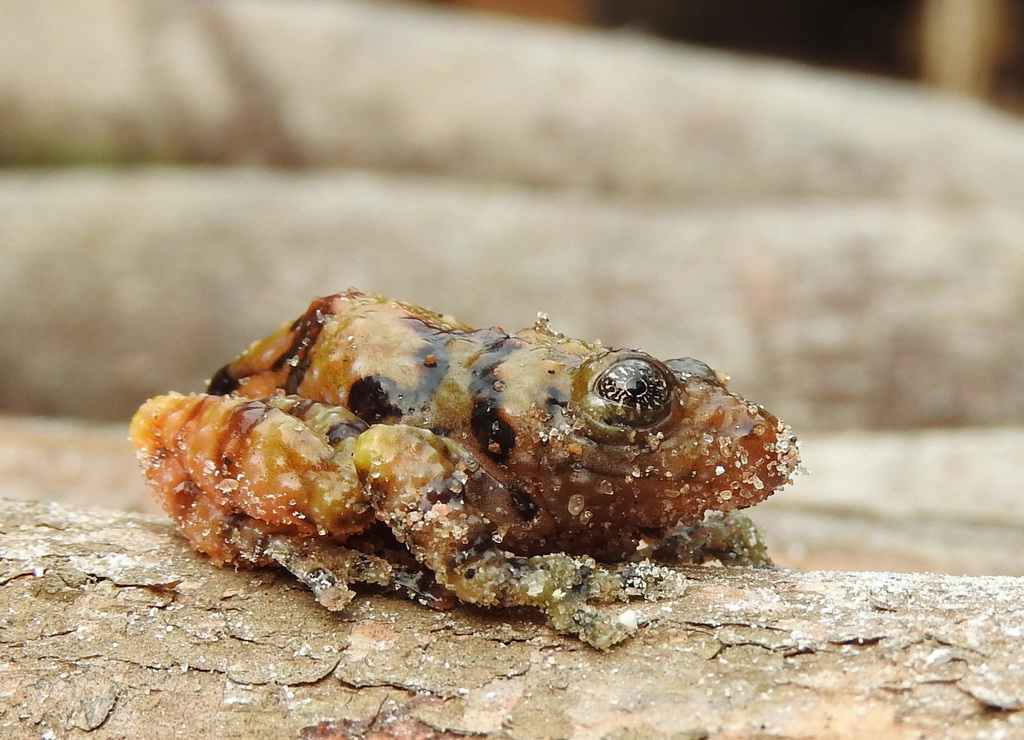
African Wart Frog
Acanthixalus spinosus
Acanthixalus spinosus is a species of frog in the family Hyperoliidae, the sedge and bush frogs. It is native to Africa, where it can be found in southeastern Nigeria and south- and eastward to Cameroon, Gabon, the Democratic Republic of the Congo, and the Republic of the Congo. It is also presumed to occur in the intervening/adjacent countries of Angola (in the Cabinda enclave), Equatorial Guinea, and the Central African Republic. Common name African wart frog...
From the article Acanthixalus spinosus on Wikipedia (CC BY-SA), quoted section by section
Description
Males measure 30–38 mm (1.2–1.5 in) and females 32–36 mm (1.3–1.4 in) in snout–vent length. The dorsum is warty, black or brownish to olive in color, and bears an hourglass pattern consisting of very irregular transverse bands on dorsum and limbs. Males have no vocal sac or vocal sac openings and are believed to be mute. Males also have strong spines on the tarsus, and they have larger digital discs than females. The tadpoles grow to 60 mm (2.4 in) in total length. Newly metamorphosed juveniles are brightly colored: they are dorsally orange, with the top of the head and bars across the middle of the back and in the lumbar region deep maroon.
Range & habitat
This frog lives in lowland rainforest. It is mostly aquatic, living in water-filled holes in trees. Apparently, they leave the tree holes only during night to forage. The eggs are deposited a few centimeters above the water surface. Upon hatching, the tadpoles fall into the water. The development takes approximately three months. They are detritivores. Because this species depends on large trees with holes that collect rainwater, it is vulnerable to ongoing forest loss.
Wikipedia: “Habitat and conservation”
What it does
This frog is host to the commensal protists Opalina proteus and Cepedea couillardi.
== References ==
Wikipedia: “Ecological interactions”
Listen
Looking for field recordings…
Where it lives
Recorded sightings
—
geo-referenced records in GBIF, from museums, herbaria and field observers.
Drag the globe to turn it. Dots are where records exist, not a range map; darker means more records.
In the stacks
Searching the stacks…
Every page naming Acanthixalus spinosus in the Biodiversity Heritage Library →
This page is assembled live from iNaturalist, GBIF, Wikipedia, the Source Library and the Internet Archive. It is not yet part of the hand-edited codex. iNaturalist taxon 23447.