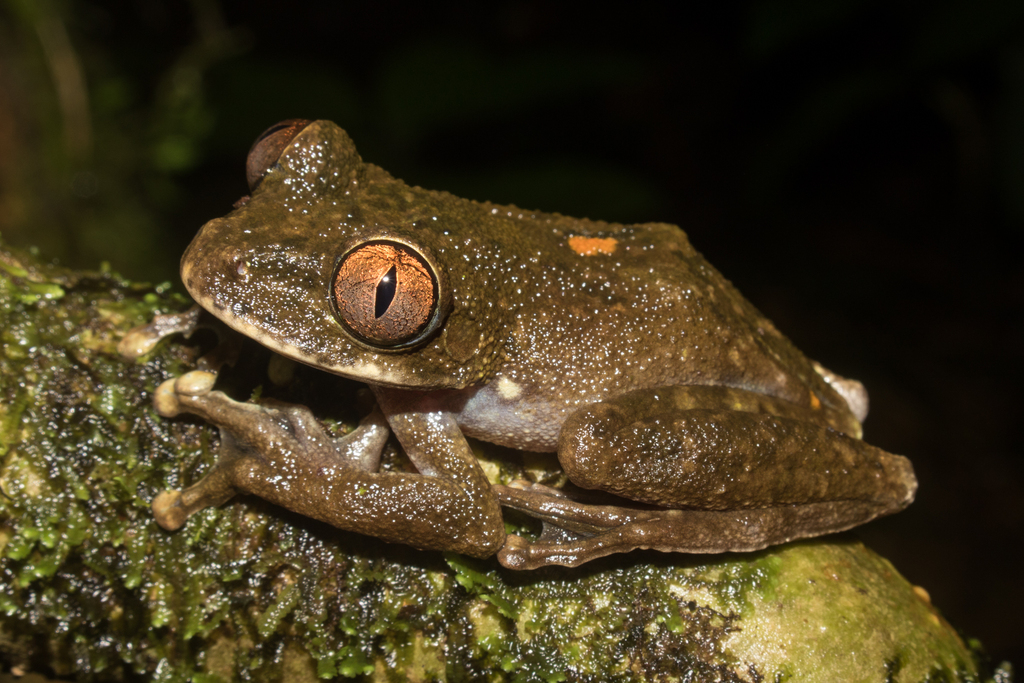
Palm Forest Tree Frog
Leptopelis palmatus
The palm forest tree frog (Leptopelis palmatus) is a species of frog in the family Arthroleptidae which is endemic to Príncipe island in São Tomé and Príncipe. Red tree frog Leptopelis rufus from the African mainland was for a long time included in this species, but is now considered a distinct species.
From the article Palm forest tree frog on Wikipedia (CC BY-SA), quoted section by section
Description
The palm forest tree frog is a large species: females measure 81–110 mm (3.2–4.3 in) in snout–vent length. The tympanum is large and the feet are fully webbed. The colouring varies, but the dorsum is typically dark green to black, sometimes with many light spots giving the frog a marbled appearance. The ventrum is dark and has a granular surface. Compared to the red tree frog, this species has larger choanae (the apertures where the nasal passages join the throat), larger tympani and differences in skin texture.
Range & habitat
The natural habitats of palm forest tree frog are wet forests along the edges of creeks and streams to 700 m (2,300 ft) above sea level, possibly to 1000 m. It also occurs in forest remnants and possibly in towns. It is believed that eggs are buried close to water; when they hatch, the tadpoles move into pools or streams where they complete their development. It is a reasonably common species throughout the island, although habitat loss through development is a potential future threat. This frog is not present in any protected areas, and the International Union for Conservation of Nature has assessed its conservation status as being "endangered", and considers that the population requires careful monitoring.
== References ==
Wikipedia: “Habitat and conservation”
Listen
Looking for field recordings…
Where it lives
Recorded sightings
—
geo-referenced records in GBIF, from museums, herbaria and field observers.
Drag the globe to turn it. Dots are where records exist, not a range map; darker means more records.
In the stacks
Searching the stacks…
Every page naming Leptopelis palmatus in the Biodiversity Heritage Library →
This page is assembled live from iNaturalist, GBIF, Wikipedia, the Source Library and the Internet Archive. It is not yet part of the hand-edited codex. iNaturalist taxon 23420.