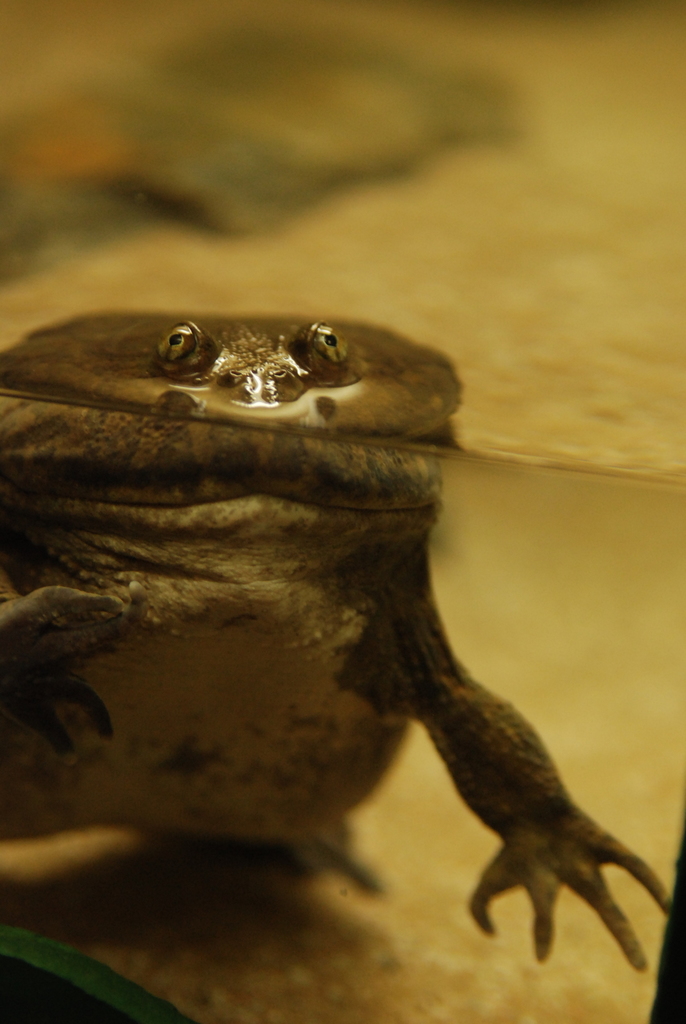
Budgett's Frog
Lepidobatrachus laevis
The Budgett's frog, wide-mouth frog, or hippo frog (Lepidobatrachus laevis, in Spanish escuerzo) is a species of frog in the Ceratophryidae family. It is often kept as a pet by mildly skilled amphibian keepers. The name "Freddy Krueger" frog also has been affectionately given due to their disturbing screech and aggression.
From the article Lepidobatrachus laevis on Wikipedia (CC BY-SA), quoted section by section
Description
This frog has become popular in pet stores due to its comical flat appearance and intelligent behavior. Females reach a size of 100 millimetres (3.9 in) while males sometimes only grow half as large. They have a large head that makes up to 1/3 of the body, with a notably large mouth. Their mouth contains a top row of teeth and two "fangs" on the lower jaw. They have extremely short and stubby limbs and the forelimbs are unwebbed. L. laevis is dark olive green with darker blotches outlined in orange. The males have a dark blue throat.
Range & habitat
It is commonly observed in Paraguay and Bolivia, and less frequently in Argentina. Its natural habitats are the dry and wet Chaco. Breeding may take place in shallow temporary pools and artificial ponds. It is in some areas threatened by habitat loss but there is a large total population size. The species is listed as Least Concern in view of its relatively wide distribution, presumed large population, and because it is unlikely to be declining rapidly enough to qualify for listing in a more threatened category.
Wikipedia: “Distribution and conservation”
What it does
The wide-mouth frog is well adapted to its environment, notably the harsh winter. During this time it will remain inactive underground in a cocoon of shed dead skin which protects it from losing water until it emerges. This species is generally very aggressive and will puff up when threatened to appear larger. If this behavior does not deter the intruder they will make a shrill screech, bite, and corner the target. They are nocturnal and hunt at night, submerged up to their nostrils waiting for prey to pass by. They then lunge and swallow the prey whole. They feed on other frogs, insects, and snails. Both adults and tadpoles of the species are known to be occasional cannibals. The tadpoles of this species are obligate carnivores that swallow their prey whole. The diet of L. laevis tadpoles is similar to that of adults and includes snails, insects, other tadpoles, and crustaceans. They have a different gut morphology than non-carnivorous tadpoles.
Wikipedia: “Diet and behavior”
Listen
Looking for field recordings…
Where it lives
Recorded sightings
—
geo-referenced records in GBIF, from museums, herbaria and field observers.
Drag the globe to turn it. Dots are where records exist, not a range map; darker means more records.
In the stacks
Searching the stacks…
Every page naming Lepidobatrachus laevis in the Biodiversity Heritage Library →
This page is assembled live from iNaturalist, GBIF, Wikipedia, the Source Library and the Internet Archive. It is not yet part of the hand-edited codex. iNaturalist taxon 23230.