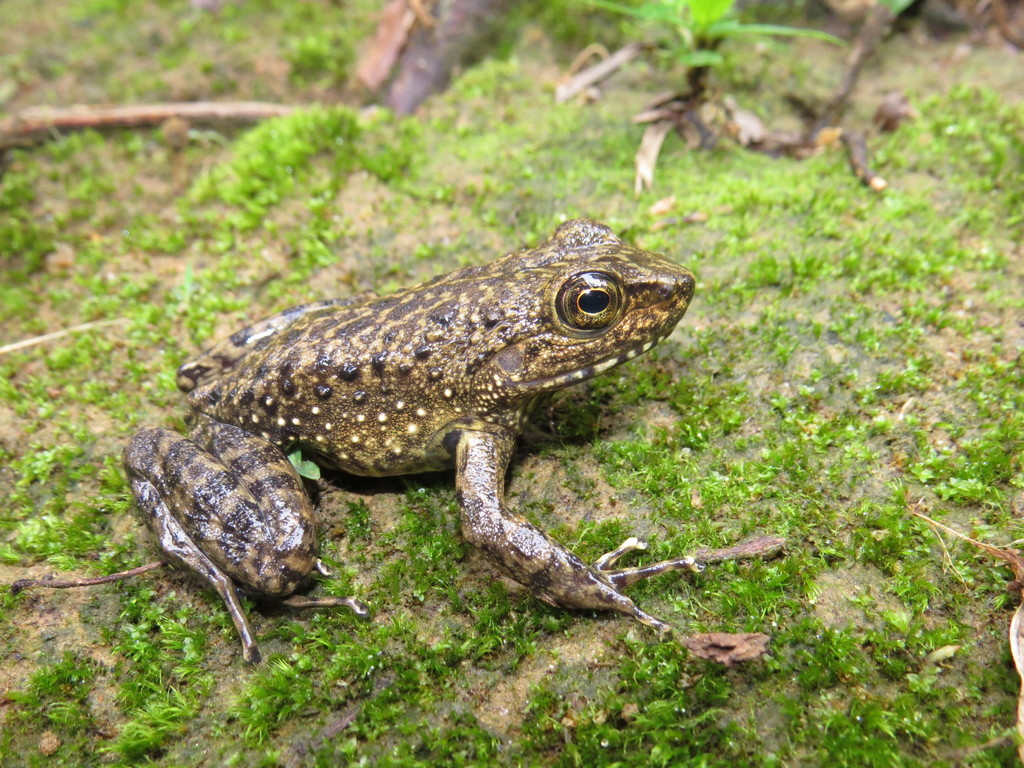
Rio Big-tooth Frog
Megaelosia goeldii
Megaelosia goeldii, also known as the Rio big-tooth frog, is a species of frog in the family Hylodidae. It is the only member of the genus Megaelosia. It is endemic to Southeast Brazil and occurs in São Paulo and Rio de Janeiro states. It is named after Émil Goeldi, a Swiss zoologist who worked in Brazil.
From the article Megaelosia on Wikipedia (CC BY-SA), quoted section by section
Description
Males measure 82–95 mm (3.2–3.7 in) and females 85–97 mm (3.3–3.8 in) in snout–vent length (based on 2 males and 3 females only). The dorsolateral skin is granular. The snout is subacuminate in dorsal view and protruding in profile. The canthus rostralis is evident and straight. Males have neither vocal sacs nor vocal slits.
Range & habitat
Its natural habitats are rivers in primary forest. During the day, they can be found on emergent rocks in shallow places. Tadpoles have been collected under large rocks in a moderate-sized forest stream. Megaelosia goeldii is a common species, but very difficult to catch. It is threatened by habitat loss caused by forest clearance and infrastructure development, and by pollution.
== References ==
Wikipedia: “Habitat and conservation”
What it does
Stomach contents have been found to contain insects (cockroaches, Coleoptera, lepidopteran caterpillars), earthworms, and plant material. In experiments, Megaelosia goeldii have consumed other frogs.
Wikipedia: “Diet”
Listen
Looking for field recordings…
Where it lives
Recorded sightings
—
geo-referenced records in GBIF, from museums, herbaria and field observers.
Drag the globe to turn it. Dots are where records exist, not a range map; darker means more records.
In the stacks
Searching the stacks…
Every page naming Megaelosia goeldii in the Biodiversity Heritage Library →
This page is assembled live from iNaturalist, GBIF, Wikipedia, the Source Library and the Internet Archive. It is not yet part of the hand-edited codex. iNaturalist taxon 23015.