- Animals
- ›Chordates
- ›Vertebrates
- ›Amphibians
- ›Frogs and Toads
- ›Southern Frogs
- ›Leptodactylinae
- ›Leptodactylus
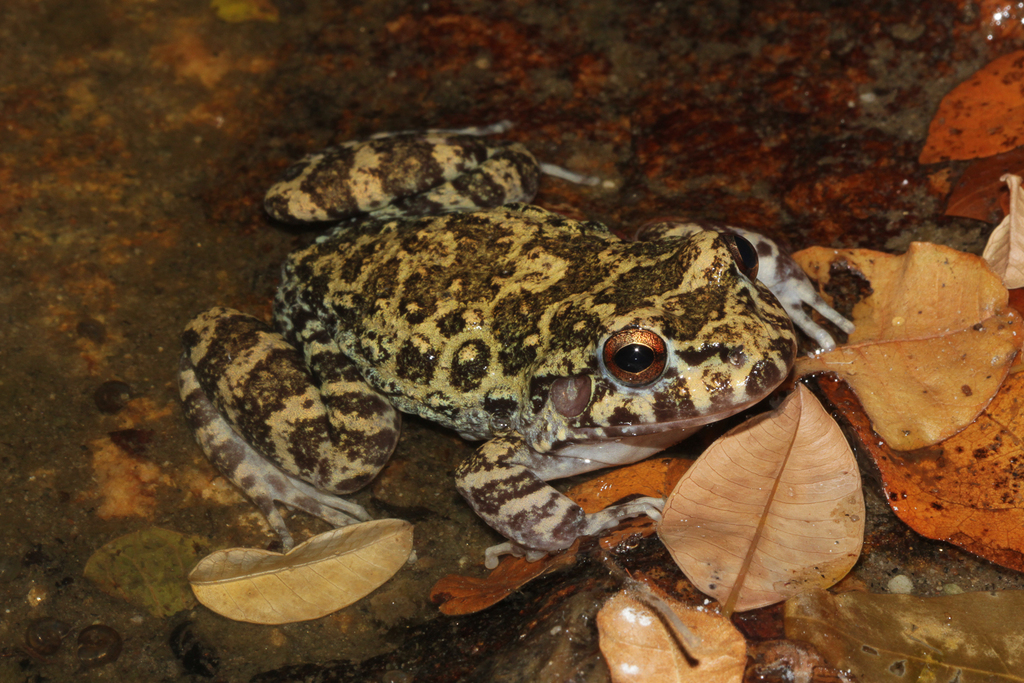
Basin White-lipped Frog
Leptodactylus syphax
Leptodactylus syphax is a species of frog in the family Leptodactylidae. It is found in Bolivia, Brazil, and Paraguay. Its natural habitats are moist savanna, subtropical or tropical moist shrubland, subtropical or tropical high-altitude shrubland, subtropical or tropical dry lowland grassland, subtropical or tropical high-altitude grassland, rivers, freshwater marshes, intermittent freshwater marshes, and rocky areas. It is threatened by habitat loss.
From the article Leptodactylus syphax on Wikipedia (CC BY-SA), quoted section by section
Description
Adult males measure 58–83 mm (2.3–3.3 in) and adult females 71–90 mm (2.8–3.5 in) in snout–vent length. The tympanum is distinct. Neither dorsal folds nor dorsolateral folds are present; lateral folds are also absent or are largely interrupted. Most specimens have a glandular dorsum with muted, tile-like dorsal pattern of darker and lighter browns. Light upper lip stripe is not present. The belly has light to moderate mottling and light gray or brown markings. The tadpoles grow to 44 mm (1.7 in) in total length (Gosner stage 41).
Range & habitat
Leptodactylus syphax occurs in open areas, often rocky outcrops, in rock or termite cavities. It reproduces in temporary and permanent pools of water. The tadpoles develop in standing bodies of water, such as quiet side pools of streams. This species can be common in ideal habitat situations but not otherwise. Overgrazing, agricultural intensification, and fire might be local threats. Scientists have observed the frog between 600 and 2000 meters above sea level. Its range contains several protected areas, including APA Pouso Alto, APA Serra da Ibiapaba, ESEC Serra Geral do Tocantins, and FLONA de Carajas.
== References ==
Wikipedia: “Habitat and conservation”
In human culture
The specific name syphax is Greek meaning "sweet new wine" and alludes to the bright red color seen in the groin, belly, and ventral surfaces of the thighs and shanks in some living specimens.
Wikipedia: “Etymology”
Listen
Looking for field recordings…
Where it lives
Recorded sightings
—
geo-referenced records in GBIF, from museums, herbaria and field observers.
Drag the globe to turn it. Dots are where records exist, not a range map; darker means more records.
In the stacks
Searching the stacks…
Every page naming Leptodactylus syphax in the Biodiversity Heritage Library →
This page is assembled live from iNaturalist, GBIF, Wikipedia, the Source Library and the Internet Archive. It is not yet part of the hand-edited codex. iNaturalist taxon 22930.