- Animals
- ›Chordates
- ›Vertebrates
- ›Mammals
- ›Therians
- ›Placental Mammals
- ›Primates, Rodents, and Allies
- ›Rodents
- ›Squirrels, Dormice, and Mountain Beavers
- ›Squirrels
- ›Ground and African Tree Squirrels
- ›Chipmunks
- ›Neotamias
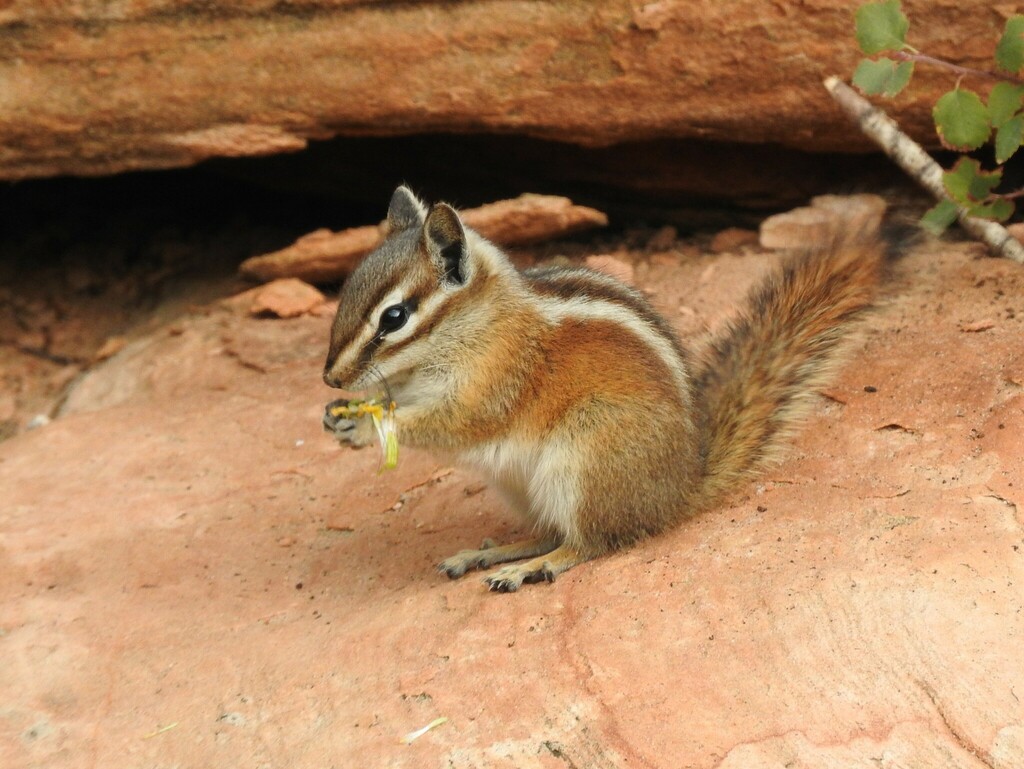
Uinta Chipmunk
Neotamias umbrinus
The Uinta chipmunk or hidden forest chipmunk (Neotamias umbrinus) is a species of chipmunk in the family Sciuridae. It is endemic to the United States. Formerly known as Tamias umbrinus, phylogenetic studies have shown it to be sufficiently distinct from the eastern chipmunk as to be placed in a separate genus, Neotamias. The same studies have also suggested that Palmer's chipmunk may actually be a subspecies of Uinta chipmunk, although the two are still generally regarded as separate species.
From the article Uinta chipmunk on Wikipedia (CC BY-SA), quoted section by section
Description
The Uinta chipmunk is a medium-sized chipmunk, with adults ranging from 20 to 24 cm (7.9 to 9.4 in) in length, including the tail at 7 to 11 cm (2.8 to 4.3 in), and weighing an average of 67 g (2.4 oz). The predominant color of the summer coat varies from yellowish brown-grey to dark brown, often with a reddish tinge. Three wide, distinct dark blackish-brown stripes run down the back, separated and surrounded by four paler stripes of pale grey to white fur. Also, three dark and three pale stripes are on each side of the face. In the winter, the coat becomes duller and more greyish, and the stripes become less distinct. The ears are black, and the underparts a very pale grey. The tail has orange and black fur, with a paler fringe of hair on the underside.
Range & habitat
The Uinta chipmunk lives in montane and subalpine forests of the western United States, between 1,400 and 3,650 m (4,590 and 11,980 ft) elevation. It is most common at the margins of pine and fir forests, or in clearings, often near rocky terrain or steep slopes. The Uinta chipmunk frequently partitions habitat with other chipmunk species, including the cliff chipmunk and the Colorado chipmunk. In northeastern Colorado, a boundary between Uinta and Colorado chipmunks occurs at approximately 2,100 m (6,900 ft) with Uinta chipmunks found at higher elevations.. It is known to co-occur with the least chipmunk. Uinta chipmunks do not have a continuous, unbroken range, but are instead found in a number of disjunct localities, perhaps reflecting changing patterns of forest cover during the Pleistocene. Seven subspecies are currently recognized:
N. u. adsitus – southern Utah and northern Arizona N. u. inyoensis – central Nevada and eastern California N. u. fremonti – western Wyoming N. u. montanus – western Colorado N. u. nevadensis – southern Nevada (possibly extinct) N. u. sedulus – southeastern Utah N. u. umbrinus – northern Utah
Wikipedia: “Distribution and habitat”
What it does
Uinta chipmunks are herbivorous. Their primary diet consists of the seeds of coniferous trees such as Douglas fir, ponderosa pine, juniper, and spruce, and on the fruit of local shrubs such as wild roses, raspberries, and chokecherries. They also eat some grass and fungi, and may supplement their diet with small quantities of insects or carrion. The chipmunks are solitary, diurnal, animals, and are aggressive to other members of their own species, each individual defending a territory of 2 to 5 ha (4.9 to 12.4 acres). They establish dens in burrows under rocks, shrubs, or other shelter, or else in natural rock crevices or hollow logs. They spend much of the winter in their dens, but are otherwise highly arboreal, climbing trees to search for food and escape from predators. The animals have been reported to make a number of different vocalizations, with most common being bursts of sharp "chip" sounds that can continue for up to 15 minutes, and are made from exposed locations, such as rock outcrops or high branches. Other vocalizations include lower-pitched "chuck" sounds, often interspersed with "chips" while fleeing from predators, trills, and squeals. Individuals caught in traps frequently emit chips and trills when approached. Squeals, similar to the distress calls of juveniles, may be produced when the chipmunks are handled. …
Wikipedia: “Diet and behavior”
Listen
Looking for field recordings…
Where it lives
Recorded sightings
—
geo-referenced records in GBIF, from museums, herbaria and field observers.
Drag the globe to turn it. Dots are where records exist, not a range map; darker means more records.
In the stacks
Searching the stacks…
Every page naming Neotamias umbrinus in the Biodiversity Heritage Library →
This page is assembled live from iNaturalist, GBIF, Wikipedia, the Source Library and the Internet Archive. It is not yet part of the hand-edited codex. iNaturalist taxon 225757.